“The Narrative of the Invisible” by Jorge Majfud

An Analysis of the Discursive Mechanisms that Organize Social Experience

by Marcelo Valente (Esfera)

In The Narrative of the Invisible, Jorge Majfud proposes a systematic reading of the cultural, political, and symbolic processes that structure what societies take for granted. Based on his own theory of semantic fields, the author examines how collective meanings are formed, how their roots are hidden, and how the narratives that define identities, hierarchies, and conflicts operate, especially in Latin America. His central hypothesis is that what is “visible” in social life is always the partial effect of a deeper conceptual architecture that has been historically constructed and, to a large extent, naturalized.

The Narrative of the Invisible is a theoretical proposal developed by Jorge Majfud to explain how societies produce, distribute, and dispute meanings. This study on the struggle for semantic fields in social narrative was originally published as a thesis by the University of Georgia in 2005. Since then, political and social events and new technologies, such as social media and artificial intelligence, have confirmed the political and historical relevance of the semantic struggle (even over the ever-present weight of production and consumption systems) exposed in this book. No changes have been made to the original study in this new edition. With its successes and errors, the author has decided to deliver this new edition of A Political Theory of Semantic Fields as it was presented in 2005, without revisions and with the intention of maintaining the immediate historical context.
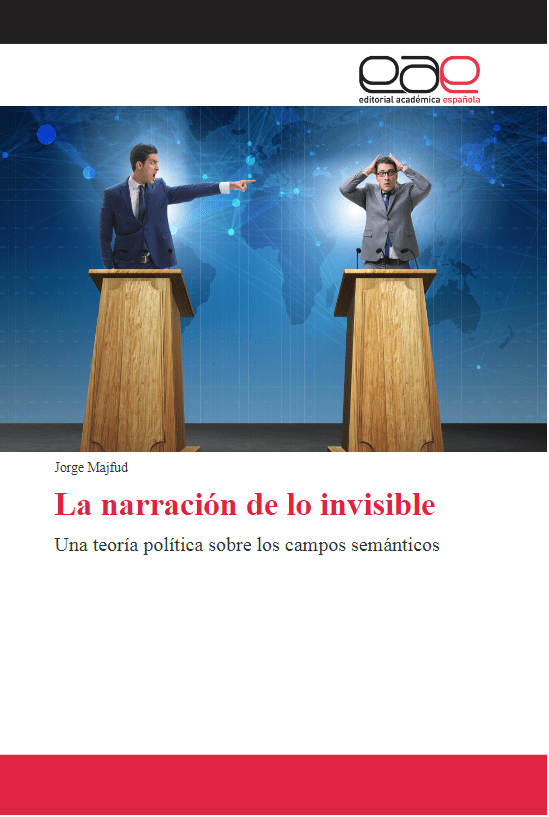
The starting point is the assertion that social reality is not presented directly, but mediated by narrative structures that precede events and condition their interpretation. This mediation, the author points out, is twofold: on the one hand, it is formed by a historical set of concepts, values, and imaginaries; on the other, it is actualized in concrete discourses that reinforce, correct, or challenge those structures. The invisibility alluded to in the title refers to that deep level of cultural assumptions that orders what can be said and thought.

Majfud articulates his proposal based on what he calls “semantic field theory,” an analytical tool through which he studies not only explicit meanings, but also their negations, associations, exclusions, and effects of meaning. In this perspective, an idea is never defined solely by its direct formulation, but by the network of relationships it maintains with a broader set of socially shared notions. The notion of “field” points precisely to this network of links that determines the reading of a word, a conflict, or an identity. The “semantic” dimension is not limited to language, but encompasses practices, institutions, and representations that shape the social world.

On this theoretical basis, the author examines a series of cultural and political debates, with a special emphasis on Latin America, where he identifies the way in which certain diagnoses are repeated, consolidated, and acquire the force of self-evident truths. One of the cases he analyzes—present in various passages of the book—is that of “Latin American failure,” a recurring topic in both critical and conservative discourses. For Majfud, this category is a paradigmatic example of how a concept laden with history is transformed into an apparently objective fact. The idea of “failure” thus acquires a descriptive status that obscures the conditions of its production, from its colonial roots to contemporary geopolitical relations.

The author also reviews the ways in which different Latin American thinkers have interpreted this diagnosis. He focuses on the explanations of Eduardo Galeano and Carlos Alberto Montaner, two opposing ideological visions that nevertheless share the same starting point: the acceptance of a failed destiny. Majfud shows how both discourses reorganize the semantic field of the continent, one emphasizing colonial heritage and the violence of empires, the other emphasizing cultural and political traditions that would be incapable of articulating a sustained modernizing project. What is relevant for the author is not the empirical validity of each argument, but the mechanism by which the category of “failure” operates as a conceptual core that orders and limits possible interpretations of the past and the future.

A discourse is defined not only by what it affirms, but also—and often more powerfully—by what it discards, minimizes, or renders irrelevant.

This reading introduces one of the central themes of the book: the idea that societies construct their interpretations based on “fundamental negations.” A discourse is defined not only by what it affirms, but also—and often more powerfully—by what it discards, minimizes, or renders irrelevant. Majfud shows, for example, how certain historical explanations support their arguments by rendering invisible external factors such as geopolitical constraints, international financial pressures, or structural inequalities in the global system. Conversely, other narratives emphasize these elements but omit internal components, such as local political disputes or cultural tensions. The author’s analysis highlights this interplay of absences and presences that shapes the common sense of an era.

Another of the book’s core themes is the examination of the “narrative devices that consolidate social identities.” Majfud explores how the figures of “the other,” “the enemy,” “the people,” or “the nation” are constructed, and how these concepts function as organizing axes of the collective imagination. The author observes that these figures do not operate as fixed categories, but are reconfigured according to political circumstances, changing their content without losing their structuring function. The idea of “national identity,” for example, can articulate progressive or conservative, inclusive or exclusive discourses, depending on how the semantic fields that sustain it are rearranged.

The book also focuses on the relationship between “language and power,” pointing out that the dispute over meanings is one of the main ways in which political conflicts manifest themselves.

The book also focuses on the relationship between “language and power,” pointing out that the dispute over meanings is one of the main ways in which political conflicts manifest themselves. For Majfud, the struggle to impose a particular reading of reality is inseparable from the struggle to transform or preserve social structures. This political dimension of language is not limited to explicit public debates, but manifests itself in the way institutions, the media, educational systems, and even everyday life reproduce particular meanings and discourage others. The author emphasizes that the stability of a social order depends largely on the stability of the narratives that legitimize it.

Within this conceptual architecture, Majfud also introduces the notion of “ideolexicon,” understood as the set of ideological discourses that operate under the guise of positive, open, or neutral categories. The author identifies forms of implicit violence that manifest themselves in narratives that naturalize hierarchies or inequalities, such as 19th-century social Darwinism, certain libertarian currents of the 20th century, or the languages of contemporary neoliberalism. In his approach, the “ideolexico” does not act as an explicitly political statement, but as a semantic device that structures social interpretation by presenting ideological postulates as rational or inevitable evidence. This dimension is integrated into his theory of semantic fields and reinforces the idea that the dispute over meanings also includes discourses that are perceived as non-ideological.

Within his conceptual architecture, Majfud also introduces the notion of ideolexico, understood as the set of ideological discourses that operate under the guise of positive, open, or neutral categories.

Within this reflection, Majfud gives central importance to the role of “historical memory.” He asserts that a society does not only remember the events of the past, but also the interpretations it has inherited about them. These interpretations, he points out, function as filters that organize our understanding of the present. The author examines historical episodes in Latin America to show how different narratives can make certain elements visible and hide others, structuring a selective perception that conditions expectations, fears, and collective projects.

A notable aspect of the book is the way it combines historical analysis, philosophical reflection, and cultural criticism. The “invisibility” that the author seeks to narrate is not metaphysical, but social: it is the everyday mechanisms that define what is considered normal, inevitable, or natural. For Majfud, this naturalization is one of the most persistent and difficult elements to question in social life, because it is rooted in unconscious practices, cultural habits, and institutional devices that are rarely problematized.

Majfud argues that understanding the mechanisms of meaning production is a fundamental step in questioning the apparent inevitability of certain social orders.

The text progresses in an argumentative and cumulative manner, using historical examples, intellectual references, and critical readings of public discourses. In several chapters, Majfud compares modes of thought and explanatory models, showing how societies create interpretive frameworks that then function as seemingly neutral criteria for evaluating their own trajectory. The author emphasizes that this circularity—the way in which a diagnosis becomes both cause and consequence at the same time—is one of the main challenges for critical thinking.

In the final section of the book, Majfud returns to the political dimension of his theoretical proposal. He argues that understanding the mechanisms of meaning production is a fundamental step in questioning the apparent inevitability of certain social orders. Although the text does not prescribe solutions or promote ideological programs, it emphasizes the importance of denaturalizing established categories. For the author, the critical task consists of examining the “semantic fields” that sustain our beliefs, detecting their omissions, and exploring alternatives that allow us to imagine other ways of organizing collective life.

Overall, La narración de lo invisible offers a systematic reflection on how the meanings that structure social experience are produced, disputed, and transformed. Its main contribution lies in showing that visible reality is sustained by a broader conceptual framework that is historically constituted and, to a large extent, imperceptible. Through the articulation of theory and case analysis, Majfud develops a perspective that allows us to understand how discourses influence our perception of the world and how that perception, in turn, conditions political and cultural action. The result is a study that proposes a rethinking of the relationship between language, power, and memory from a perspective that privileges the complexity of symbolic processes and the historicity of social narratives.

Marcelo Valenti, Esfera Comunicacional

The Narration of the Invisible. A Political Theory of Semantic Fields (Book, 2004)

(En español aquí >>)

This study on the struggle over semantic fields in social narrative was originally published as a thesis by the University of Georgia in 2005. Since then, political and social events and new technologies, such as social media and Artificial Intelligence, have confirmed the political and historical relevance of the semantic struggle (even under the ever-present influence of production and consumption systems) presented in this book. No significant changes have been made to the overall study in this new edition. Despite its successes and failures, the author has decided to present this new English edition of The Narration of the Invisible. A Political Theory of Semantic Fields as it was presented in Spanish in 2005, without revisions and with the intention of maintaining the immediate historical context.


The University of Georgia, 2005. Humanus, 2025.

Jorge Majfud

Study Points to Mother of All Mother Tongues

Languages of Africa map

Image via Wikipedia

By GAUTAM NAIK

The world’s 6,000 or so modern languages may have all descended from a single ancestral tongue spoken by early African humans between 50,000 and 70,000 years ago, a new study suggests.

The finding, published Thursday in the journal Science, could help explain how the first spoken language emerged, spread and contributed to the evolutionary success of the human species.

Quentin Atkinson, an evolutionary psychologist at the University of Auckland in New Zealand and author of the study, found that the first migrating populations leaving Africa laid the groundwork for all the world’s cultures by taking their single language with them—the mother of all mother tongues.

«It was the catalyst that spurred the human expansion that we all are a product of,» Dr. Atkinson said.

About 50,000 years ago—the exact timeline is debated—there was a sudden and marked shift in how modern humans behaved. They began to create cave art and bone artifacts and developed far more sophisticated hunting tools. Many experts argue that this unusual spurt in creative activity was likely caused by a key innovation: complex language, which enabled abstract thought. The work done by Dr. Atkinson supports this notion.

His research is based on phonemes, distinct units of sound such as vowels, consonants and tones, and an idea borrowed from population genetics known as «the founder effect.» That principle holds that when a very small number of individuals break off from a larger population, there is a gradual loss of genetic variation and complexity in the breakaway group.

Dr. Atkinson figured that if a similar founder effect could be discerned in phonemes, it would support the idea that modern verbal communication originated on that continent and only then expanded elsewhere.

In an analysis of 504 world languages, Dr. Atkinson found that, on average, dialects with the most phonemes are spoken in Africa, while those with the fewest phonemes are spoken in South America and on tropical islands in the Pacific.

The study also found that the pattern of phoneme usage globally mirrors the pattern of human genetic diversity, which also declined as modern humans set up colonies elsewhere. Today, areas such as sub-Saharan Africa that have hosted human life for millennia still use far more phonemes in their languages than more recently colonized regions do.

«It’s a wonderful contribution and another piece of the mosaic» supporting the out-of-Africa hypothesis, said Ekkehard Wolff, professor emeritus of African Languages and Linguistics at the University of Leipzig in Germany, who read the paper.

Dr. Atkinson’s findings are consistent with the prevailing view of the origin of modern humans, known as the «out of Africa» hypothesis. Bolstered by recent genetic evidence, it says that modern humans emerged in Africa alone, about 200,000 years ago. Then, about 50,000 to 70,000 years ago, a small number of them moved out and colonized the rest of the world, becoming the ancestors of all non-African populations on the planet.

The origin of early languages is fuzzier. Truly ancient languages haven’t left empirical evidence that scientists can study. And many linguists believe it is hard to say anything definitive about languages prior to 8,000 years ago, as their relationships would have become jumbled over the millennia.

[…]

source>>read more>> 

Estudiar idiomas rejuvenece el cerebro (entre otras cosas)

Old stories

Image by Celeste via Flickr

2 languages make your brain buff

If you had any doubts about exposing your child – or yourself – to a foreign language, there’s more evidence than ever that being bilingual has enormous benefits for your brain.

Scientists presented their research supporting this idea Friday at the American Association for the Advancement of Science annual meeting in Washington, D.C.

As the human body begins its natural decline in old age, bilinguals seem to maintain better cognitive function, said Ellen Bialystok of York University in Toronto, Ontario. This is the case even for people with dementia. Bialystok and colleagues have studied many Alzheimer’s patients, both monolinguals and bilinguals. They found that bilinguals were on average four to five years older than monolinguals at comparable points of neurological impairment.

Once Alzheimer’s disease begins to compromise the brain, it appears that bilinguals can continue to function even though there’s damaged tissue, she said.

So what’s going on? One theory is that language learning is an example of «cognitive reserve.» It something that keeps the mind active in the same way as puzzles and games do, and works toward compensating for the build-up of dementia-causing pathology in the brain, Bialystok said.

In terms of starting language learning in middle or old age, the likelihood of becoming truly fluent in a new tongue is low, but it seems that every little bit helps in preventing cognitive decline, she said. And proficiency may be more important than age of acquisition, said Judith Kroll, researcher at Pennsylvania State University, before the conference.

Bilinguals are also better than monolinguals at multitasking, Kroll said. Juggling their languages helps bilinguals ignore irrelevant information and prioritize tasks better than those who only can only speak on tongue, she has found in her research. That makes sense considering that when a bilingual person speaks one language, the other language is still potentially active. That means that speakers of two languages are constantly inhibiting one language in favor of another, which perhaps enhances their overall attentional skills.

Why is it so hard for adults to learn a new language, compared with kids? The answer might not lie entirely in the brain. The social, educational, and other circumstantial conditions are different when an adult gets exposure to language, Bialystok said. As a child, learning a language is pretty much all you do. Adults can’t devote as much time or attention to the experience of picking up a new tongue.

«It’s a change we can deal with as adults if there’s sufficient time and opportunity,» she said.

Are there any downsides to being bilingual? Babies exposed to two languages throughout pregnancy, or who hear two languages in their first days of life, don’t confuse their languages, said Janet Weker of the University of California, Santa Barbara. The scientific evidence suggests bilingual and monolingual kids have similar language development milestones; it appears that children learning two languages do not experience delays in this regard generally.

There is, however, some research suggesting that the competition that’s produced by this mental juggling may introduce a delay in processing. But it’s so small that it’s not something that would be noticeable consciously, Kroll said. It appears that the benefits of being bilingual outweigh the costs.

What are you waiting for? Check out these resources for learning a new language online.

CNN.com (Feb. 22, 2011)


Aprender idiomas es la mejor gimnasia cerebral para prevenir el Alzheimer

language variety on cadbury's choc
WASHINGTON (EFE).— Aprender idiomas es la mejor gimnasia cerebral que existe, ya que no sólo proporciona la capacidad de comunicarse con otros, sino previene demencias seniles como el Alzheimer, aseguró hoy un panel de expertos en Washington.
Durante la reunión anual de la Asociación Estadounidense para el Avance de la Ciencia (AAAS), los investigadores indicaron que los estudios realizados con individuos en diferentes etapas de aprendizaje, desde los bebes hasta los adultos, han demostrado que las personas bilingües tienen mayores capacidades de concentración y aprendizaje.
«Dicen que los niños que tienen dos idiomas parece que lo tienen más confuso pero eso no es así, ya que desde muy pequeños aprenden a separar los idiomas y evitan las interferencias», señaló la doctora María Teresa Bajo, del departamento de psicología experimental de la Universidad de Granada.
Los idiomas tienen estructuras diferentes y requieren estructuras cognitivas diferentes, aseguró, pero está demostrado que los niños que aprenden dos idiomas, ya sea castellano y catalán, que tienen una raíz común, o sean dos idiomas totalmente diferentes, inglés y francés, tienen la memoria activa en todo momento.
Esto beneficia a la capacidad de concentración a la hora de realizar una tarea cuando hay otros que interfiere la atención, y ayuda a desarrollar más algunas partes del cerebro.
Según explicó, los niños bilingües son capaces de cambiar de un idioma a otro sin dificultad y a diferencia de quien aprende un idioma de adulto, que tiene que dejar de pensar en uno para centrarse en el otro, ellos mantienen abiertos los dos canales.
Alternar entre las lenguas permite a las personas bilingües ejercer sus mentes de manera más eficaz que las personas que hablan un solo idioma, aseguró.
«Los niños bilingües son capaces de alguna manera de negociar entre la competencia de las lenguas, lo que incrementa sus habilidades cognitivas y les hace más capaces a la hora de realizar varias tareas a la vez», señaló.
Pero no sólo ser bilingüe, sino también aprender un idioma de adulto puede ayudar a retrasar los efectos del envejecimiento, según explicó la doctora Ellen Bialystok, profesora de Psicología de la Universidad de York en Toronto (Canadá).
Bialystok mostró los resultados de un estudio realizado con 450 pacientes con Alzhemier. La mitad había hablado dos lenguas la mayor parte de su vida y el resto sólo una y encontró que, a las personas que hablaban más de un idioma empezaron a mostrar los síntomas y se les diagnosticó la enfermedad entre 4 y 5 años más tarde.
La doctora coincidió en señalar que una de las razones por las que el bilingüismo es un potente mecanismo de protección de los síntomas de demencia es que mantienen el cerebro activo.
«Son como un gimnasio para el cerebro», dijo.
Pero Bialystok señaló que no hace falta ser bilingüe para disfrutar de los beneficios que aportan los idiomas ya que incluso aunque se empiece a estudiar a los 50 años o a edades en las que es poco probable que se llegue a ser bilingüe «se está contribuyendo a una reserva cognitiva a través de actividades muy intensas», dijo.
Los estudios neuronales de las personas bilingües abren una nueva vía para identificar las partes más débiles del cerebro en los adultos a la hora de aprender un idioma y potenciarlas.
En la Universidad de Maryland, los científicos estudian la forma de identificar a los adultos que serían buenos candidatos para dominar un nuevo idioma según explicó la directora adjunta del Centro de Estudios Avanzados de Lingüística, Amy Weinberg.
También están desarrollando métodos para ayudar a mantener y mejorar las habilidades lingüísticas en adultos.
Los panelistas señalaron que otras actividades como completar pasatiempos como sudokus o sopas de letras también ayudan, pero los idiomas son un de las maneras más completas de mantener el cerebro en forma.

fuente>>

The Original Frustration

A printed circuit board inside a mobile phone

Image via Wikipedia

La frustración original (Spanish)

The Original Frustration

Jorge Majfud

Lincoln University


There are at least three dreams that were persistent from my childhood: in the first one I would try desperately to say something, but I would open my mouth and the words would not come out; in the second one I would try to walk and even though I would lean exaggeratedly forward my legs would not respond in a coordinated way; in the third one I could talk and walk, but the central theme was an endless flight, a mixture of fear and pleasure from escaping the aggression of a mob of people, probably representatives of the law, who did not understand my arguments of innocence. Looking back, I see that this last theme of the series is also central to my three novels. In all of them there is some kind of enclosed space and someone imagining exits. But now I am interested in outlining the problem of the first dream.

My son just turned one year old and in this time of close living I have been recognizing those obsessive dreams, my first frustrations, in his. By helping him to walk I have re-lived my own frustrated desire to do so harmoniously. Certain vertigo panics, falls, his body exaggeratedly leaning forward to aid in producing a step that is not produced, hands and feet that don’t respond the way we want. But without doubt the greatest frustration for this little one, like my own and – I suppose – like the frustration of women and men throughout history, is the precariousness of communication. During the entire first year of life, a person only has one sign for expressing what is most important: crying. Even with all it possible variations, for two adults who have forgotten that first metaphysical language, it is always the same or almost the same crying. A cry to say that they are hungry, to ask for water, to say that they are ready to sleep, to say that the stomach hurts, or the head, the teeth, or the hands those teeth have bitten, to say that they are hot or cold, to say they have a fever or don’t know what they have. Only one sign to say they are frustrated because only one sign is not sufficient for so much emotional complexity. Little by little laughter is incorporated, first as an expression of joy and later, likely, as a self-interested sign of complicity. The game with a little baseball that the child throws from his crib and bursts with laughter – one of his first belly laughs – when he discovers that he can share with his father or his mother a couple of basic rules, becomes a fact of communication. The ball (the tool, the dendrites and axones) is like a new word that is integrated to a new language, the rules of the game. Mere ludic pleasure cannot explain that shout of satisfaction. That fullness that he did not encounter playing alone, signifies the phenomenon of having created or discovered another form of communication, of liberation from his own limits. What else is culture but the radicalization of this attempt at liberation of the individual that often ends in the oppression of oneself or others? The little one has discovered a secret that he projects beyond the fundamental frustration, suspending it in the game. But in the most intense moments of his life, crying remains the principal sign, like an indiscriminate and simultaneous mixture of all words and all languages. In his adult life, like all of us, he will be obligated to make much use of laughter and smiling. In almost every photograph he will be obligated to smile, to demonstrate that he is happy even though he is not; he will repress the crying and, as in childhood, he will reserve it only for certain intense moments of his life, which we all hope will be as few as possible.

Somehow the child’s communication is produced, but the frustration is a perhaps indelible experience, and perhaps the first of all frustrations in life and the frustration that unleashes all the rest: language, writing, the building of bridges, houses, automobiles, political speeches, crimes of passion, declarations of love. Now, how is this communication anxiety reproduced in society? Does some relationship exist between the development of an individual and the development of history? We can sustain the hypothesis that communication in our global world expresses a need for survival as ancient as the invention of writing in Sumeria or of the signs and myths in the Paleolithic period. But this functional necessity is also the reflection of a psychological fixation, product of the “original frustration” of communication. Most, if not all, religious texts, aside from the particular ideological interests of the moment, in general structure their narration of human history as the consequence of the lack of communication of the Father. Nevertheless, the theological reading of each group in power will interpret this human condition as simple disobedience, not only because this can be a sensible theological interpretation for a God like the Judeo-Islamo-Christian God but rather, above all, because it is a convenient interpretation for those who narrate from within a space of social power. Thus, “wanting to know” and “sin of disobedience” have been linked recurrently from the cosmogonic myths to the most sophisticated political myths.

What proportion of the hours of cellular telephone use, e-mail or any other public activity is strictly necessary in its production and reproduction function? Perhaps a negligible part. Most of the time we dedicate to communicating for the exercise of communication itself. Communication forms part of our “inter-ego,” the we that is never fully achieved. In some cases, as in the present historical moment, it would appear that the main obsession is not rooted so much in communication as a medium but as an end: the frustration resulting from the unspoken word translates into an interminable monologue. On occasions, when two people speak by telephone, in essence they effect the superimposition of two monologues. In the monologue, the individual expects the satisfaction of being listened to and satisfied. Listening is not as important as being listened to; in a blog, in a forum of discussion, reading is not as important as being read, which is demonstrated by the immediate opinion of the reader who didn’t complete the reading of the article under discussion. In any case the attention paid by the alienated individual to the other is a social requirement in order to be listened to, in order to be on display in a progressively narcissistic culture. As with a domestic argument, where communication is equally frustrated, as with the child’s crying: what is important is not to listen but to be listened to, to make one’s own arguments prevail. But both dialectical contestants attempt the same thing, the only mutually shared thing is frustration, if not the illusion of a frustrated communication.

Perhaps this phenomenon is a logical reaction against the previous culture, where for centuries one listened to and read infinitely more of what was written or asserted as anti-establishment opinion. With the new cultural and technological tendency, the proportion has been altered in such a way that one might say, exaggerating slightly, that today more is written than what is read, more opinion is expressed than what is listened to, researched and analyzed. Looking at this model, it would not be absurd to imagine another swing of the pendulum, product of a maturation of a culture that might cease to view the new technologies as toys and begin to see them as tools of its own liberation.

It is likely that we are in a stage of history where we have already learned to speak but not yet to communicate. And our arguments fall into the nothingness, which obliges us to flee endlessly. It is likely that the slogans on the T-shirts, with which we believe we express our social ideas in three or four words – or those thoughts and emotions pre-fabricated by Microsoft – are nothing more than that mute cry that others hear by don’t know how to interpret correctly. Is it likely that the eternal and feverish political and religious proselytism is the fiercest expression of this cry?

If the desire for justice proceeds from this frustration of communication, what role does power play in this relationship? Perhaps silence is the form that social power has – the blind voice of the father, of the older brother –of resolving the lack of communication by force, radicalizing it, alienating individuals in a nature deceptively balanced and in peace. And this reaction, that of imposed silence, is new fuel on the fire of the original frustration of the failed communication and of desire, frequently violent, for justice on the part of the one held incomunicado.


Translated by Bruce Campbell