The Word

(Fiction became real again–Atlanta, 2007)

With growing nervousness he made triangular shapes by folding the little paper that said 22-A. He tried to think about the advantages of the A or the K over the intermediate letters. He was sure he would say the word as soon as he faced the woman at door H.

This absurd certainty had frightened him so much that, without looking anywhere, he took a step and left the line. He feigned discomfort. He took his suitcase and headed to the bathroom. He made several suspicious movements: he took a hallway full of people going in the opposite direction; he had to struggle with ten or twenty people who didn’t notice someone was going against the flow. Everyone smelled of perfume, of cleanliness. The men wore black and blue suits. Even the homophobes wore pink socks and ties, because it was fashionable. Sweet perfumes predominated. One even smelled like watermelon, but without the stickiness that comes from the sugar of dried watermelon on the hand. At least five women wore real jewelry, mostly white gold. They all looked alike. They must all have been beautiful, according to the enormous beauty ads in the duty-free shop windows. Full lips of a mouth that could open and swallow a person. Giant eyes with wrinkle-free eyelids.

Although he had been born there, although he had lived there for forty years, 22-A felt like a foreigner, or something caught his attention. He was disturbed by offending the strict routine; lately he hadn’t fulfilled the usual Sunday services; a recent experience in the mountains—he had been disconnected for a week, cut off by a weather accident from all the indices he loved most—had kept him under a mild but suspicious fever. His new state revealed itself in enigmatic phrases, perhaps thoughts. “One day for God,” he said to a friend from the stock exchange, “six days for Money.”

He took another hallway just to save himself from the current that dragged him in a compromising effort. Although he didn’t know where the row of bathrooms he had used half an hour earlier was, he walked with feigned confidence. After several changes of direction that must have been picked up by the hidden cameras in the dark Christmas spheres, he found a restroom.

He entered a stall, dragging his suitcase cart, and forced himself to urinate. But he had nothing to do and feared that someone might be watching him through the air vent. A black hole revealed no glass eye. Nor its absence either.

The obscene dialogues of the sixties, which had been erased for years by the rigorous moral hygiene in place, were beginning to return in a more dignified form. In impeccable red printed letters, the company W wanted to remind the happy urinator that the world was in danger and needed his cooperation. Across the way, on the door, another sign warned the current defecator of the deceptions of all forms of relief and the need for permanent maximum alertness.

He tucked himself away modestly and left, absurdly nervous. What would he say if someone stopped and interrogated him? Why was he nervous? If he had nothing to hide, he wouldn’t have any reason for that pallor on his face, for that revealing sweat on his hands.

While washing his hands, he saw it. This time, yes, there was a small camera. Or it pretended to be a camera, it didn’t matter. Like those half-spheres hanging in big stores. Out of ten, maybe one has a camera that watches. What matters isn’t whether it exists or not, but that no one can say for sure if it exists or not. A kind of agnosticism of the other’s gaze was the best restraint for the basest instincts. Surveillance that no one could accuse of violating privacy, because all those were public places, including the bathroom area where people wash their hands. The cameras (or the suspicion of cameras) were there for the safety of the people themselves. In fact, no one was against this system; quite the opposite. One would have to imagine how terrible it would be if those checkpoints didn’t exist. Those who occasionally dared to imagine it were horrified or wrote voluminous novels that sold like hotcakes.

For some reason, 22A understood that going to the bathroom and not being able to urinate couldn’t be anything extraordinary. Less suspicious. This thought calmed him. Touching his stomach, then his head, trying to think what might have upset him, he left again, heading toward door H.

“The monster must die. What do you think?”

“Which monster?”

“Which one? Beardy.”

“Oh, right, Beardy, the monster…”

“Do you doubt he’s a monster?”

“Me? No, I don’t doubt it. He’s a monster.”

“Then why do you ask which monster? Were you thinking of Oldbeard?”

“Well, no. Not exactly.”

“What other monster could deserve to be judged in a court like the one that judged Beardy? Can you explain it to the audience of Your News Show?”

“Well, I don’t know…”

“But you doubt.”

“Yes, of course, I doubt. I firmly doubt.”

“Incredible. Who are you thinking of?”

“I can’t say.”

“What do you mean you can’t? Don’t we live in a free world?”

“Yes, Sir. We live in a free world.”

“Then say what you’re thinking.”

“I can’t.”

“Aren’t you free to say that Beardy and Oldbeard are two monsters?”

“Yes, sir, I’m free to say it and repeat it.”

“Then?”

“Am I free to say everything I think?”

“Of course. Why do you doubt it?”

“Anything I say could be used against me. It’s better to be a good person.”

“Of course, freedom and licentiousness aren’t the same.”

“Yes, Sir.”

“Are you going to tell me what you were thinking?”

“Yes, sir.”

“Were you thinking that thank God dictators are judged by justice?”

“Yes, sir. I’ve always thought that all dictators should be judged. It saddens me a little that some always escape.”

“Excellent. The problem is that we don’t live in a perfect world. But your words are very brave. Of course, such an act of rebellion wouldn’t have been possible under a monstrous dictatorship like Beardy’s or Oldbeard’s.”

“Yes, sir.”

“Do you realize you can say it freely?”

“Yes, sir.”

“Is anyone torturing you to say what you don’t want to say?”

“No, sir.”

“Do you understand, then, the value of freedom?”

“Yes, sir.”

“Excellent. We’re going back to the studio and continuing with Your News Show, where You are the main star. Can you hear me, Rene? Hello, can you hear me?”

But he didn’t join the line he was waiting in to enter. He wanted to know if he was sure of himself. For a moment he felt better; the symptoms of panic were gone. But he still hadn’t reached the certainty that, even if forced, he wouldn’t utter the word. He knew that fractions of a second were enough to say it. Fractions that had been fatal for many people who, unaware of the danger, unaware of the consequences of their actions, had dared to use it in jest. He knew of the case of a foreign senator who had entered a store to buy a pen. When he passed through the checkout, the clerk asked him what it was. Why the hell did she ask that? Didn’t she know that a pen is usually used for writing? Even if the pen had other functions, for example, sexual or for serving bread at breakfast, what did it matter to her what he wanted that tiny object for, sold in her own store? That is, in the store of someone she didn’t know but for whom she worked day after day under those lights that didn’t allow her to know if it was day or night, like in industrialized chicken coops where the good layers never see the variable light of the sun.

A pen, miss. That’s what the senator should have answered. But no, the fool said the word, as if irony were recognized by the law. How stupid; irony is only recognized by intelligence. If that were that, the senator wouldn’t have said it. He said it because that wasn’t that, and saying it was supposed to be funny, like when the surrealists put a pipe in a museum and titled it This is Not a Pipe.

The senator was lucky because he was a senator. His country paid a fortune, and he was released after several days in jail. A poor devil, who knows what. A poor devil has to be very careful not to say the bad word and, moreover, not to seem like he’s about to say it.

As soon as he reached this point, he realized that saying it was a matter of a slight distraction. A slight betrayal, the kind that a sick man or woman often commits against their own physical integrity, throwing themselves off a balcony for no reason or planting a kiss on the most puritanical woman on the continent, who at the same time is the boss on whom the job and life of a poor devil, a sick devil, depend.

He stood up almost rebelliously. He stood up without thinking. Suddenly he found himself standing, surrounded by people who, without stopping their hurried pace, looked at him as if he were crazy. He was starting to look suspicious, now not just to himself but to everyone else. He realized that far from helping him, the delay and the meditation were doing him harm. In bad, in terrible condition, he would reach the woman at door H. He would face the least attractive of all the officials and say the word. The more he thought about it, the more likely it became. Hadn’t he been thinking about going to door H when suddenly he found himself standing, in one leap, next to his gray suitcase and the other people watching him pass by?

Suddenly, without remembering the previous steps, he found himself in front of the woman at door H, who asked him:

“Anything to declare?”

To which he responded with a silence that suspiciously began to stretch.

The woman at door H looked at him and then at the guard. The guard approached, pulling a transmitter from his belt. Two more appeared immediately.

The woman repeated the previous question.

“Anything to declare?”

Peace,” he said.

The guards grabbed him by the arms. He felt hydraulic pliers cutting through his muscles and finally breaking his bones.

“Peace!” he shouted this time. “A little Peace, yes, that’s it, PeacePeace, damn it! Peace, you son of a bitch!”

The guards immobilized him with a high-amperage electric shock.

He was accused in court of threatening public safety and later convicted for having concealed the word in time with the word Peace, which is also dangerous in these special times. The defense appealed the ruling citing psychiatric disturbances resulting from his recent traumatic experience in the mountains.

Atlanta, 2007

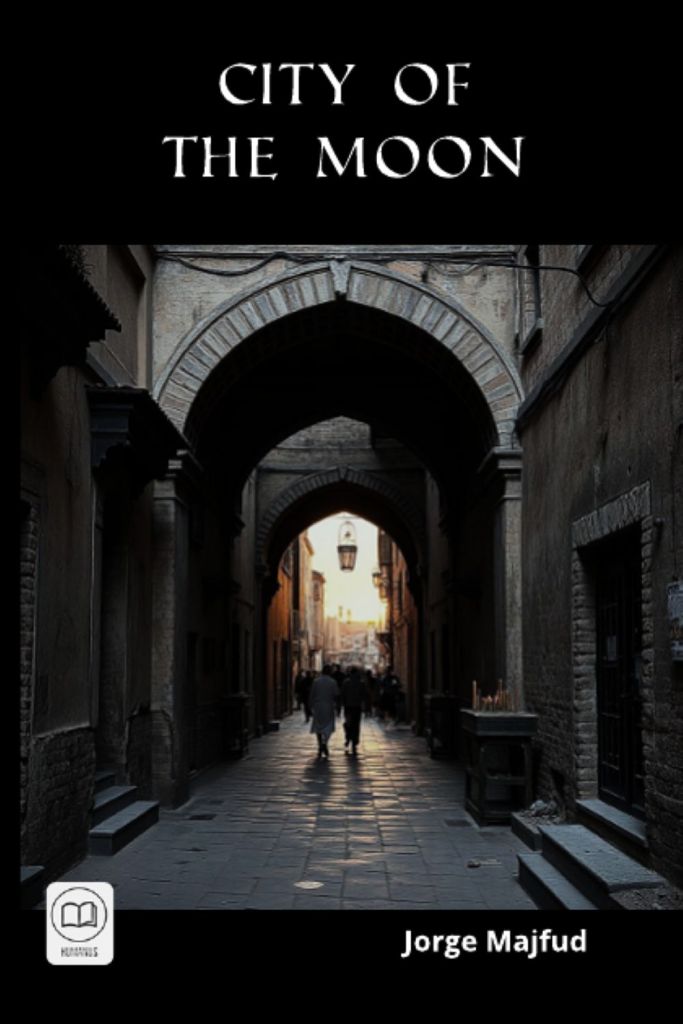
City of the Moon

City of the Moon was conceived prior to the events of September 11, 2001, and completed following the U.S. invasion of Iraq. The book serves as a poignant metaphor for a civilization that perceives itself as superior and thus feels justified in imposing its moral standards on others—turning myth into reality through fanatical ideologies. Two decades later, we witness a resurgence of neo-medievalism and a wave of anti-Enlightenment sentiment, known as the Dark Enlightenment. This movement, incensed by its decline yet emboldened by a perceived ethnic, ideological, and cultural superiority, is once again taking root in the West. It seeks to persecute and suppress diversity and tolerance, ironically under the banners of democracy, freedom, higher moral values, and true faith.

First published in 2009, City of the Moon is set in Calataid, a walled city in southern Algeria between 1955 and 1992. This city, surrounded by the Sahara Desert, probably founded by a stray corps of the Spanish army after the Iberian Reconquista of 1492, has the peculiarity of being inhabited almost exclusively by white Europeans, mostly Christians, confined to a silent and unknown corner after Algiers’ independence in 1962. To survive, Calataid attempts to sever physical and cultural ties with the outside world, especially with the train that arrives there once a month. One of its protagonists and narrators is the «monster-son» of an Argentine doctor who, from his solitude, sees the reality of a society that considers itself perfect, the moral reserve of a corrupt world. Calataid is a metaphor for sectarian cruelty and fanatical pride. Despite the obvious signs of ethical, economic, and urban decline, Calataid resists any change until it succumbs to a tidal wave of sand that overcomes the resistance of its thick walls. Part of the narrative in this novel experiments with Cubist perspectives, so that different narrators can converge in a single sentence, with the intention of emphasizing the central role of the city-society.

Go to BookStore>>

Deconstructing “The American dream” in selected works of Hari Kunzru and Jorge Majfud

By Sumit Gupta, PhD. Jawaharlal Nehru University, NewDelhi

The quest for the betterment of social and economicstatus has led human beings to move from one place to another from time immemorial. In this process, immigrants often encounter various changes and challenges that, at times, are easy to adapt and overcome, but in the majority of the cases, they find themselves struggling to adjust to the social, cultural, and political changes that they experience in the foreign land. And in order to adjust to a new country, they undergo a series of changes, like adapting to new cultures, customs, norms, and languages. The process of adjusting to the new culture and environment often leads to assimilation, discrimination, acculturation, alienation, and social exclusion. The present article aims to explore the above-mentioned harsh realities and the unrevealed face of the global world through the narratives of India and Latin America. The researcher will also attempt to see whether the undocumented immigrants only face the harsh realities in the new land and are unable to fulfil their ‘American dream’. Or is it the same situation for immigrants who enter the USA legally? The two works, Transmission and Crisis, reveal the grim reality of the globalised world, where injustice and discrimination go hand in hand in the name of progress and development. The chosen works deal with the problems of immigrants and the working class in the USA. The present article also attempts to highlight the socio-cultural problems— problems of assimilation, exploitation and discrimination—that immigrants encounter in new land, apart from the economic issues.

The chosen works highlight the experiences of people who leave their native places to settle in developed countries in the hope of a promising career and a better life. In both works, one witnesses that the protagonists see America as a land of fortune, where they can fulfil their dream of becoming rich. As described by James Truslow Adams, an American historian, in his book The Epic of America, the American dream is:

«That dream of a land in which life should be better and richer and fuller for every man, with opportunity for each according to his ability or achievement. It is a difficult dream for the European upper classes to interpret adequately, and too many of us ourselves have grown weary and mistrustful of it. It is not a dream of motor cars and high wages merely, but a dream of a social order in which each man and each woman shall be able to attain to the fullest stature of which they are innately capable, and be recognized by others for what they are, regardless of the fortuitous circumstances of birth or position.» (404)

Therefore, our protagonists see America as a land of fortune, as described by James Truslow, where immediate success is guaranteed for them, but the moment they arrive in America, their hopes, dreams, and the image that they were carrying in their minds of America turn out to be a deception. Since, they find themselves in an appalling position compared to their native places, as the work they find in the new land is exploitative and underpaid.

In Transmission, Hari Kunzru, through his protagonists, reveals the bitter truth of the globalised world. His protagonists, Arjun Mehta, a software engineer and Guy Swift, head of the company Tomorrow, are shown as the victims of the present global order, where opportunities are for a few and disappointments for the majority, like our protagonists. Arjun, on receiving a job from Data bodies, which sends him to the US, finds himself in jeopardy, as initially he could not get the job, and when he gets it in spite of doing the job wholeheartedly, due to a financial crisis, he will be the first one to lose the job, as he is an outsider. In order to prove his worth and save his job, he creates a virus and plans to resolve it to show the company his capabilities and importance, but things don’t go as planned, and he becomes the cyber terrorist. He soon realises that the American dream was a deception, as the unfolding situations in the new land embitter his expectations and hopes from the new land. Similarly, Guy Swift also becomes the victim of the virus that Arjun creates, as he is arrested by the police due to his wrong identification with some transgressor due to the havoc created by the virus in their computer systems.

In Crisis, Jorge Majfud deals with the issues of immigrants, specifically Latin-American immigrants in the USA. As one starts reading the novel, the harsh reality and experiences of immigrants unfold. The work deals succinctly with the problems that immigrants face in the new land. Rejection, discrimination, assimilating to a new culture, earning a livelihood, and a lack of health facilities are the principal obstacles that generally immigrants face in the neo space. In Crisis, one also witnesses that the protagonists, like María Isabel Vásquez Jiménez, Guadalupe, Lupita, and others, see the USA as the only solution to the extreme poverty and economic problems that they face in their respective countries. The protagonists of Majfud represent the agony and despair of immigrants, who, in search of an enhanced life, leave their homeland without realising that obstacles in the new land are waiting for them. Mostly, the immigrants are considered outsiders by the host country and even seen as a social threat. They are not easily welcomed by the host country due to differences in cultural and social status.

As, Wang remarks, “In fact, in the early stage, even with the help of policy, the poor were exploited by the rich under the appealing of the American dream. Hence, the American dream is misleading and even can be seen as a trap for cheap labour force” (35). Hence, immigrants are often manhandled by the companies, who use them as cheap labour without granting them any rights. For example, in the novel Crisis, one observes the harsh realities that immigrants facein thenew land. Thenovel begins with the description of MaríaIsabel Vásquez Jiménez, who, from México, enters the USA and dies working in an exploitative condition in the vineyard due to a heart attack. Thestory of María Isabel in Crisis represents the exploitative nature of the big corporations that exploit these helpless people who leave their native places due to extreme poverty and hunger. The story of María Isabel represents the treatment that immigrants get in developed countries. To quote from the novel:

«Quizás nunca podamos imaginar los miedos de María al dejar su pueblo con tan pocos años y tan poco conocimiento del mundo exterior, sus nervios al llegar a Putla para contactar a un coyote, el vértigo y el cansancio de su paso por la ilegalidad…Pero algo salió mal. El 14 de mayo el termómetro marcó casi cuarenta grados centígrados a la sombra. Después de nueve horas bajo el sol despiojando retoños de las vides, María se sintió mareada. Tambaleándose, caminó hacia su novio y antes de llegar se desplomó… Dos días después, María y su hijo de dos meses de vientre murieron de insolación.» (Majfud 8-9)

This episode throws light on the extreme inhuman conditions under which immigrants work. They are only seen as cheap labour in the new land, and their exploitation is done for economic benefits. And the immigrants who leave their country in the hope of a better future and economic prosperity find themselves entrapped in the vicious cycle of cruelty. Therefore, the immigrants without any social or legal rights in the new place often live an isolated life because the fear of deportation always haunts their minds.

Therefore, in both novels, one observes that the protagonists see the USA, as described by James Truslow, as aland of prosperity and fortune wherethey will not betroubled by the problems they were facing in their homelands. But in reality, when they get the chance to live their «American Dream,» they find America totally opposite of what they have watched, heard, and read on television, in the news, and in books. Their optimism about the new land soon turns into dejection. They see themselves trapped in a net of false hopes and promises, where they are seeing themselves turning into cheap labour. The difficulties, harsh realities, hardships, and physical and psychological traumas that immigrants go through are very well reflected by one of the characters of Hari Kunzru. Arjun Mehta, who wants to fulfil his American Dream, moves to America, but the reality turns out to be different from what he expected. He finds himself jobless for a year. In the novel, one observes the deceptive and exploitative sides of Arjun’s job in the new land, when he is informed about the nature of his job. To quote from the novel:

Good. Until the second day, when Arjun asked where he would be working and was told that the job Databodies had guaranteed him was not in fact guaranteed at all. He would have to interview by phone with potential clients. Until at his induction meeting he shook the hand of a man who seemed like a clone of Sunny Srinivasan…who coldly informed him that until he successfully secured a post, Databodies would pay him a grand total of $500 a month, half of which would be taken back as rent for the house-share. Arjun reminded him of the $50,000 a year his contract guaranteed. Sunny’s brother-in-law shrugged. If you don’t like it, he said, you can always go back home. You’ll owe us for your visa and ticket, and we’ll have to charge you an administrative fee for the inconvenience. Ten thousand should cover it. Rupees? No, bhai, dollars. (Hari Kunzru 40)

This eye-opening event in a foreign land acquaints him with the realities of the globalised world, where his «American Dream» turns out to be a nightmare. Like other immigrants, he also experienced a long period of unemployment. And even after getting the job, the fear of termination bothers him, so he creates a virus deliberately imagining that after finding a solution to the problem, he will get a stable position in the company. And ultimately, he gets consumed by the very thing that attracted him. Likewise, the protagonists of Majfud also express the bitter experiences, difficulties, and pains faced by undocumented immigrants in the USA. The protagonists of Majfud are also from economically backward regions and also desire better living conditions and better employment, but in reality, like Arjun Mehta and Guy Swift, the protagonists of Majfud also meet the same fate. They also see themselves in the new land without social and legal rights. The protagonists of Majfud expose the truth of the globalised world, where people from developing countries get trapped in the false promises and opportunities claimed by globalisation, and they are exploited and used as cheap labour. And many times, due to extreme exploitative working conditions, they even lose their lives. In the novel, María Isabel, a Mexican girl, reflects the exploitative nature of big corporations, who use them as cheap labour without granting them any legal or social rights. The immigrants who are without documents or enter America illegally are generally the first preference of the companies, as they are not given any legal rights and are also underpaid. Without any legal or social rights, they are massively exploited. They are generally in demand as cheap labour but not accepted as citizens. As Navarro remarks, “Without the availability of a large pool of cheap exploitable migrant labour, the country’s economy would come to a halt—in short, an economic paralysis would occur. Undeniably, undocumented workers perform jobs that most U.S. domestic workers refuse to perform” (xxxii).

So, here one notes that the illegal immigrants are accepted for the sole purpose of their exploitation and the benefit of the big corporates. As Lenin rightfully asserts, “There can be no doubt that dire poverty alone compels people to abandon their native land, and that the capitalists exploit the immigrant workers in the most shameless manner…” (qtd. in Smith 31). Both works represent the same preoccupation, i.e., the condition of immigrants in the USA. The protagonists of both novels, who leave their homelands in the search of a better future and prosperity, are seen struggling for the basic amenities rather than the bright future and success they had imagined before coming to America. They often feel isolated, dejected, and alienated and live in constant fear of deportation. They are often maltreated and exploited due to a lack of social security, and people often take advantage of their situations by exploiting and harassing them. In Crisis, one observes how Nacho is treated badly and cruelly in public gatherings. As reflected in one of the events of the novel, Nacho is invited to a birthday party, and while leaving the party, he kisses and hugs Lilian, which is a common custom in most Hispanic countries. But his kissing and hugging resulted in a cultural shock for the Lilian family. They accuse him of sexual harassment and deliberately threaten him that they are going to call the migration police since they know that Nacho’s parents were undocumented immigrants. The above incident sheds light on the challenges that immigrants face in day-to-day life in the new land. The host country sees these immigrants as others, and the people of the host country never accept their culture and customs; rather, the immigrants are expected to learn everything about the host country, thus, in the process, immigrants are forced to disregard their own culture and traditions, leading to assimilation. ‘‘Ellos siempre avanzan así, no respetan el espacio personal. Dicen que los latinos son así, pero si vienen a este país deben comportarse según las reglas de este país’’ (Majfud 46). Thus, these disrespectful incidents force immigrants to live isolated lives. The novel also highlights other issues, like the fear that haunts every immigrant’s mind. And due to this fear, many times they are vulnerable to physical and psychological suffering. In the novel, Nacho is always seen as afraid of the police, and when someone steals his wallet in the metro while he was going to the airport to catch his flight, rather than making a police complaint, he returns back to his home, fearing they might deport him, as his parents were undocumented immigrants. The novel highlights the traumas that many immigrants face throughout their lives. As reflected in the novel, Nacho, who is not an illegal immigrant, always lives in fear of deportation, and many times criminals take advantage of their fear by targeting them.

The above analysis of two works exposes the problems faced by both legal and illegal immigrants in America. In both works, one observes how the protagonists try their best to achieve prosperity and a better life through determination and hard work, but soon they witness their ´American Dream´ turning into a nightmare. We see our protagonists fall into two categories: those who don’t see any hope of progress and growth in their own country, and are suffering from extreme poverty. The second category of protagonists are like Arjun Mehta, who wants to go to America to improve his financial as well as social status. But in both cases, the protagonists fail to achieve their dreams because of the capitalist system,which always sees them as cheap labour and a source of profits. Big corporations always keep immigrants in subordinate positions so that they can be easily exploited. The analysed works reveal that neither of the two categories of immigrants achieves their goals. As in both cases, the protagonists are seen as cheap labourers in the new land, and they are struggling for their daily bread instead of a content and respectable job.

HISPANIC HORIZON. Journal of the Centre of Spanish, Portuguese, Italian&LatinAmericanStudies, 2019.

Bibliography

Adams, James T. «The Epic of America, 433 p.» Boston, Little (1931).

Alba, Richard. “Mexican Americans and the American Dream.” Perspectives on Politics, vol. 4, no. 2, 2006, pp. 289–96. JSTOR, http://www.jstor.org/stable/3688267.

Kunzru, Hari. Transmission. Penguin, 2005.

Majfud, Jorge. Crisis. CreateSpace Independent Publishing Platform, 2014.

Navarro, Armando. The immigration crisis: Nativism, armed vigilantism, and the rise of a countervailing movement. Rowman Altamira, 2008.

Crisis (IV)

 Jorge Majfud’s books at Amazon>>


Crisis IV (Spanish)

Crisis (IV)


Saturday September 20.  Dow Jones: 11,388

San Francisco, California. 5:30 AM


We were feeling really laid back at Lilian’s party when he arrived with his usual two little friends, Patrick and the other guy whose name I don’t remember.  I asked Lilian if she had invited them and she just laughed, which in this case meant no, or that she had no choice but to invite them.  I had never had problems with Nacho before so don’t come at me with that stuff about animosity or predisposition, much less premeditation.

It wasn’t premeditated.  Nacho Washington Sánchez had come to the party with a gift for the young girl who was turning fifteen two days later.  Her parents had moved the celebration up so that it would fall on Saturday the 14th, and as a reward for her good grades.

Nacho Sánchez, Santa Clara, 19, had gone back to school at the age of almost twenty, after spending a time in a Georgia chicken factory.  And this time he had come back with enough maturity and motivation to carry him to the second best grades in his class.

According to his friends’ statements to the police, Nacho didn’t go to the party because of Lilian but because of Claudia Knickerbacker, the Chilean friend of the birthday girl.  And if he said goodbye to miss Wright with a hug and a kiss on the cheek, that didn’t mean anything.  Or it didn’t mean, like George Ramírez yelled at him, sexual harassment.

—The thing is that George speaks less and less Spanish all the time and he forgot or acts like he forgets that we Latinos hug and kiss more often than Yankees do.  The other stuff is inside the head of one of those repressed people who see sex everywhere and try to surgically remove it with a pair of hot tongs.  It’s true that before heading for the bus stop Nacho turned around and told him that George wasn’t a Mexican-American anymore because in Calabazas North the “Mexican” part had fallen off of him.  It wasn’t necessary, but it was after tolerating like a prince the insults that George had thrown at him since he left the Wrights’ house.

—What insults?  Do you remember any of them?

—He said to him that Nacho was a child abuser, that Lilian was still only fourteen years old and that he was going to report him to the police and he followed him around threatening him with the telephone in his hand.  Without turning around Nacho told him, sure, call 911.  The others were coming up behind.

—How many were they?

—Five or six, I don’t remember exactly.  It was dark and I was really scared that there would be a fight and we would all get pulled in.  We were about a hundred yeards from the bus stop and the bus was waiting for the light to change a block away and George decided to yell at him that he wasn’t going to call 911, but the Migra instead.  Everybody knew that Nacho’s parents were illegals and hadn’t gotten papers for as long as Nacho could remember, which was why, even though he was a citizen, he always avoided run-ins with the police, as if they would deport him or put him in jail for being the child of illegals, which he knew perfectly well was absurd but was something that was stronger than him. When his wallet got stolen in the metro to the airport he didn’t report it and chose to go back home and he missed his flight to Atlanta.  And that’s why you could say the worst to him and Nacho always kept his cool, biting back his anger but never lifting a hand, and he was strong enough to knock out a mule if he wanted to.  Not him, of course, he wasn’t illegal and the others must have known it.  But the ones coming from farther back, including John, Lilian’s older brother, who heard the part about “the Migra” and the part about “sexual harassment,” and he caught up with George who stood out because of his size and his white shirt…

—Do you want them to bring you some water?

—I started walking faster, saying that the bus was going to leave without us and I got on it.  After that I don’t know what happened.  I just saw through the window, from a distance, that they had rushed at Nacho and Barrett was trying hopelessly to rescue him from the mob.  But Barrett is smaller than me.  Then all I saw were the streetlights on Guerrero and Cesar Chavez, and I sat in the last seat with my cell phone in my hand until I got home.  But Nacho never answered any of the messages I left him asking him to call me back.  Nacho said good-bye the way he did because he was happy.  She had invited him so he would have a chance to ask the Knickerbacker girl out, and in the kitchen while they were cutting the tres leches cake Knickerbacker hadn’t told him no.  She told him that  they could go out next Saturday and that left Nacho feeling really happy.  He had such a complex because of his prematurely thinning hair at 19 years old, which he thought was sufficient reason for any pretty girl to reject him.  It’s not like the Chilean girl was a model or anything, but Nacho was blindly in love since starting back to school.

—And you?

—I don’t think that such a warm good-bye was because he was happy.  They always come across that way, they don’t respect your personal space.  They say Latinos are like that, but if they come to this country they should behave according to the rules of this country.  Here we just shake hands.  We’re not in Russia where men go around kissing each other. Much less kiss a child like that in front of her parents and all of her friends.  You’re right, her parents didn’t complain, but they also didn’t say anything when George and his friends decided to go out and teach those intruders a lesson. The Wrights are polite and when they saw that Nacho left without causing trouble they decided not to intervene.  But I’m sure they spoke with Lilian afterward, because they looked worn out.  It was because of a moral issue. A matter of principles, of values.  We couldn’t allow some nobody to come and upset the peace at the party and abuse one of the little girls. No, I don’t regret it.  I did what I had to do to defend the morality of the family.  No, it wasn’t my home, but it sort of was.  I’ve been Johnny’s friend since middle school.  No, we didn’t want to kill him, but he was asking for it.  What worse crime is there than abusing a little girl?  He didn’t fondle her, but that’s how they all start.  Them, you know who I’m talking about.  Them!  Don’t coerce my statement, I know my rights.  They don’t know how to respect personal distance and then they lose control.  No, my partents were Mexicans but they entered the country legally and they graduated from the University of San Diego. No, no, no… I’m an American, sir, make no mistake.

(from the novel Crisis)

Jorge Majfud

Translated by Bruce Campbell


Jorge Majfud’s books at Amazon>>