The native peoples encountered by Jesuits and other explorers in North America always laughed at the ideas of the colonists (the quote is a personal synthesis of several documents):
“You say you are free, and yet everything you do, you do out of obedience to your kings, your captains, your shamans, your husbands…”
If the leaders failed to convince their people in their assemblies, the people and even individuals simply withdrew and disobeyed. The same was true of women with regard to their men. Women and warriors had the right to veto the assemblies’ war resolutions if they were not convinced by the arguments.
The European military, religious, and intellectuals who attended these assemblies and meetings with white people recognized that “savages” never forgot anything; no one could win an argument with them. Savages did not punish their children; they let them make mistakes so that they could learn from experience. They accepted people of any ethnicity without restriction, including Europeans and Africans. They had no prisons, because the accused had to make amends to the victim, and the shame of the sentence was already a painful punishment. The savages considered the loss of personal control due to passions to be a sign of poor education and spiritual inferiority. They were far more realistic than the European fanatics. A French Jesuit wrote that, once, when discussing the existence of hell, they argued that there could be no fire under the earth because there was no wood down there, only stones, and because fire needs air. They ended up accepting the argument of fire without oxygen when the priests lit a sulfur stone, but the idea of hell continued to be resisted by peoples such as the Iroquois, who defeated the French and British for three centuries because their social organization was superior to that of the Europeans, because they had a military defense based on cooperation and knowledge of their land, and because they did not believe the fanatical stories of earning heaven through martyrdom and suffering. They lived longer, were taller, and were healthier. They invented modern pharmaceuticals and true democracy. They had fewer wars, worked fewer days, knew no depression, and suicide was almost unknown until the white man arrived with his rum, his loss of control, and his fantastic concept of the individual. They knew tobacco, but not smoking or the addictions introduced by commercialism. Private ownership of land did not exist.
Yes, they were not saints. Yes, throughout history there have been many fanatical cultures, but few more fanatical than the one that emerged with capitalism in the 17th century. As proof, it would suffice to mention that the most destructive and fanatical dogma of recent centuries asserts that “My selfishness is good for the rest of society” and to receive in less than two seconds epidermal attacks from its fanatical defenders, especially from individuals who are impoverished and enslaved in body and soul.
We could go on, as other demonstrations of radical fanaticism that, like all fanaticism, pass for common sense: enslaving millions of people because of their color and turning them into hereditary private property. Massacring hundreds of millions of humans for the sole greed of capital, of enrichment, and doing so in the name of freedom. Even under the banner of Christianity (from the Crusades, the Inquisition, and slavery to the brutal empires that survive in different forms), turning Jesus’ idea that it is almost impossible for a rich person to enter Heaven on its head with the idea that if you are rich it is because God loves you and with dollars you can buy Paradise. Weren’t the native peoples right about the absurdity of our convictions about freedom?
Susana Groisman confessed to me her frustrations with the current government of Uruguay.
“This is not what I voted for. I voted for a party, and a group of people is governing.”
This is another aspect of the “Americanization of Europe” and “Latin America.” The first presidential election I experienced in the United States was in 2004. One of the things that surprised me most was that the candidates spoke about themselves as people, as individuals (I will…, Me, I am… I believe…) and not about the party’s program, as I was used to hearing in Uruguay: “The individual does not matter; what matters is the party’s government program.”
For better or worse, these platforms were published and distributed among the people. Although not everyone read them, at least it was a form of political contract.
I later learned that the “I” (Me, I) is only important to the Protestant culture of their voters because, in reality, those who decided and decide were not and are not the parties or the leaders (men), but the financial corporations. Almost the same thing is happening now in Uruguay and other Latin American countries, but the process has been so gradual that people have become accustomed to it without noticing the inoculation.
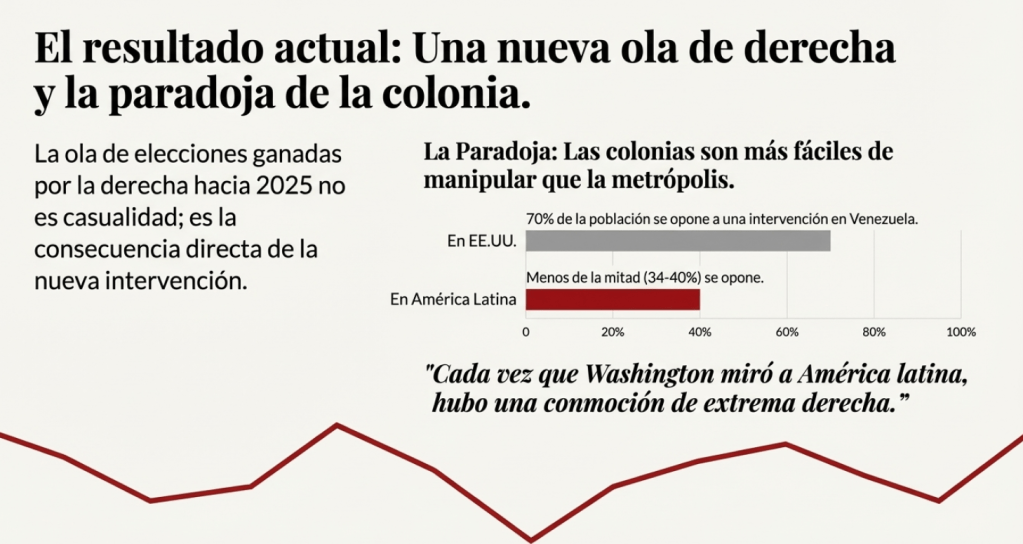
We saw a caricature of this in early 2026, after Washington broke all international laws by blocking Venezuelan oil, hijacking its cargo ships, carrying out summary executions of alleged drug traffickers in boats without capturing them to bring them to court (many turned out to be fishermen), and kidnapping its president on charges that Washington itself acknowledged to be false (such as the Cartel of the Suns); justifying summary executions of its own citizens by masked paramilitary groups (ICE), as in the case of Renee Nicole Good, for being (a) a provocative leftist, (b) a terrorist who insulted secret agents and then tried to flee, and (c) a lesbian and mother of three children. A day later, a New York Times reporter asked the president at the White House if there were limits to his power:
“Yes. My own morals. My own conscience. That’s the only thing that can stop me.”
All of this is the perfect description of a dictatorial regime, no longer in the plutocratic style of corporations (P=d.t), but in the more primitive tradition of the banana dictator, like in The Autumn of the Patriarch, where even García Márquez’s magical realism is expressed in the University of Texas A&M’s ban on Plato’s books for being leftist woke.
Susana responded with a question:
“So what can be done?”
The answer is the same one we have been repeating for years: (1) There is no possibility of democratization as long as power remains concentrated in the financial centers. (2) This concentration has become more radical, which we can see not only in the “Americanization of the West,” from consumerist habits to politics and education systems, but also in its final phase, where we are now entering a (3) “double Palestinianization of the world.” In other words, (4) the electoral systems of liberal democracies have contained some of capitalist neofeudalism, but they will never change it.
(5) Change will come through a massive global crisis. I understand that we are in a stage of accumulating popular pressure. We cannot say when it will happen, but a social and international explosion is inevitable.
What we can do is little, but necessary: (7) resist. Resistance has always been the engine of social progress (see “When resistance is progress and change is reaction”).
As history proves, (8) no resistance has been sufficient to change a historical system such as capitalism, but (9) individuals do not have multiple lives to wait centuries. We cannot put an end to one of the most cruel and fanatical systems that humanity has created, capitalism, but we can reverse or limit some of its suppurations, neoliberalism and fascism.
Slaves can survive slavery, but not lynching.
Jorge Majfud, January 9, 2026.




 Escritos Críticos
Debe estar conectado para enviar un comentario.