(A 20 años de su publicación, este estudio se encuentra libre de derechos por parte de la Universidad de Gerogia. En esta página se puede descargar gratis.)
Este estudio sobre la lucha por los campos semánticos en la narrativa social fue publicado originalmente como tesis por la Universidad de Georgia en el año 2005. Desde entonces, los acontecimientos políticos y sociales y las nuevas tecnologías, como las redes sociales, han ido confirmando la relevancia política e histórica de la lucha semántica (aún sobre el siempre presente peso de los sistemas de producción y consumo) expuesta en este libro. En esta nueva edición no se han introducido cambios relevantes al estudio general. Con sus aciertos y errores, el autor ha decidido entregar esta nueva edición de Una teoría política de los campos semánticos tal como fue presentada en 2005, sin revisiones y con la intención de mantener el contexto histórico inmediato.

Una madre y su hijo en una manifestación en Arkansas (1959) contra la integración racial: “Gobernador Faubus, salve nuestra América cristiana”; “La integración racial es comunismo”. (Everett Collection Historical / Alamy Stock Photo)
This work explores the complex relationships between semantic fields, identity, power, and historical narratives, focusing on Latin America. Majfud contrasts differing interpretations and models for understanding the sociopolitical and cultural dynamics of the region, particularly through a critique of Eduardo Galeano’s Las venas abiertas de América Latina and Carlos Alberto Montaner’s Las raíces torcidas de América Latina. The work incorporates poststructuralist, dialectical, and political theory perspectives.
Descargar el libro en formato PDF

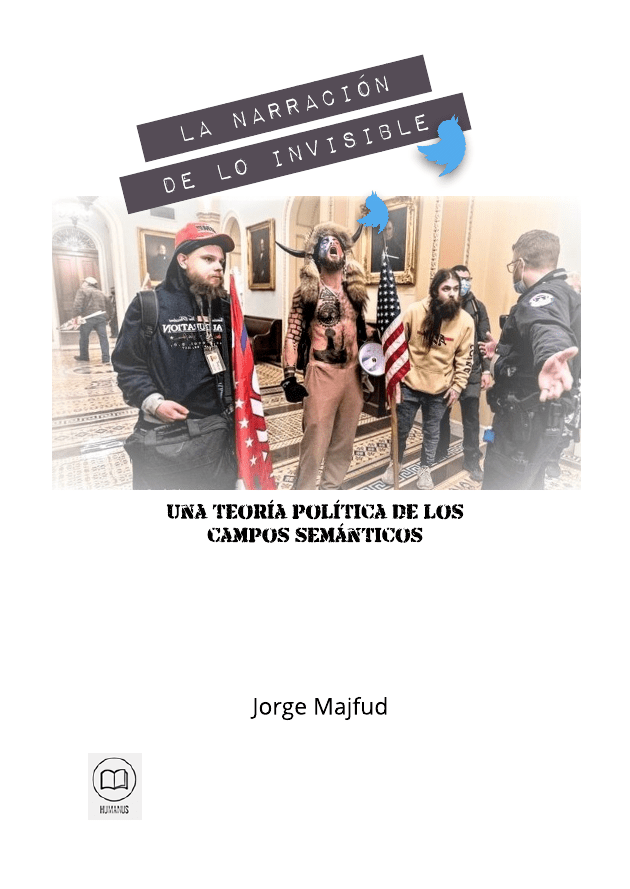
Summary of Una teoría política de los campos semánticos by Jorge Majfud (2005)
Introduction to Semantic Fields and Political Struggles
Una teoría política de los campos semánticos develops a theoretical framework to explore the construction, struggle, and administration of meanings within sociopolitical contexts. Central to this work is the idea that history, power, and identity are shaped through competing narratives and semantic interpretations. Majfud describes these “semantic fields” as arenas where concepts like freedom, justice, and progress are contested, revealing the ideological and historical forces behind their formation.
The book focuses on the narratives of Latin America’s identity and history, contrasting Eduardo Galeano’s Las venas abiertas de América Latina (1971), a Marxist critique of imperialism and exploitation, with Carlos Alberto Montaner’s Las raíces torcidas de América Latina (2001), which attributes Latin America’s struggles to internal cultural and ideological failures. Majfud uses these two works to illustrate the dual perspectives of external oppression versus internal flaws in understanding Latin America’s sociopolitical evolution.
Deconstruction of Binary Oppositions
Majfud uses poststructuralist tools, especially Jacques Derrida’s deconstruction theory, to interrogate how binary oppositions like oppressor/oppressed or development/underdevelopment dominate ideological discourse. He argues that these binaries are not «natural» but constructed by dominant metaphors and ideologies. This critical method enables Majfud to expose the underlying power structures embedded in historical narratives. For example, the binaries in Galeano’s and Montaner’s works reflect broader tensions between materialist and culturalist interpretations of history.
Majfud critiques both perspectives for privileging one term in these binaries while marginalizing the other. Galeano views external imperialist exploitation as the primary driver of Latin America’s struggles, whereas Montaner sees internal cultural «deficiencies» as central. Majfud highlights the limitations of these unilateral views, advocating for a synthesis that recognizes both external and internal factors in historical processes.
The Clash of Historical Narratives
A significant focus of the book is the analysis of how historical narratives shape perceptions of justice, freedom, and identity. Galeano’s Las venas abiertas constructs Latin America as a subject of external exploitation, with its resources drained by colonial powers and later by modern imperialism. This materialist perspective posits that economic structures determine cultural and political realities, aligning with Marxist history theories.
In contrast, Montaner’s Las raíces torcidas emphasizes cultural and educational shortcomings, arguing that Latin America’s failures stem from inherited ideological and intellectual frameworks that stifle innovation and progress. Montaner’s approach can be seen as a «culturalist» critique that shifts responsibility inward, portraying Latin America’s underdevelopment as self-inflicted.
Semantic Fields and Identity Formation
Majfud explores the concept of “semantic fields” to analyze how terms like «America,» «Latin America,» and «identity» are socially constructed and contested. He delves into the etymology and historical development of these terms, showing how they reflect layers of ideological and geopolitical conflict. For instance, the term «Latin America» emerged as a French invention to assert cultural connections with the region, but it later became a symbol of resistance and unity against imperialism.
Majfud critiques the homogenization of Latin American identity, arguing that it reduces the region’s diverse cultures and histories into a single, oversimplified narrative. This homogenization serves political purposes, but it also perpetuates misunderstandings and exclusions. For example, indigenous and Afro-descendant populations are often marginalized in mainstream narratives of Latin American identity.
The author highlights the tension between imposed identities (e.g., colonial definitions of “Latin America”) and self-defined identities, showing how the struggle over semantic fields shapes collective consciousness. The process of naming and defining becomes an act of power, where dominant groups impose their meanings while marginalized groups resist and reinterpret them.
Materialist and Culturalist Models of Interpretation
Majfud contrasts two primary models of interpretation in his analysis: the materialist model, which sees economic structures as the foundation of historical processes, and the culturalist model, which attributes historical outcomes to ideological and cultural factors. Galeano represents the materialist perspective, while Montaner exemplifies the culturalist view.
- Materialist Model: Galeano argues that the exploitation of Latin America’s natural resources by colonial and neocolonial powers has perpetuated its underdevelopment. Economic dependency and unequal trade relationships have locked the region into a subordinate position in the global capitalist system.
- Culturalist Model: Montaner claims that Latin America’s problems stem from internal factors such as authoritarianism, collectivist ideologies, and resistance to modernization. He attributes these traits to cultural legacies, particularly those inherited from colonial and medieval European institutions.
Majfud critiques the rigidity of both models, arguing that they fail to account for the interplay between material and cultural factors. He advocates for a dialectical approach that recognizes the mutual influence of economic and ideological forces in shaping historical realities.
The Role of Metaphors and Symbols
A recurring theme in the book is the power of metaphors and symbols in constructing reality. Majfud argues that metaphors are not merely rhetorical devices but fundamental tools for shaping thought and perception. For instance, the metaphor of «open veins» in Galeano’s work evokes a sense of victimization and exploitation, while Montaner’s metaphor of «twisted roots» suggests internal dysfunction and decay.
Majfud emphasizes that these metaphors are not neutral; they carry ideological baggage and influence how readers interpret history. By unpacking the metaphors in both works, Majfud reveals the underlying assumptions and biases that shape their arguments. He calls for greater awareness of the symbolic dimensions of language, urging readers to critically examine the metaphors they encounter.
Justice, Freedom, and Ethical Evolution
The book also explores the evolving meanings of justice and freedom in historical and ethical contexts. Majfud critiques simplistic notions of justice as either a natural law or a product of economic systems, arguing that justice is a dynamic concept shaped by cultural, ethical, and political struggles.
He draws on examples such as the abolition of slavery and the feminist movement to illustrate how ethical values evolve in response to changing social and economic conditions. Majfud rejects reductionist explanations that attribute these changes solely to material or ideological causes, also emphasizing the symbiotic relationship between ethical consciousness and economic structures.
Toward a Synthesis: A Dialectical Approach
Majfud concludes by advocating for a dialectical approach that transcends the limitations of materialist and culturalist models. He argues that historical analysis must consider the dynamic interplay between external and internal factors, economic and ideological forces, and individual and collective agency. This approach recognizes the complexity of historical processes and avoids the pitfalls of reductionism.
In the context of Latin America, Majfud calls for a reevaluation of the region’s history and identity, one that acknowledges its diversity and contradictions. He urges readers to move beyond binary oppositions and embrace a more nuanced understanding of the factors shaping Latin America’s past and present.
Conclusion
Una teoría política de los campos semánticos is a profound exploration of the power of language, ideology, and history in shaping collective consciousness. Through his analysis of Galeano and Montaner, Majfud reveals the ideological struggles underlying competing narratives of Latin America’s identity and history. His call for a dialectical synthesis challenges readers to critically examine their assumptions and engage with the complexities of historical processes.
The book’s insights extend beyond Latin America, offering valuable tools for analyzing the dynamics of power and meaning in any sociopolitical context. Majfud’s work is a testament to the transformative potential of critical thought and the enduring struggle for justice and freedom in the semantic fields of history.

 Escritos Críticos
Debe estar conectado para enviar un comentario.