I. Model of Inverse Progression

Alternate Variation of History

Although the Western representation of time continues to be a line where the future is forward and the past is backward, reality insists on proving older, more contemplative cultures right: the past is forward and the future is backward, which is why we can only see the former and not the latter. But predicting the future has been more important to humanity than finding the goose that lays the golden eggs.

In the work routine, for example, the most important element in any job application is the resume and the reference letters of the individual or the applying company. In any case, the section on projects and objectives is much smaller and less relevant than the rest, which refers to the applicant’s background, whether ethical or professional. Even though the employer is interested in what the candidate has to contribute in the future, when reading the resume and references, they always focus on analyzing the applicant’s past to form a vague idea of the future. Even artificial intelligence systems that read applications, whose goal is to predict a candidate’s behavior, do so exclusively based on their background.

On a larger scale, sociology and economics do the same: their main tools of understanding and prediction are not in equations but in history. This was already recognized by John Maynard Keynes when, after predicting the tragic consequences of the impositions on defeated Germany in World War I, he failed to foresee the great collapse of markets and economies in 1929. From his obsessive search for a pattern in the stock market, he came to recognize that the unpredictability of the economy is due to the “animal factor” of human psychology. Of course, he did not observe that the animal factor in humans is far more complex and unpredictable than in other animals.

Economists themselves have observed that even today, when one of them manages to predict a crisis, it is due to luck, not to any objective calculation. Out of hundreds and thousands of predictions made by economists before the great crisis of 2008, few specialists were correct. One of them was the economist Nouriel Roubini, who, after becoming famous for his prediction (which he attributed to his intuition, not to a mathematical calculation), continued making predictions that never materialized—even the nose can be wrong.

However, human history is not a succession of chaotic and disconnected events. It not only rhymes but also allows for the identification of certain common elements, certain patterns, such as the cyclical crises of capitalism described by Marx. It is also true that the search for patterns has its dangers, not because patterns do not exist (like the physical and psychological stages of human beings) but because their simplifications often lead to wrong and even opposite conclusions.

One of the simplest and most general abstractions derived from this study is a model we might call the inverse progression model.
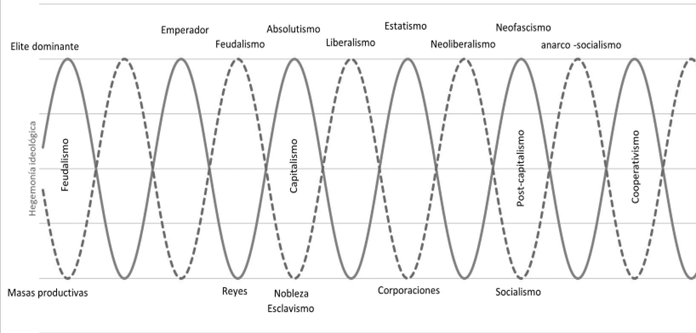
(figure 1)

For reasons of space, for this model of history, we will limit ourselves to considering the last thousand years, analyzing only the last five centuries and focusing in more detail on our time. In this sense, we can observe that each period reacts against the previous one and crystallizes its demands, but, in all cases, it is a matter of opposing ideological narratives that serve the same goal: the accumulation of power in a dominant minority, usually the one percent of the population, through the exploitation of the rest by the exercise of physical coercion first, followed by narrative proselytism and, finally, consolidated by “common sense” and the obvious truths created by the media. Once the economic system convenient to the minority is exhausted by the growing inverse consensus of the majority (Christianity in the time of Constantine) or a new minority with growing power (the capitalist bourgeoisie of the 17th century), it is replaced by the alternative claimed by those below (movements against racism, sexism) and, finally, captured, hijacked, and colonized by the dominant minority. In this way, we can see a continuity between opposing ideologies, such as, for example, feudalism and liberalism, rural slavery and industrial corporatism, monarchical absolutism and Soviet statism.

We start from the axiom that the human condition is the result of a dialectic between a historical component and an ahistorical one that precedes it. We will focus mainly on the observation of the first element of the pair, history, but we will consider its ahistorical component as always present, as are psychic and physiological needs.

On the other hand, this model of reading history is based on another ahistorical component, denied for more than half a century by poststructuralist thought: the dualism of action and reaction in human action and perception. For example, in liberal democracies, elections are almost always decided by a coin toss, that is, by two or three percent of the votes. If not by one percent. In many other aspects of individual and social life, the complexity of reality is often reduced to a pair of opposites, from religions (good-evil, angel-demon, yin-yang), politics (right-left, state-private enterprise, socialism-capitalism, liberal-conservative, rich-poor) to any other aspect of intellectual and emotional life: up-down, white-black, forward-backward, cold-hot, pleasure-pain, inside-outside, euphoria-depression, etc.

In June 2016, in an interview about the possibilities of Donald Trump’s victory in the November elections, we mentioned this pattern and this emotional component in political elections, whereby if a goat were to compete with Mahatma Gandhi, after a certain period of electoral campaigning, the goat would close the supposed logical advantage of the rival candidate.[i] In June 2016, most polls and analysts dismissed a Trump victory. As in the 1844 elections, when everyone laughed at the intellectual shortcomings of candidate James Polk. In 2016, the difference in favor of Hillary Clinton was two percent of the total votes (though Trump was elected president due to the electoral college system inherited from the slaveholding era). In 1844, James Polk won the election by one percent, which ultimately led to a radical change in the history of the world in the following century.[1]

Capitalism emerges as a novelty and reaction (though neither intentional nor planned) against monarchical absolutism, which in turn had arisen as a reaction to feudalism and the power of the landowners. Its economic and ideological system opposes the feudal and absolutist systems while simultaneously drawing from both, and later, it ends up reproducing them with the consolidation of economic and financial corporations, through a radically different culture: the oligopolistic power of transnational corporations served by weaker neocolonial states and protected by central metropolises with almost absolute powers, expressions of democratic political systems indebted to dictatorial economic systems.

The new capitalist class, the bourgeoisie, founds and grounds its revolution in democratic opposition to kings and absolutism, but once it becomes the dominant class, spider-like, it does not abandon the tradition of minority accumulation over the majority. Since its banner is democracy, it cannot abandon it once power is monopolized, but must disguise it to continue the dynamic of appropriating the wealth-power of the majority. In this way, it was possible that throughout the Modern Age, the most brutal empires in the world were democracies. Its ideology, liberalism and more recently neoliberalism, also emerges as a critique of the power of the minority of its time (monarchical absolutism) and becomes the narrative that justifies the dominant power of the new minority, corporate and imperial, articulated by economists functional to the current power with a veneer of science and material objectivity. At the center of the new neoliberal narratives lies a purely ideological and cultural component: the reduction of human existence to a single goal: the pursuit of individual profit at any cost, even at the price of the most radical dehumanization, the simplification of the human being as a producing-consuming machine, and the destruction of the planet. All in the name of democracy and freedom.

Liberals are the continuation of feudal lords, opposed to absolutist kings (to central governments), but they cannot renounce the banner of freedom and democracy, even though they only have the words of these two principles, repeated mechanically like a rosary. By freedom, they mean the freedom of capitalist lords, of the minorities in financial power. By democracy, they mean that electoral system that can be bought every two or four years or, as Edward Bernays, the inventor of modern propaganda, will summarize, that system that tells people what to think for their own good.

In all cases, we will see a progressive divorce between narrative and reality until a new super crisis, a social and civilizational paradigm shift, causes both to collapse. The more words like freedom and democracy are hijacked and repeated, the less relevance they have. A reality creates a dominant narrative-web, and this narrative sustains the reality so that it does not dissolve in its own contradictions. To achieve this, the narrative resorts to religious sermonizing, in our time dominated by mass media.

In this study, we will analyze the most significant moments of the last four centuries of this dynamic. Based on the “Inverse Progression” proposal illustrated earlier, we will begin by projecting the same logic to earlier periods in the following scheme, which, without a doubt, must be adjusted in its details for greater clarity for different readers.

Scheme of Ideological Pairs

PeriodsDominantResistant
MonocraticPolycraticMonocraticPolycratic
Antiquity PolytheismsMonotheisms 
Classical Middle AgesEmpires  Tribes/Provinces
 Confederation Republics CaliphatesDictatorships Empires regional 
Catholic Church  Non-canonical Christianities
 FeudalismMonarchy 
Modern EraCatholic Monarchy  Protestantism Liberalism
 Liberalism FederalismMonarchy Centralism 
Imperialism  Anti-colonialism
 Slavery ConfederationNation, Union 
19th CenturyNation-Empire  Colonies
20th Century Corporate CapitalismState Capitalism 
Fascism Stalinism  Socialism Anarchism
 Liberal CapitalismState Socialism 
State Capitalism  Social Democracies, Unionism
 Neoliberalism NeofeudalismCapitalist Socialism 
21st CenturyMilitarist Capitalism  Cooperative Democracy
 Cooperative DemocracyCommunist Capitalism 

Descriptive Examples

Before we begin, let’s provide a few brief examples. When capitalism emerged, feudalism simultaneously transformed into anti-monarchical liberalism in Europe and, later, into slavery against the central government in the United States. This ideocultural tradition persists today in the Southern principle of “defending state independence,” the same principle that led to the Civil War to maintain slavery over a century ago and later the transformation of slaveholders into CEOs and boards of dominant corporations.

Today, neoliberals repeat the imperial rhetoric of the free market when, in reality, they refer to the earlier school they refuted, mercantilism. Mercantilism was a system of currency accumulation that, to a large extent, practiced the interventionism of imperial states to protect their own economies and destroy those of their colonies through protectionist policies and forced purchases at gunpoint. Not without irony, the ideology of the capitalist free market ended the free market. What we have today, five centuries later, is corporate mercantilism, where corporations are no longer medieval guilds but the same feudal lords who accumulate more power than monarchies. Today, the surplus (capital accumulation) prescribed by the mercantilists of the past does not reside in national governments but in the neo-feudal lords of finance. Conversely, countries manage debts.

In the United States, as in other countries, the competition between two political parties will eventually lead to a role reversal, as with the Southern slaveholding Democrats and the Northern liberal Republicans in the past. The inverse identification of Southern Confederates with the Republican Party, to some extent starting with Franklin D. Roosevelt, or perhaps earlier during the Progressive Era, and of the leftist Democrats, follows this model and leads us to predict that it will eventually reverse again, especially given some demands of the Republican right that align with old demands of the Democratic left. I suspect this crossover and inflection will occur sooner in their disputes over international policy, which have never been very antagonistic. In chapters like “Social Networks Are Right-Wing,” we will provide a more recent case.

If we consider the immediate present and a projection into the future, we can see the case of the United States during Postcapitalism. Only in the last century, the superpower experienced the sine wave of the Inverse Progression in an accelerated manner, with periods of fifty years. During the Great Depression of the 1930s, progressive policies not only migrated from the Republicans to the Democrats but also established the paradigm for the next fifty years. This paradigm strengthened unions, made possible the creation of State Social Security, and allowed government intervention in the economy without major questioning. This cycle ended with the election of Ronald Reagan in 1980 and the triumph of the neoconservative-neoliberal reaction, also a consequence of the global crisis of the 1970s. In all cases, ideological changes were followed by transmutations and travesties of the elites at the top of the social power pyramid to maintain continuity amidst change.

Today, fifty years later, the system is once again in crisis for the third time, with minor symptoms but major causes. For the United States, it is not yet a massive economic crisis, but it is already a crisis of hegemony that will end its monetary privileges and, later, geopolitical ones. As happened with the crisis of the Spanish Empire in 1898, this country will have to turn to deep introspection.

This megacrisis will likely occur in the 2030s or 2040s, and it will be a new opportunity, judging by the dynamics of the Inverse Progression, for new generations to reorganize themselves into a system removed from neoliberalism, from capitalism as an existential framework, and to question the postcapitalist dictatorship with atomized options but with the common factor of a less consumerist and more cooperative politics and philosophy. The death of the capitalist paradigm will not mean the automatic disappearance of its institutions, but rather a new way of seeing and living in the world. Extending the theory of the Inverse Progression, it would not be an exaggeration to predict that, even if the two-party system remains, the current Republican Party, hijacked by the nationalist far-right, could even switch roles again in a few decades and represent these new aspirations that in the past century were associated with the left, while the Democratic Party would return to its 19th-century role of representing the conservative, corporate, and Eurocentric South. But this last point would be a detail.

In the 21st century, another pair begins to invert: a large number of center-left politicians and governments position themselves in favor of the “free market” and trade agreements (which have little to nothing to do with a free market but rather guarantee, in secret agreements like the TPP, the freedom of investors) while other conservative right-wing governments, such as that of Donald Trump, align with the traditional protectionist line of the left. While in the West the neo-feudal model represented by mega-companies and corporations whose powers surpass those of the states signifies not only the death of classical capitalism but also a return to its socioeconomic predecessor, feudalism, in China the system of state capitalism centered on the Communist Party is a confirmation of the monarchical model, where the fiefdoms (the corporations) are subordinated to the State.

Corollary

In a Cartesian graph we can place on the x-axis a progression ranging from (a) absolute government (x=0) to (z) absolute and self-regulated anarchy (x=10) and on the y-axis we distribute the degree of religious fanaticism, starting from (a’) a radically secular or atheist society (y=0) to another (z’) theocratic or sectarian society (y=10). We could speculate that in secular societies with centralized governments, like China, their position would be: x→0; y→0. The Middle Ages or Feudal period could be placed at the top of the curve (x→5; y→10) with a fragmented political power, that of the feudal lords, but not anarchic-democratic. The extreme x→10; y→0 signifies a break with the Middle Ages where the fragmentation of power has surpassed the maximum curve of religious sectarianism to render it ineffective as a ligament (religion, re-ligare) of the concentrated and independent powers of the feudal lords of the Middle Ages or the financial elites of our time. Obviously, the crossing of this critical point (x→5; y→10) cannot occur without a general upheaval, a conflict likely on a global scale.

(figure 2)


[1] We explained this in The Wild Frontier (2021).


[i] Radio Uruguay. (2016). “La teoría de la cabra de Majfud”. 14 de junio de 2016: http://www.youtube.com/watch?v=Y1DXbl2MvIA

From Flies in the Spiderweb: History of the Commercialization of Existence—and Its Means, by Jorge Majfud

Majfud, Jorge. Flies in the Spiderweb: History of the Commercialization of Existence—and Its Means. Humanus, 2023, 2025, p. 17-25

Power’s Tolerance of Dissent in Open Societies

An Equation for the History of Power

Throughout history, we can observe a frequent and consistent pattern that spans different periods, economic systems, and cultures. This pattern can be summarized in a minimal and simple equation, but with diverse derivations:

P = d.t

where P is the hegemonic power (it need not be absolute power to be dictatorial); d represents dissent against P, diversity (cultural, ideological, political, economic), and “freedom of expression”; and t represents that power’s tolerance of d.

If we solve for t, we have

t = P/d

which leads us to deduce that, as dissent–diversity–freedom of expression (d) increases in a given social system, tolerance (t) decreases, unless power (P) increases in the same proportion. A weakened dominant power, challenged by alternatives or a changing social context, has a low tolerance for dissent in all its forms. A hegemonic power without real opposition embellishes its Pax Romana with greater tolerance, confirming its legitimacy to both insiders and outsiders.

Naturally, this is a logic that refers to the balance of power. It is a zero–sum equilibrium.

P – d.t = 0

From this, we can ask ourselves: what happens when the equation fails to close at zero? The answer is a conjecture derived directly from the formula: in that case, we are facing a revolution where one order replaces (violently, according to the Thucydides Trap) another, and after a crossover: Pa = Pc, a new order is established: Pc > Pa, with a change of roles. So, following the original formula,

dc.tc > da.ta

Both a declining hegemonic power and a rising hegemonic power will be governed by the same formula P = d.t, but the clash between the two conflicting systems cannot resist the formula’s equilibrium (for example,

Pa – d.t = 3 or Pc – d.t = –2

Tolerant, as long as power does not tremble

If we judge the first century AD by biblical accounts (real, imaginary, or distorted by repetition and convenience), we will always see the same dynamic. Jesus was crucified by the political establishment of a ruling Jewish class in complicity with the empire of the day, which allowed freedom of expression and freedom of religion as long as the disorder did not challenge its political hegemony in the colony. With the rise of Christianity and the subsequent decline of the Empire, persecution and intolerance toward these dissidents increased until the collapse of the early fourth century.

Both Jesus and other subversives of the time (from the Zealots to the Sicarii, or hired assassins, both considered terrorists for violently opposing the empire’s occupation) challenged the pyramid of power in different ways, which is why the resolution was a summary trial and political execution using the same method used at the time to execute criminals. Jesus’s bad example lay in a nonviolent challenge to the power of the rich and powerful and to social injustices, something all too common in the tradition of the so–called biblical prophets and therefore especially dangerous. In the case of anti–colonial resistance, it was feared by those in power with greater perplexity than armed resistance.

The same can be said of the political execution of Socrates four centuries earlier, when his dissent touched the most sensitive nerves of the power of Athenian democracy. Socrates was accused of corrupting the youth with excessive questioning (his recourse to maieutics or “birth attendant”) and of his excessive doubts about the dominant gods of Athens.

Among the periods of greatest intolerance in Europe are those where the dominant power was challenged or threatened. Europe radiates an image of civilization, peace, and freedom, but its history of obsessive and continuous violence says exactly the opposite. In the Middle Ages, their fanaticism translated into the Crusades “against the infidel” (the political and intellectual power of the time: the Muslim world) and the Inquisition, a paradigm of intolerance toward dissent and freedom of expression. The brutality of this ideological police (the origin of the modern police and secret agencies like the CIA and the NSA) had different moments and, in all cases, was a response by those in power to new threats to public opinion. From the persecution of the Cathars and Waldensians in the 12th century, the intolerance of Spanish Catholicism during the so–called Reconquista (which contrasted with the greater tolerance of the then hegemonic power, the Islamic world, its main enemy), to the fight against the new heretics, the Protestants, and their subversive reform in the 16th century.

Freedom of expression in open societies

Over the last four centuries of humankind, the most brutal, racist, oppressive, and genocidal empires have been democracies. Political democracies and economic dictatorships. Liberal regimes framed by a single ideology, capitalism, and justified by multiple strategic fictions turned into dogmas, such as the Free Market and Human Rights. At the same time that private mega–companies from the early 17th century, such as the East India Company, the West India Company, and the Virginia Company, plundered and massacred millions of people from Asia to the Americas, instilling racism and racial and hereditary slavery; at the same time that they imposed the worst forms of colonialism known to history, they destroyed prosperous societies through drugs, cannons, and protectionist tariffs; at the same time that they destroyed market freedom, their propaganda machines peddled their own narrative about “the free market,” the “expansion of civilization,” the “promotion of freedom and democracy,” “the struggle for justice,” and the sole recipe for “the progress and prosperity of the people.”

In practice, there was another notable paradox. These same brutal global dictatorships, and even national dictatorships, as in the case of the slave–owning United States, permitted (by law and, often, in practice) freedom of expression for their own citizens and even for foreigners. The American ethnic dictatorship (1776–1868) promulgated and protected the right to freedom of expression and conscience in its First Amendment from the outset. This freedom, like the earlier “We the People” (1787), did not extend to Black people, Native Americans, or Mexicans, despite the fact that “all men are created equal” (1776). When the Southern Confederacy went to war to destroy the Union (the United States) and thus maintain its “peculiar Institution” (the slave system), it established in its 1861 Constitution the sacred right to private property (especially in other human beings) while explicitly establishing the right to “free speech,” albeit somewhat more limited than the original Union Constitution: “Congress shall make no law respecting an establishment of religion, or prohibiting the free exercise thereof, or abridging the freedom of speech, or of the press; or the right of the people peaceably to assemble, and to petition the Government for a redress of such grievances as the delegated powers of this Government may warrant it to consider and redress.” That is, freedom of speech as long as slavery and the power of the slaveholders were not questioned.

In practice, there was also a notable paradox. These same brutal global dictatorships, and even national dictatorships, as in the case of the slave–owning United States, effectively permitted freedom of expression for their own citizens and, often, for foreigners themselves. This freedom of expression and criticism of the dominant power was, from many points of view, indisputable and unquestionable. Karl Marx himself, exiled from the Prussian regime, found refuge in England where, despite his poverty, he wrote sweeping critiques of British colonialism and, thanks to translations from German to English provided by his friend Frederick Engels, was able to publish them in the New York Daily Tribune. Both survived in England on some money given to them by Engels’s father and the ten cents per article paid by the New York newspaper. Both lived under British police surveillance, but censorship did not prevent them from publishing articles in newspapers, nor even the first and most important critical analysis of the capitalist system in history, Das Kapital, published a few years later. The first volume of Capital was published in 1867 and the last in 1894. Karl Marx only saw the first volume published.

Eight years after the publication of the third volume of Capital, in 1902, British professor John A. Hobson published Imperialism: A Study, in which he criticized the brutality of the empire of which he was a citizen and dismantled the meritocratic logic of the superior race: “To a larger extent every year Great Britain has been becoming a nation living upon tribute from abroad, and the classes who enjoy this tribute have had an ever–increasing incentive to employ the public policy, the public purse, and the public force to extend the field of their private investments, and to safeguard and improve their existing investments. This is, perhaps, the most important fact in modern politics, and the obscurity in which it is wrapped has constituted the gravest danger to our State.” Hobson was critically marginalized, discredited by academia and the mainstream press of the time. He was neither arrested nor imprisoned. While the empire he himself denounced continued to kill millions of human beings in Asia and Africa, neither the British government nor the British crown bothered to directly censure the economist. Not a few, as is the case today, pointed to him as an example of the virtues of British democracy. It’s similar to what happens today with those critics of American imperialism, especially if they live in the United States: “Look, he criticizes the country he lives in; if he lived in Cuba, he wouldn’t be able to criticize the government.” In other words, if someone points out the crimes against humanity in the multiple imperial wars and does so in a country that allows freedom of expression, that is proof of the democratic virtues of the country that massacres millions of people and tolerates anyone daring to mention it. For Hobson, the highest stage of capitalism was imperialism, the nationalist enterprise of a financial system dominated by an oligarchy at the center of the Empire, which exploited not only the colonies but also the workers of the imperial nation. This idea (in addition to Marx’s principle of capital accumulation) would be taken up by Lenin in his analysis of Imperialism, the Highest Stage of Capitalism of 1916.

The examples of dissent within the northwestern empires are numerous and notable. How is it possible that Great Britain, France, and the United States, the two centers of Anglo–Saxon capitalist hegemonic power, allowed this radical type of freedom of expression within their own midst?

Every paradox is an apparent contradiction with internal logic. In Moscase en la telaraña (2023), I summarized it this way: “An imperial, dominant power, unanswerable, unafraid of the real loss of its privileges, has no need for direct censorship. Indeed, the acceptance of marginal criticism would prove its merits. It is tolerated if it does not cross the line into genuine questioning. If hegemonic dominance is not in decline and in danger of being replaced by something else.”

Imperial Democracies

Now, if we jump to the 20th century and another center of the “Free World” and a media example of an “Open Society,” we will observe the dynamics of P = dt at different moments. For example, with the reaction to the anti–immigrant laws of 1924, no longer against the Chinese, who in the 19th century threatened to contaminate Anglo–Saxon blood and power, but against the dark–skinned southern Europeans who, besides representing an inferior race, were workers who brought the contamination of socialist or anarchist ideas. By the 1920s and 1930s, these new unwelcome groups were anti–fascists expelled from Italy, Germany, and Spain, threatening the Nazi popularity of big businessmen in the United States.

If we leave aside World War II (which deserves another chapter) and continue with the Cold War in the United States, we will see the phenomenon of McCarthyism and its restrictions on freedom of expression as a direct result of a power insecure in its own forces, despite its privileged position, derived from the Second World War and due to the undeniable economic, social, and geopolitical achievements of its former ally and new enemy by default—the Anglo–Saxon fever cannot live without an enemy, nor with an enemy either—the Soviet Union.

Outside the United States, in its southern colonies, the reality was even more unstable. Freedom of expression (freedom always when it is inconsequential and controlled when it transcends) is characteristic of consolidated empires. Tolerance of others (especially others who think differently and challenge the dominant power) is characteristic of those systems that cannot be threatened by freedom of expression or dissent. Quite the opposite: when popular opinion has been crystallized, either by tradition or by mass propaganda, the opinion of the majority is the best form of legitimation. This is why these systems, always dominant, always imperial, do not grant their colonies the same rights they grant their citizens. The many banana republic dictatorships imposed by imperial democracies are just one example that follows this logic. We will explain further below.

The Ladder of Intolerance

Now let’s review the (2) legal aspect, the second step in controlling dogma after (1) harassment, discrediting, and demonization of dissidents and before (3) police or military intervention where necessary, whether in the form of military dictatorships or proxy wars, as is the case with the last three, two of which are already underway to crush any challenge to the dogma of power: Ukraine and Gaza—Taiwan or the South China Sea would be the third, which we analyzed almost two decades ago, when the world was distracted by “the Islamic threat.” When the United States was in its infancy and fighting for its survival, its government did not hesitate to pass a law prohibiting any criticism of the government under the pretext of spreading false ideas and information—seven years after approving the famous First Amendment, which did not arise from religious tradition but from the European anti–religious Enlightenment. Naturally, that 1798 law was called the Sedition Act. More than a century later, another law, also called the Sedition Act, the 1918 Act, was passed as soon as there was popular resistance to the propaganda organized by masterminds like Edward Bernays in favor of intervening in the First World War—thus ensuring the collection of European debts and (according to other theories) as a bargaining chip in the negotiation of the surrender of Palestine to the growing Zionist movement, a betrayal that turned the country most open to Jewish tradition, Germany, into an anti–Semitic machine. But that would be a topic for another book.

Let’s return to the United States. In 1894, following the national strike crushed by the United States Army, trade unionist Eugene Debs paid for his social activism with six months in prison. There he began studying socialist theory and, in 1901, founded the Socialist Party of America, receiving six percent of the vote in the 1912 presidential election. For the 1920 election, he received almost a million votes while in prison, having been convicted in 1918 of a crime of opinion. Debs opposed the United States’ entry into World War I, for which he was sentenced to ten years under the Sedition Act and pardoned by President Warren G. Harding three years later due to the cardiovascular problems he developed in prison. That’s the fact. Following our formula, we see that Debs was pardoned when the Socialist Party had been dismembered, and World War I had been resolved with the defeat and humiliation of Germany and the consolidation of the Paris–London–Washington axis.

Until a few years earlier, the harsh anti–imperialist critiques of writers and activists like Mark Twain were demonized, but there was no need to tarnish the reputation of a free society by imprisoning a renowned intellectual, as they had done in 1846 to David Thoreau for his criticism of Mexico’s aggression and plundering to expand slavery, under the perfect excuse of not paying taxes. Neither Twain nor most public critics managed to change any policy or reverse any imperialist aggression in the West, since they were read by a minority outside the economic and financial powers. In that regard, modern propaganda had no competition; therefore, direct censorship of these critics would have hampered their efforts to sell aggression in the name of liberty and democracy. On the contrary, the critics served to support that idea, according to which the greatest and most brutal empires of the modern era were proud democracies, not discredited dictatorships. The Free World, the Civilized World…

All ideological and narrative fossils, like when people repeat “extremes are bad.” This popular maxim is easy to understand in medicine; even drinking too much water is dangerous. It also seems easy to understand when we talk about political issues. It’s assumed that we are at the center and that any call for radical change is extremism. Nothing new. During slavery, abolitionists were demonized as extremists, proponents of the end of civilization, of God’s divine order, of freedom and prosperity for societies.

Today, to say that a micro–minority has taken over countries and is leading the planet to catastrophe is to be an extremist.

Forecast: If not by law, then by cannon

Continuing to observe the formula P = d.t, we can deduce that in this century we will see an increase in Chinese t and a progressive decrease in northwestern or Euro–American t due to the inverse balance of Pa and Pb (Northwest and East).

Pa/ta = Pb/tb where Pa < Pb and ta < tb

But we will leave this issue for a later study.

Jorge Majfud, June 2024. Summary of three chapters from the book Bosquejo de una teoría del poder: P = d.t  / Outline of a Theory of Power: P = d.t (2024) https://www.amazon.com/dp/1956760164?ref_=pe_93986420_774957520

Esos estúpidos intelectuales

Una vez un estudiante me preguntó: “Si América Latina ha tenido siempre tantos buenos escritores, ¿por qué es tan pobre”? La respuesta es múltiple. Primero habría que problematizar algo que parece obvio: ¿de qué hablamos cuando hablamos de pobreza? ¿De qué hablamos cuando hablamos de éxito? Estoy seguro que el concepto asumido en ambos es el mismo que entiende el Pato Donald y su tío: como observó Ariel Dorfman, para los personajes de Disney sólo hay dos posibles formas de éxito: el dinero y la fama. Los personajes de Disney no trabajan ni aman: conquistan —si son machos— o seducen —si son hembras. Razón por la cual nunca encontramos allí obreros ni padres ni madres ni más amor que seducción. Lo que nos recuerda que nuestra cultura del consumo estimula el deseo y castiga el placer. Y lo que me recuerda, especialmente, lo que me dijera un viejo budista en Nepal, hace ya muchos años: “ustedes los occidentales nunca podrán ser felices; porque la cultura del deseo sólo conduce a la insatisfacción”. Si aún vive aquel sabio sin zapatos, seguramente hoy se estará tirando de las barbas al ver cómo esa cultura del deseo comienza a vencer en la India hindú.

Ahora, por otro lado, a la pregunta original tenemos que responder con una pregunta retórica: “Bueno, ¿y cuándo en América Latina las estructuras de poder, los gobiernos y las empresas privadas que dirigieron la suerte de millones de personas, le hicieron algún caso a los intelectuales?”. Sí, en el siglo XIX hubo presidentes intelectuales, cuando no militares. En la siguiente centuria escasearon los primeros y abundaron los segundos. Aunque pienso que sería mejor escuchar un poco a alguien que ha dedicado su vida al estudio en lugar de tantas opiniones sobre política, economía y cultura de futbolistas y estrellas de la farándula, no creo que los intelectuales deberían tener una voz gravitante en la sociedad —como en algún momento pudieron tenerla Jean-Paul Sartre y Simone de Beauvoir, por ejemplo— y menos en las decisiones de su destino. Sólo son otra voz, poco escuchada, pero otra voz. Quizás no peor que la voz de una gran parte de los políticos profesionales que, atrapados en su mismo “espíritu de partido”, deformados por la práctica de la defensa de posiciones comprometidas, de intereses estratégicos, de pasiones personales y electorales, están paradójicamente negados al ejercicio del ideal de cualquier “estadista”, o “educador”.

En el siglo XX los intelectuales fueron sistemáticamente ninguneados o expulsados por las estructuras de poder. Tal vez este tipo de marginaciones sea saludable para ambos. No lo es, creo, cuando la marginación es política y social. Observaba el Nobel argentino César Milstein, que cuando los militares en Argentina tomaron el poder civil en los ‘60 decretaron que nuestros países se arreglarían apenas expulsaran a todos los intelectuales que molestaban por aquellas latitudes. Brillante idea que llevaron a la práctica, para que tiempo después no hubiese tantos preguntando por ahí por qué fracasamos como países y como sociedades. En Brasil, el educador Paulo Freire fue expulsado por ignorante, según los golpistas del momento. Por citar sólo dos ejemplos autóctonos.

Pero este desdén que surge de un poder instalado en las instituciones sociales y del frecuente complejo de inferioridad de sus actores, no es propio sólo de países “subdesarrollados”. Poco tiempo atrás, cuando le preguntaron a la esposa del presidente de Estados Unidos cómo había conocido a su marido, confesó: de una forma muy extraña. Ella trabajaba en una biblioteca. Lo conoció allí, por milagro, porque su esposo no visita ese tipo de recintos. Paradojas de un país que fue fundado por intelectuales.

Tampoco en Estados Unidos escuchan a sus intelectuales aunque, paradójicamente, ha sido este país, en casi toda su historia, el refugio de disidentes, casi siempre de izquierdas, como Albert Einstein, Érico Veríssimo, Edward Wadie Said o Ariel Dorfman —por citar a los más moderados. Quizás por esa misma razón: porque no son escuchados, a no ser por otros intelectuales. Es más, siempre son los intelectuales, los escritores o los artistas críticos quienes encabezan las listas de los diez estúpidos más estúpidos del país. Entre los preferidos de estas listas han estado siempre críticos como Noam Chomsky y Susan Sontag. Las universidades son respetadas al mismo tiempo que sus profesores son burlados en los canales de radio y televisión como estúpidos izquierdistas porque se atreven a opinar de política, área que parece reservada a los talk shows. Esta actitud recuerda a la crítica del teólogo peruano Gustavo Gutiérrez a su propia iglesia: “la no intervención en materia política vale para ciertos actos que comprometen la autoridad eclesiástica, pero no para otros. Es decir que ese principio no es aplicado cuando se trata de mantener el statu quo, pero es esgrimido cuando, por ejemplo, un movimiento de apostolado laico o un grupo sacerdotal toma una actitud considerada subversiva frente al orden establecido”. (Teología de la liberación, 1973).

Algo semejante podemos ver en la realidad universitaria de hoy en casi todo el mundo. Si se asume que la academia universitaria debe responder a un determinado interés político, religioso o ideológico, o a un determinado “proyecto” de sociedad, estamos anulando su principal fundamento. Incluso si advertimos que los académicos tienen una tendencia A o B no podríamos nunca legislar para cambiar esa tendencia —en teoría, producto de la misma libertad intelectual— con la excusa de buscar un “equilibrio”. Un “equilibrio” que siempre es planteado por el poder político cuando advierte que está representado por una minoría en algún sector de la sociedad. Por ejemplo, en Estados Unidos se ha propuesto muchas veces una ley para “equilibrar” el desproporcionado número de profesores liberales, es decir, de “izquierdistas” —tendencia que se repite en la mayoría de las universidades de Occidente. (En algún momento podríamos pensar que la idea de promover semejante equilibrio, aunque no sea un resultado espontáneo, es excelente: las universidades con más empresarios conservadores y las grandes compañías que controlan los países con más intelectuales de izquierda…)

Los intelectuales son estúpidos, y quienes hacen estas listas, ¿quiénes son? Los mismos de siempre: orgullosos hombres y mujeres con “sentido común”, como si esta falsificación del realismo no estuviera cargada de fantasías y de ideologías al servicio del poder del momento. “Sentido común” tenían los hombres y mujeres del pueblo que afirmaban que la Tierra era plana como una mesa; un hombre de “sentido común” fue Calvino, quien mandó quemar vivo a Miguel de Servet cuando se cansó de discutir por correspondencia con su adversario, sobre algunas ideas teológicas. Hombres de “sentido común” fueron aquellos que obligaron a Galileo Galilei a retractarse y cerrar su estúpida boca, o aquellos otros que se burlaban de las pretensiones de un carpintero llamado Jesús de Nazaret —asesinado por razones políticas y no religiosas.

Un personaje de la novela Incidente em Antares, de Érico Veríssimo, reflexionaba: “Durante a era hitlerista os humanistas alemães emigraram. Os tecnocratas ficaram com as mãos e as patas livres”. Y más adelante: “Quando o presidente Truman e os generais do Pentágono se reuniram, no maior sigilo, para decidir si lançavam ou não a primeira bomba atômica sobre uma cidade japonesa aberta… imaginas que eles convidaram para essa reunião algum humanista, artista, cientista, escritor ou sacerdote?”.

Otro brasileño, Paulo Freire, nos recordó: “existe, en cierto momento de la experiencia existencial de los oprimidos una atracción irresistible por el opresor. Por sus patrones de vida” (Pedagogía del oprimido, 1971). Aunque provista de una incipiente y precoz consciencia historicista, la monja rebelde, la mexicana sor Juana Inés de la Cruz ya había advertido otro factor ahistórico que completa la respuesta: “no puede estar sin púas que la puncen quién está en lo alto […] Cualquiera eminencia, ya sea de dignidad, ya sea de nobleza, ya de riqueza, ya de hermosura, ya de ciencia padece esta pensión; pero la que con más rigor la experimenta es la del entendimiento: lo primero porque es el más indefenso, pues la riqueza y el poder castigan a quien se les atreve; y el entendimiento no, pues mientras es mayor, es más modesto y sufrido, y se defiende menos” (Respuesta a sor Filotea, 1691).

Estas últimas observaciones nos llevan a recordar —no debería ser necesario, pero nunca se debe subestimar la ignorancia del poder— que la división no radica en intelectuales y obreros, entre “cultos” e “incultos”, sino entre aquellos que respetan y defienden la cultura y el pensamiento y aquellos otros que la atacan o la ningunean. Ejemplos hay de sobra de doctores que, llegados al poder, liquidaron las universidades y la educación del pueblo mientras otros líderes sin educación formal pero con una conciencia más sensible la defendieron a ultranza —tal vez porque reconocieron en ella el camino más sólido de liberación de la pobreza y de la opresión social que divorcia brillantes discursos con las opacas realidades que promueven.

En nuestro tiempo y en los tiempos por venir, la misión del intelectual ya no será aquella escolástica mala costumbre de desplegar una erudición sin resultados concretos sino, por el contrario, la de poder realizar diferentes síntesis conceptuales, refinar y expurgar del mar de datos, ideas y divagaciones que la futura sociedad producirá, las ideas fundamentales, los pensamientos generatrices, los peligros del entusiasmo, de la propaganda y de las narraciones ideológicas; como un médico que busca detrás de los síntomas los desórdenes funcionales. Esta tarea será como ha sido siempre crítica. Como toda verdadera crítica, deberá apuntar al menos contra dos factores: el poder y la autocomplacencia. El primero —ya lo supo Descartes—, porque todo pensamiento antes de producirse como tal debe romper primero las cadenas invisibles que lo aprisionan con ideas prefabricadas, “políticamente correctas”, “moralistas”, al servicio de un determinado interés de clase, de género, de raza, etc. La segunda, porque la autocomplacencia es, en cierta forma, una consecuencia de la opresión del poder que reproduce el mismo oprimido para evitar el segundo paso que, tradicionalmente, han estado en deuda los intelectuales: la creación. Creación de caminos, de proyectos sociales y culturales, de una nueva forma de ser que tanto reclamaron Juan Bautista Alberdi, José Martí y José E. Rodó. Tal vez este déficit se haya debido a que la tarea es gigantesca para una simple elite intelectual o porque, especialmente en América Latina, la necesaria crítica, que nunca ha sido suficiente, ha absorbido todas sus energías. Pero el desafío sigue en pié y esperando.

Los intelectuales seguirán siendo una elite, como a su manera son una elite los electricistas y los calculistas. La virtud será que estas elites dejen de representarse y ser vistas en un orden vertical y comiencen a conformar una unidad más armónica y orgánica al servicio de las sociedades y no de algunas elites entronadas en el poder social. Me dirán que los intelectuales se han equivocado feo a lo largo de la historia; y tendré que darles la razón. Pero también se equivocan los electricistas, los médicos y los calculistas. Con la diferencia que, si bien cualquiera de estos errores pueden tener consecuencias trágicas en la sociedad, el trabajo del intelectual, por su naturaleza creativa sobre lo desconocido, sobre la nada, es mucho más difícil que la tarea del calculista, por ejemplo —y lo digo por experiencia personal: calcular la estructura de un edificio en altura implica una gran responsabilidad, pero su proceso no involucra, normalmente, ninguna duda fundamental.

Ernesto Che Guevara escribió en El socialismo y el hombre: “Los revolucionarios carecemos, muchas veces, de los conocimientos y la audacia intelectual necesarios para encarar la tarea del desarrollo de un hombre nuevo por métodos distintos a los convencionales; y los métodos convencionales sufren la influencia de la sociedad que los creó”.

Yo no sería tan extremista: tampoco los intelectuales tienen la fórmula de la creación de ese “hombre nuevo”, reclamado por Europa en el siglo XIX. Pero sin duda podrán ser agentes estimulantes en su creación o en su desarrollo —si no se los aplasta antes, con la persecución o el ninguneo; si ellos mismos no se precipitan antes, desde esas inútiles alturas que suelen escalar, enceguecidos por sus propios —por nuestros propios egos.

Jorge Majfud

The University of Georgia, 14 de octubre de 2006.

Power and the Intellectuals

Jorge Majfud

University of Georgia

A student once asked me: “If Latin America has always had so many good writers, why is it so poor?”  The answer is multiple.  First one would have to problematize a little something that seems obvious: what do we mean when we talk about poverty?  What do we mean when we talk about success?  I am certain that the concept assumed in both cases is the same one understood by Donald Duck and his uncle. As Ariel Dorfman observed, for the Disney characters there are only two possible forms of success: money and fame.  The Disney characters neither work nor love:  they conquer – if they are male – or seduce – if they are female.  Which is why we never encounter among them workers or fathers or mothers.

Now, on the other hand we have to answer a rhetorical question: “And when in Latin America have the structures of power, the governments and private enterprises, ever paid any attention to the intellectuals?”  The answer is again multiple.  Yes, in the 19th century there were intellectual presidents, when they weren’t military men.  In the following century the former became scarce and the latter abundant.  Although I believe it would be better to listen a little to someone who has dedicated their life to study instead of listening to so many opinions about politics, economics and culture from soccer players and movie stars, I don’t believe we intellectuals should have  a central voice in society or in the decisions about its future.  It is curious that in these times the intellectuals don’t play soccer or displace the actors from the theater stage, and don’t take work from the politicians, and yet any sports figure, star of film or of “the real world” repeatedly exercises their right to publicly express their thoughts even though they might not be thoughts so much as spontaneous vibrations of the moment.  An old man who has spent his life researching birds is a failure; but if Madonna or Maradona has an opinion about ornithology they are listened to and discussed on a mass scale.

In the 20th century intellectuals were systematically expelled or demoted by the power structures.  According to César Milstein, when military leaders in Argentina took control of civilian power in the 1960s, they declared that our countries would be put in order as soon as all the intellectuals who were meddling in the region were expelled.  In Brazil, the educator Paulo Freire was kicked out of the country for being ignorant, according to the organizers of the coup d’ etat of the moment.  To cite just two of our many cases.

But this contempt that arises from a power installed in the social institutions and from the inferiority complex of its actors, is not a property of “underdeveloped” countries.  In the United States they don’t listen to their intellectuals either.  In fact, it is always the critical intellectuals, writers or artists who head the top-ten lists of the most stupid of the stupid in the country.  Intellectuals are stupid, and those who make these lists, who are they?  The same as always: prideful men and women with “common sense,” as if this distorted claim to realism were not heavily laden with fantasies and ideologies at the service of the status quo.  “Common sense” is what the common men and women had who asserted that the Earth was flat like a table; Calvin was a man of “common sense” who ordered that Miguel de Servet be burned alive, after he tired of arguing about theology via correspondence with his adversary.  It was men of “common sense” who obligated Galileo Galilei to retract his claims and shut his stupid mouth, as were those others who mocked the pretensions of a carpenter named Jesus of Nazareth.

A character from the novel Incident in Antares, by Érico Veríssimo, reflected: “During the Hitler era the German humanists emigrated.  As a result, the technocrats were given free reign.”  And later: “When president Truman and the generals of the Pentagon met, under the greatest secrecy, to decide whether or not to drop the first atomic bomb over a Japonese city… do you think they invited to that meeting a humanist, artist, scientist, writer or priest?”

Jorge Majfud

The University of Georgia

Translated by Bruce Campbell

Bruce Campbell is an Associate Professor of Hispanic Studies at St. John’s University in Collegeville, MN, where he is chair of the Latino/Latin American Studies program.  He is the author of Mexican Murals in Times of Crisis (University of Arizona, 2003); his scholarship centers on art, culture and politics in Latin America, and his work has appeared in publications such as the Journal of Latin American Cultural Studies and XCP: Cross-cultural Poetics.  He serves as translator/editor for the «Southern Voices» project at http://www.americas.org, through which Spanish- and Portuguese-language opinion essays by Latin American authors are made available in English for the first time.

El pensamiento y la política

La crisis de la transición y el Nuevo Orden por venir.

Entiendo que una de las traiciones más graves al pensamiento es su manipulación por parte de una ideología. Otra es la demagogia o la complacencia, lo que en textos antiguos se acusa como “adulación”, y tanto da adular al rey como al pueblo, cuando de éste recibimos el sustento. Pero sálveme Dios de andar por ahí moralizando sobre los demás.

Si entendemos por ideología a un sistema de ideas que pretende explicar el vasto universo de los seres humanos, debemos reconocer que todos, de una forma u otra, poseemos una determinada ideología. El problema surge cuando nuestra actitud ante este hecho es de sumisión, de lealtad o de conveniencia y no de rebeldía. Si no estamos dispuestos a desafiar nuestras propias convicciones entonces dejamos de pensar para adoptar una actitud de combate. Es decir, nos convertimos en soldados y convertimos el pensamiento en ideología, en trinchera, en retórica; es decir, en un instrumento de algún interés político o de alguna supersticiosa lealtad. Es en este preciso momento cuando nos convertimos en obediente rebaño detrás de la ilusoria consigna de una supuesta “rebeldía”. Los beneficiados no sólo son los arengadores de un bando sino, sobre todo, los del bando contrario.

Durante casi toda la historia moderna, esta prescripción —el individuo anulado en el soldado, en la imitación de sus movimientos de mecano— ha sido construida según los códigos de honor del momento: en la Edad Media, por ejemplo, los “soldados de Dios” se caracterizaban por su obediencia absoluta al Papa o al rey. Si era mujer además debía obediencia a su marido. El mártir recibía la promesa del Paraíso o los laureles del honor, inmortalizados en las crónicas reales del momento o en los cantos populares que alababan el sacrificio del individuo en beneficio del reino, es decir, de las clases en el poder. Sin embargo, y no sin paradoja, siempre han sido las clases altas las que más han moralizado sobre la lealtad del patriota al mismo tiempo que han sido éstas las primeras en entregar sus reinos al extranjero. Así ocurrió cuando los musulmanes invadieron España en el siglo VIII o cuando los españoles invadieron el Nuevo Mundo en el XVI: en ambos casos, las elites de nobles y caudillos se entendieron rápidamente con el invasor para mantener sus privilegios de clase o de género.

Desde los primeros humanistas del siglo XVI, la lucha de clase significó una conciencia nueva, la rebelión del “villano” contra el “noble”, del lector contra la autoridad del clero. Casi simultáneamente, el pensamiento puso el dedo en otras opresiones ocultas: la opresión de género (Christine de Pisan, Erasmo, Poulain de la Barre, Sor Juana, Olimpia de Gouges, Marx y Engels) y de raza (Montesinos, de las Casas, etc.). Siglos más tarde, se consolidaron los movimientos sindicales, la crítica post-colonialista y diferentes feminismos. Con excepciones (Nietzsche), la lucha del pensamiento ha sido hasta ahora contra el Poder. A veces contra un poder concreto y no pocas veces contra un Poder abstracto.

Muchos de los logros contra la verticalidad se han realizado con un precio doble: el sacrificio del mártir y el sacrificio del individuo. La sangre de los mártires libertadores (no vamos a problematizar este punto ahora) no es despreciable; sus heroísmos, su frecuente altruismo tampoco. El problema surge cuando ese mártir es elogiado como soldado y no como individuo, no como conciencia. Y si es reconocido como conciencia se espera que sus seguidores sólo continúen la obra anulando su individualidad por razones estratégicas que se asumen provisorias y se convierten en permanentes.

Desde el poder tradicional, la lógica es la misma. Como escribió Sábato en 1951, la Tumba al Soldado Desconocido es la tumba del “Hombre-cosa”. Los Estados normalmente honran a los soldados caídos porque es una forma de moralizar sobre el virtuoso sacrificio a la obediencia. Desde niños se nos impone en las secundarias el deber de jurar por “nuestra bandera”, prometiendo morir en su defensa. Si bien todos estamos inclinados a poner en riesgo nuestras vidas por alguien más, el hecho de exigirnos un cheque en blanco firmado es la pretensión de anularnos como individuos en nombre de “la patria”, sin importar las razones para oponernos a las decisiones de los gobiernos de turno. Claro que ante esta observación siempre habrá “patriotas” dispuestos a justificar aquello que no necesitaría ser justificado si no tuviese algún sentido implícito, como lo es la construcción del soldado a través de la subliminal moralización del individuo. El proceso no es muy diferente al que es sometido un futuro suicida “religioso”: antes que nada se procede a anular al individuo a través de una moralización utilitaria y con un discurso trascendente que le promete la gloria o el paraíso.

Ahora, alguien podría decir que, según mi perspectiva, el “revolucionario” es el modelo perfecto de individuo. A esto hay que responder con una pregunta básica: “¿qué es eso de revolucionario?”. Porque si hay una costumbre en el pensamiento de segunda mano es dar por asumido los términos centrales. Si por revolucionario entendernos aquel que sale a la calle a romper vidrieras, enardecido por un discurso redentor, mi respuesta sería no. O aquel otro que, atrapado en las viejas dicotomías maniqueístas, ha aceptado como propia la división del mundo entre ángeles y demonios, entre “ellos los malos” y “nosotros los buenos”. Ese es el perfecto soldado. Dudar de que nosotros somos los ángeles y ellos son los demonios es una forma grave de traición a la patria o a la causa, al partido o a la santa religión. Durante los tiempos de la Guerra Fría —que para América Latina fueron los tiempos de la Guerra Caliente— era común justificar el asesinato de un obrero o de un cura porque era “marxista”, siendo que los soldados que cumplían apasionadamente con su deber jamás habían leído un libro de Marx ni habían escuchado las ideas de sus víctimas. Otro tanto hacían los falsos revolucionarios, tirando bombas en un ómnibus lleno de campesinos “traidores a la causa” o de “cipayos vendidos al imperio”, en nombre de un marxismo que desconocían. Y otro tanto hacen hoy en día los Mesías de turno, confundiendo el espíritu de comunidad con el espíritu de masa. Pero ¿cómo se puede ser revolucionario repitiendo los mismos discursos y las mismas estrategias políticas del siglo XIX? ¿Por qué subestiman así al pueblo latinoamericano? ¿Por qué necesitamos tirar piedritas al Imperio de turno para definirnos o para ocuparnos de nuestras propias vidas, tanto como el Imperio necesita de la demonización de la periferia para cometer sus atrocidades (también en masa)? ¿Cuándo aportaremos a la humanidad la creación de una forma de vivir nueva y propia, de la que tanto reclamaba el cubano José Martí, y no esos viejos resabios del colonialismo hispánico que Andrés Bello equivocadamente creyó muy pronto serían superados, allá a principios del siglo XIX?

La historia está llena de conservadores fortalecidos por supuestos rivales revolucionarios. En América Latina podemos observar ciclos de diez años que van de un discurso extremo al otro y a largo plazo volvemos siempre al mismo punto de partida. Porque la obra siempre es llevada a cabo por caudillos y el último siempre es presentado como el tan esperado Salvador. Pero no sólo las viejas dictaduras latinoamericanas se alimentaron siempre de este “peligroso desorden”, sino también las grandes potencias conservadoras explotaron sabiamente los peligros del margen desestabilizador para radicalizar sus imposiciones, un (viejo) orden en peligro. Así, Orden y Desorden resultaron igualmente peligrosos. La dialéctica del poder, aún en eso que por alguna razón histórica se llama “democracia”, sería imposible sin su antítesis. Por lo general existen dos partidos, dos rivales que luchan por el poder y, de esa forma, promueven la ilusión de un posible cambio. La política tradicional no cambiará nada, como no fue la política de los papas y de los emperadores que cambiaron el mundo en el Renacimiento. Suponer lo contrario sería como igualar la historia a una telenovela, donde los malos y los buenos son tan visibles que nadie cuestiona el subyacente orden social e ideológico que es reproducido con el triunfo del bueno y el fracaso del malo.

Lo que la política puede hacer es retrasar o acelerar un proceso; sus grandes obras casi siempre son retrocesos a la barbarie. Un tirano puede inventar un genocidio en pocos meses, pero nunca avanzará la humanidad a la siguiente etapa de su destino. La Reforma luterana nace en la misma conciencia crítica de los católicos humanistas del siglo XV y XVI; el mismo feminismo le debe más al Renacimiento —regreso al “hombre” después de una tradición religiosa y patriarcal— que a las actuales “soldados” que creen que la mujer es hoy más libre gracias a una acción de confrontación con el sexo tirano y no a una larga historia de cambios y evoluciones, gracias a la apasionada mediocridad de una Oriana Fallaci en el siglo XXI y no a una crítica que tiene siglos trabajando desde diferentes culturas. O como tantos otros grupos ideológicos que se levantan un día, orgullosos, creyéndose los inventores de la pólvora.

Entonces, ¿qué paso es necesario para una verdadera revolución? (Advirtamos que nunca se cuestiona la necesidad de un cambio radical; porque la realidad es siempre insatisfactoria o porque esa es nuestra tradición política.) El primer paso —según mi modesto juicio, está de más decirlo— es una negación: el pueblo latinoamericano debe romper con el antiguo círculo, negándole autoridad al caudillo, sea este de izquierda o de derecha, si es que todavía podemos dividir la política de forma tan simple. Nuestro presente no es el presente de Bolívar, de Sarmiento, de Getúlio Vargas o de Eva Perón, aunque una narrativa de la continuidad siempre es atractiva, aunque encontramos Perones por todas partes cada quince años, luchando entre sí para mantener a la masa en la misma plaza, en el mismo estado de alienación, renovando la ilusión de la novedad, que es renovar el olvido. En México dominó durante décadas un llamado “Partido Revolucionario Institucional”; ahora en Argentina hay “Piqueteros Oficiales”. Semejante oxímoron es una afrenta a la inteligencia del pueblo y una muestra de la efectividad de la masificación ideológica, casi tan perfecta como la masificación de consumo. Lo único que permanece son las pasiones y las promesas de redención, pero el mundo y hasta América Latina son otros. No inventemos la pólvora otra vez. El nuestro es el tiempo del individuo amenazado doblemente por la alienación del consumo y de la vieja política, el individuo que ha sido disuelto en la masa y en el individualismo. Seamos desobedientes a las guerras que otros inventan para sostener un sistema anacrónico, como lo es la democracia representativa —representativa de las clases dominantes o de los demagogos de turno—, sostenida no sólo por un discurso conservador sino por la supuesta amenaza de los caudillos de antaño. No hay Salvadores. Cada vez que América Latina cree descubrir al Mesías termina donde comenzó.

El segundo paso, como ya lo hemos señalado y definido hace años, es la desobediencia. El pueblo, en lugar de andar peleándose enardecidamente por un candidato o por otro, debería exigir las reformas estructurales que lleven a la participación directa en la gestión de las sociedades. Los Estados deben estar penetrados por el control ciudadano, su gestión debe ser más susceptible de cambios según los individuos y no según los burócratas de turno. Una forma nueva de referéndum deberá ser un instrumento habitual, procesado a través de los nuevos sistemas electrónicos, no como una forma excepcional para enmendar abusos del poder tradicional, sino como instrumento central de gestión y control ciudadano. En una palabra, sacar a la abusada “democracia” del prostíbulo, de un estado de aletargamiento y devolverle su principal característica: la progresiva devolución del poder a aquellos de donde proviene; el pueblo. Las decisiones sobre la producción deben residir en la creatividad de los individuos, de los grupos comunitarios antes que en los Estados o las grandes compañías monopolizadoras. La victimización del oprimido debe ser reemplazada por una rebeldía radical, una toma de acción directa del individuo, aunque sea mínima, y no una renuncia de su poder en los “padres del pueblo”, en esa eterna y confortable promesa llamada “buen gobierno”.

Yo tengo para mí que cada vez que veo, en Estados Unidos o en América Latina, una encuesta que varía dramáticamente luego de un discurso presidencial, reconozco que la desobediencia del individuo aún se encuentra lejos. El individuo aún es material e ideológicamente dependiente de la propaganda, de las decisiones y las estrategias políticas que se toman en un salón lleno de “gente importante”. Cada vez que un publicista se jacta de haber llevado a un hombre a la presidencia de un país, está insultando la inteligencia de todo un pueblo. Pero este insulto es recibido como el acto heroico de un individuo admirable. Cuando este síntoma desaparezca, podemos decir que la humanidad ha dado un nuevo paso. Un paso más hacia la desobediencia, que es como decir un paso más hacia su madurez social e individual.

Jorge Majfud

The University of Georgia, mayo 2006