In a 2007 back cover of Página12, we reflected on the ideolexical concept of being right-wing: «Twenty or thirty years ago in the Southern Cone, it was enough to declare yourself a leftist to go to prison or lose your life in a torture session (…). Being right-wing was not only politically correct but also a necessity for survival. The assessment of this ideolexical concept has changed dramatically. This is demonstrated by a recent trial taking place in Uruguay. Búsqueda has filed a lawsuit against a senator of the republic, José Korzeniak, because it defined him as ‘right-wing…’»
Ideolexics (and, with them, ideological crystallizations) seem to show cycles of 30 years—a generation. But these cycles, beyond a possible social dynamic or psychological nature, such as “the dynamics of the four generations,” are also affected, distorted, and even determined by the gaze of empires (see “The logic of reactionary waves in Latin America”).
Differently, at the epicenter of the Empire, this ideological dynamic has longer cycles (60 years), because they do not depend on external interventions. They depend on the relative power of their ruling class—not on the ruling class of another country. In any case, laws are the expression of the power (plutocracy) or powers (democracy) of a society. In capitalist societies and, even more radically, in the plutocracies of neoliberal and neo-feudal capitalism, power lies in the concentration of money, which is why millionaires buy politicians and their corporations directly write the laws, as in the United States, or decide governments in banana republics.
Since no legal system recognizes the right of one country to write the laws of other sovereign countries, empires and supremacist governments write doctrines, such as the Monroe Doctrine and other treaties, for other peoples to obey as long as it serves the owners of the gun. But these doctrines and this re-ideologization of the colonies have always been dressed up in some sacred excuse, such as God, race, freedom, private property, or democracy. Something that, in the United States, is beginning to dry up, leaving the true reasons for its violence bare and undisguised, such as President Trump’s acknowledgment of invading Venezuela to «make a lot of money with (our) oil«―in his press conference after the kidnapping of President Maduro, he mentioned the word oil 23 times and not once democracy, which is in line with Project 2025 and neo-monarchists like Curtis Yarvin.
American imperialism stems from the Protestant, Calvinist, and privatizing fanaticism of four centuries ago, since the plundering of the “savages who attacked us without provocation” began. Today, its violent behavior of intervention and dispossession is repeated with the same nakedness as in the beginning, as when James Polk ordered an emissary to find a river in Mexico with the same name as the then border, or, if he could not find one, to name another river with the same name in order to provoke a “war of defense” against Mexico and thus take half of its territory. Trump did exactly the same thing by accusing Maduro of drug trafficking and then decreeing that fentanyl was a “weapon of mass destruction,” a decoration used for the invasion of Iraq, the kidnapping of Saddam Hussein, and the appropriation of oil.
Until then, emperors like Bush and Obama kept their tuxedos fairly well ironed. With the Tea Party and then Trump’s first presidency, being fascist, racist, and misogynistic began to be considered a source of pride. That was the beginning of “the rebellion of the masters,” fought, as in medieval battles, by faceless, nameless pawns with nothing to gain or lose except their lives.
In his early years in the White House, Trump still denied being sexist, racist, or imperialist. In his second term, he remained the same as always, but no longer hid it. At a conference in the Oval Office, the mayor-elect of New York was asked if he still thought Trump was a fascist, to which Trump said it was okay: “Tell them yes.”
Mamdani replied yes, to the president’s satisfaction.
A few years ago, we proposed the formula P = d.t, which relates power (P), tolerance (t), and diversity/dissent (d), according to which unchallenged empires have a high tolerance for diversity and dissent when their power (P) is unchallenged, and become intolerant of diversity and dissent when their power begins to decline, a relationship that keeps the equation P-d.t = 0 in equilibrium. Currently, the growing intolerance of dissent, criticism, books and courses on slave and imperial history, or the acceptance of equal rights for different ethnicities, genders, sexes, or social classes is an unmistakable sign of the growing weakness of the American Empire.
Masks and tuxedos are no longer necessary. The CIA launched its operation to kidnap President Maduro to be tried for drug trafficking three weeks after President Trump ordered the release of former Honduran President Juan Orlando Hernández, sentenced to 40 years in prison by a federal jury in the same state for drug trafficking, and 24 hours after meeting with Benjamin Netanyahu, wanted by the International Criminal Court for war crimes and crimes against humanity in Palestine.
In response to the harassment and then bombing of Venezuela (which has already cost the lives of dozens of people and will, over time, lead to more violence), the UN and several presidents have said the same thing: heartfelt statements from foreign ministries that “the US military attack sets a dangerous precedent.”
Haven’t we been setting dangerous precedents for more than 200 years? What is happening that has not happened before? (1) Imperial invasion out of greed for natural resources, only now the excuses are not important; (2) cowardly and submissive local servility; (3) timidity of the region’s leftist leaders; (4) lack of consensus in the face of the most serious violations of international law…
Is this something new? We continue to move toward the “Rebellion of the Masters” through the “Palestinization of the world” like a driver who slowly falls asleep at the wheel. This is just another chapter in a process that will become more radical.
The kidnapping of disobedient leaders is an old imperial practice. Empires have always violated the laws of others, but they were careful to do so within their own fiefdoms (which is why the Guantanamo prison is in Cuba and not in Illinois), but this too has changed. Now, the masked ICE and National Guard agents have extended the Palestinianization of the world within the borders of the United States, accustoming its population to brutality, fear, and the violation of human rights.
The reactionary conflicts of the supremacist and decadent Western empires will continue to add to the old-style interventions: invasions, coups d’état, revolts, and civil wars instigated by secret agencies (CIA-MI6-Mossad). We will continue to see a scenario of growing violence by the United States and Europe-Israel in their backyards—Latin America, Africa, and the Middle East.
The goal is to crush the rise of China and the Global South, but this struggle will bleed the Middle East, Africa, and Latin America more than China, until China has no choice but to intervene in a massive war.
For now, Russia cares about Ukraine and China cares about Taiwan. That is why their reactions to the supremacist re-colonization of the Global South are merely symbolic.
The Global South is alone.
Jorge Majfud, January 3, 2026
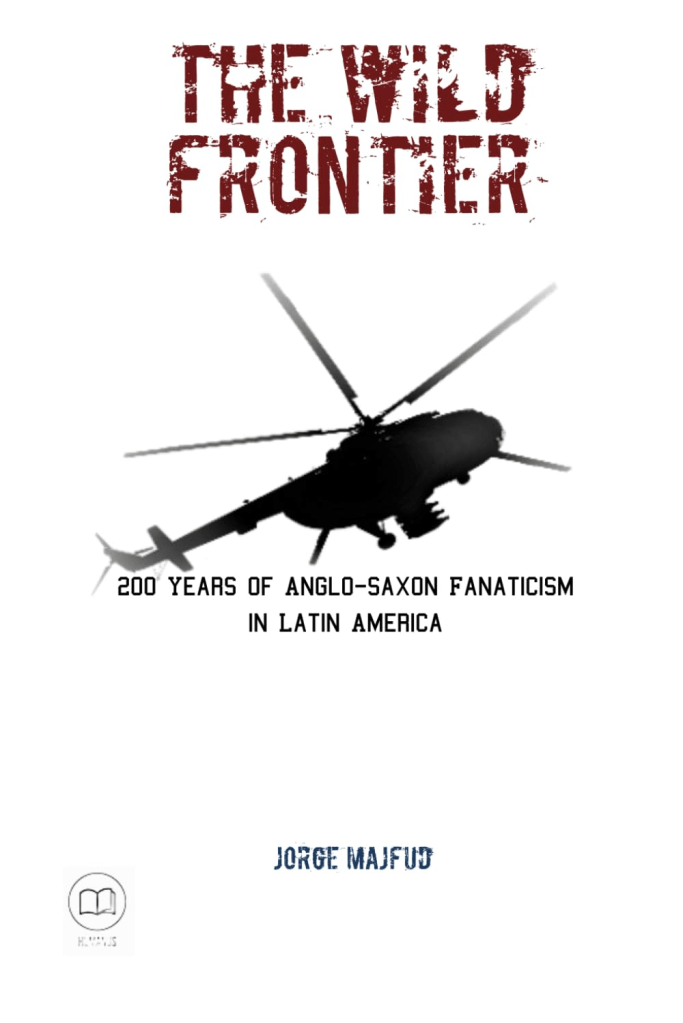




 The sacred cow of neoconservative North Americans is liberty (since according to them liberalism is a bad word), as if it had to do with an exalted concept separate from reality. In order to attain it, it would be enough to do away with or reduce everything called state and government, with the exception of the military. Hence, the strong inclination of some people for keeping guns in the hands of individuals, so that they can be used against meddling government power, whether their own or that of others.


 Escritos Críticos
Debe estar conectado para enviar un comentario.