If Latin America Had Been a British Enterprise

His family was originally from Serantes, Ferro...

Image via Wikipedia

Si América Latina hubiese sido una empresa inglesa (Spanish)

If Latin America Had Been a British Enterprise

Jorge Majfud

In the process of conducting a recent study at the University of Georgia, a female student interviewed a young Colombian woman and tape recorded the interview.  The young woman commented on her experience in England and how  the British were interested in knowing the reality of Colombia.  After she detailed the problems that her country had, one Englishman observed the paradox that England, despite being smaller and possessing fewer natural resources, was much wealthier than Colombia.  His conclusion was cutting:  “If England had managed Colombia like a business, Colombians today would be much richer.”

The Colombian youth admitted her irritation, because the comment was intended to point out  just how incapable we are in Latin America.  The lucid maturity of the young Colombian woman was evident in the course of the interview, but in that moment she could not find the words to respond to the son of the old empire.  The heat of the moment, the audacity of those British kept her from remembering that in many respects Latin America had indeed been managed like a British enterprise and that, therefore, the idea was not only far from original but, also, was part of the reason that Latin America was so poor – with the caveat that poverty is a scarcity of capital and not of historical consciousness.

Agreed: three hundred years of monopolistic, retrograde and frequently cruel colonization has weighed heavily upon the Latin American continent, and consolidated in the spirit of our nations an oppositional psychology with respect to social and political legitimation (Alberto Montaner called that cultural trait “the suspicious original legitimacy of power”).  Following the Semi-independences of the 19th century, the “progress” of the British railroad system was not only a kind of gilded cage – in the words of Eduardo Galeano -, a strait-jacket for native Latin American development, but we can see something similar in Africa: in Mozambique, for example, a country that extends North-to-South, the roads cut across it from East-to-West.  The British Empire was thus able to extract the wealth of its central colonies by passing through the Portuguese colony.  In Latin America we can still see the networks of asphalt and steel flowing together toward the ports – old bastions of the Spanish colonies that native rebels contemplated with infinite rancor from the heights of the savage sierras, and which the large land owners saw as the maximum progress possible for countries that were backward by “nature.”

Obviously, these observations do not exempt us, the Latin Americans, from assuming our own responsibilities.  We are conditioned by an economic infrastructure, but not determined by it, just as an adult is not tied irremediably to the traumas of childhood.  Certainly we must confront these days other kinds of strait-jackets, conditioning imposed on us from outside and from within, by the inevitable thirst for dominance of world powers who refuse strategic change, on the one hand, and frequently by our own culture of immobility, on the other.  For the former it is necessary to lose our innocence; for the latter we need the courage to criticize ourselves, to change ourselves and to change the world.

Translated by Bruce Campbell

* Jorge Majfud is a Uruguayan writer and professor of Latin American literature at the University of Georgia.

Propaganda and the Myth of Reconquest

Diego Rivera

Image via Wikipedia

Propaganda and the Myth of Reconquest


By Jorge Majfud

A few days ago a well-known syndicated talk radio personality repeatedly asserted an opinion that is becoming common these days:  illegal immigrants should be denounced as dishonest and criminal, not only because they have entered the U.S. illegally but, mainly, because their objective is the Reconquest.

Let’s analyze the syllogism posited here. Even assuming that illegal workers are Reconquistadors – that’s what they were called – which is to say that they lay claim to vast territories lost by Mexico to Anglo Saxon settlers in the 19th century, one would have to conclude, according to the argument of the angry sophists, that the U.S. is founded on illegitimacy and the actions of alleged criminals.  (Texas was conquered in 1836 and thereby re-established slavery in a Mexican territory where it was illegal; other Western states met the same fate, following a war with Mexico and a payment to the vanquished in the manner of a purchase, because by then money was already a powerful legitimating agent.)

Now, if a reconquest is a crime, then what is a conquest?  In any case it would be understandable to assert that this immigration phenomenon is not politically convenient (although economically it appears to be so). But, dishonest? Criminal?  Would they dare to qualify as criminal the Spanish Reconquest of the Iberian Peninsula?  No, of course not, and not because it wasn1t carried out in a bloody and racist fashion, but because in that case it was a matter of Christians against Muslims – and Jews.

Any conquest, like any reconquest, is a simple political deed that aims to hide behind morality. The legitimacy of the deed always originates from force; propaganda then takes on the task of confusing force with morality, or with exposing the contradictions to analysis. In general, the former is abused by the victors, and the latter is a meager resource of the vanquished.  Much like today, in the Middle Ages propaganda, religious and political, was indispensable.  The nobility, the upper classes, were the ones who produced the greatest quantity of nationalist propaganda, aimed at morally orienting the people. Nevertheless, both in the early years of the Muslim conquest in Spain, and later in the Spanish conquest in the Americas, the upper classes were the first to come to an agreement with the invaders in order to maintain their class and gender privileges.

Propaganda is the hook in the jaw of history.  The idea of a reconquest is a fiction for millions of expatriated workers, the forever disinherited who simply look to survive and feed their economically marginal families by recourse to a hundred-years-old, unjust, anachronistic social tradition.  But it is a strategic fiction for the propagandists who are able to use it to hide the dramatic political rationale – i.e., the rationale of power – that exists behind the moralizing discourse.

Every time I hear someone sermonizing, I lose faith. That faith to which the haranguers of the U.S. extreme right and the caudillos of Latin American liberation lay claim. The more I hear, the less I believe.  But this surely is the fault of my personal inability to enjoy what other people enjoy, like the safety of trenches dug with propaganda and self-indulgence.
Jorge Majfud, The University of Georgia. July 2006.
Translated by Bruce Campbell

The History of Immigration

Cesar Chavez Estrada

Image by Troy Holden via Flickr

The History of Immigration


by Jorge Majfud


One of the typical – correction: stereotypical – images of a Mexican has been, for more than a century, a short, drunk, trouble-maker of a man who, when not appearing with guitar in hand singing a corrido, was portrayed seated in the street taking a siesta under an enormous sombrero. This image of the perfect idler, of the irrational embodiment of vice, can be traced from old 19th century illustrations to the souvenirs that Mexicans themselves produce to satisfy the tourist industry, passing through, along the way, the comic books and cartoons of Walt Disney and Warner Bros. in the 20th century. We know that nothing is accidental; even the defenders of “innocence” in the arts, of the harmless entertainment value of film, of music and of literature, cannot keep us from pointing out the ethical significance and ideological function of the most infantile characters and the most “neutral” storylines. Of course, art is much more than a mere ideological instrument; but that does not save it from manipulation by one human group for its own benefit and to the detriment of others. Let’s at least not refer to as “art” that kind of garbage.

Ironies of history: few human groups, like the Mexicans who today live in the U.S. – and, by extension, all the other Hispanic groups, – can say that they best represent the spirit of work and sacrifice of this country. Few (North) Americans could compete with those millions of self-abnegating workers who we can see everywhere, sweating beneath the sun on the most suffocating summer days, in the cities and in the fields, pouring hot asphalt or shoveling snow off the roads, risking their lives on towering buildings under construction or while washing the windows of important offices that decide the fate of the millions of people who, in the language of postmodernity, are known as “consumers.” Not to mention their female counterparts who do the rest of the hard work – since all the work is equally “dirty” – occupying positions in which we rarely see citizens with full rights. None of which justifies the racist speech that Mexico’s president, Vicente Fox, gave recently, declaring that Mexicans in the U.S. do work that “not even black Americans want to do.” The Fox administration never retracted the statement, never recognized this “error” but rather, on the contrary, accused the rest of humanity of having “misinterpreted” his words. He then proceeded to invite a couple of “African-American” leaders (some day someone will explain to me in what sense these Americans are African), employing an old tactic: the rebel, the dissident, is neutralized with flowers, the savage beast with music, and the wage slaves with movie theaters and brothels. Certainly, it would have sufficed to avoid the adjective “black” and used “poor” instead. In truth, this semantic cosmetics would have been more intelligent but not completely free of suspicion. Capitalist ethics condemns racism, since its productive logic is indifferent to the races and, as the 19th century shows, slave trafficking was always against the interests of industrial production. Hence, anti-racist humanism has a well-established place in the hearts of nations and it is no longer so easy to eradicate it except through practices that hide behind elaborate and persuasive social discourses. Nevertheless, the same capitalist ethics approves the existence of the “poor,” and thus nobody would have been scandalized if instead of “blacks,” the Mexican president had said “poor Americans.” All of this demonstrates, meanwhile, that not only those in the economic North live off of the unhappy immigrants who risk their lives crossing the border, but also the politicians and ruling class of the economic South, who obtain, through millions of remittances, the second most important source of revenue after petroleum, by way of Western Union to the “madre pobre,” from the blood and sweat of those expelled by a system that then takes pride in them, and rewards them with such brilliant discourses that serve only to add yet another problem to their desperate lives of fugitive production.

Violence is not only physical; it is also moral. After contributing an invaluable part of the economy of this country and of the countries from which they come – and of those countries from which they were expelled by hunger, unemployment and the disfavor of corruption – the nameless men, the unidentified, must return to their overcrowded rooms for fear of being discovered as illegals. When they become sick, they simply work on, until they are at death’s door and go to a hospital where they receive aid and understanding from one morally conscious part of the population while another tries to deny it to them. This latter part includes the various anti-immigrant organizations that, with the pretext of protecting the national borders or defending the rule of law, have promoted hostile laws and attitudes which increasingly deny the human right to health or tranquility to those workers who have fallen into illegality by force of necessity, through the empire of logic of the same system that will not recognize them, a system which translates its contradictions into the dead and destroyed. Of course we can not and should not be in favor of any kind of illegality. A democracy is that system where the rules are changed, not broken. But laws are a product of a reality and of a people, they are changed or maintained according to the interests of those who have power to do so, and at times these interests can by-pass the most fundamental Human Rights. Undocumented workers will never have even the most minimal right to participate in any electoral simulacrum, neither here nor on the other side of the border: they have been born out of time and out of place, with the sole function of leaving their blood in the production process, in the maintenance of an order of privilege that repeatedly excludes them and at the same time makes use of them. Everyone knows they exist, everyone knows where they are, everyone knows where they come from and where they’re going; but nobody wants to see them. Perhaps their children will cease to be ill-born wage slaves, but by then the slaves will have died. And if there is no heaven, they will have been screwed once and forever. And if there is one and they didn’t have time to repeat one hundred times the correct words, they will be worse off still, because they will go to Hell, posthumous recognition instead of attaining the peace and oblivion so desired.

As long as the citizens, those with “true human” status, can enjoy the benefits of having servants in exchange for a minimum wage and practically no rights, threatened day and night by all kinds of haunts, they will see no need to change the laws in order to recognize a reality installed a posteriori. This seems almost logical. Nonetheless, what ceases to be “logical” – if we discard the racist ideology – are the arguments of those who accuse immigrant workers of damaging the country’s economy by making use of services like hospitalization. Naturally, these anti-immigrant groups ignore the fact that Social Security takes in the not insignificant sum of seven billion dollars a year from contributions made by illegal immigrants who, if they die before attaining legal status, will never receive a penny of the benefit. Which means fewer guests at the banquet. Nor, apparently, are they able to understand that if a businessman has a fleet of trucks he must set aside a percentage of his profits to repair the wear and tear, malfunctions and accidents arising from their use. It would be strange reasoning, above all for a capitalist businessman, to not send those trucks in for servicing in order to save on maintenance costs; or to send them in and then blame the mechanic for taking advantage of his business. Nevertheless, this is the kind and character of arguments that one reads in the newspapers and hears on television, almost daily, made by these groups of inflamed “patriots” who, despite their claims, don’t represent a public that is much more heterogeneous than it appears from the outside – millions of men and women, overlooked by simplistic anti-American rhetoric, feel and act differently, in a more humane way.

Of course, it’s not just logical thinking that fails them. They also suffer from memory loss. They have forgotten, all of a sudden, where their grandparents came from. Except, that is, for that extremely reduced ethnic group of American-Americans – I refer to the indigenous peoples who came prior to Columbus and the Mayflower, and who are the only ones never seen in the anti-immigrant groups, since among the xenophobes there is an abundance of Hispanics, not coincidentally recently “naturalized” citizens. The rest of the residents of this country have come from some part of the world other than where they now stand with their dogs, their flags, their jaws outthrust and their hunter’s binoculars, safeguarding the borders from the malodorous poor who would do them harm by attacking the purity of their national identity. Suddenly, they forget where a large part of their food and raw materials come from and under what conditions they are produced. Suddenly they forget that they are not alone in this world and that this world does not owe them more than what they owe the world.

Elsewhere I have mentioned the unknown slaves of Africa, who if indeed are poor on their own are no less unhappy for fault of others; the slaves who provide the world with the finest of chocolates and the most expensive wood without the minimal recompense that the proud market claims as Sacred Law, strategic fantasy this, that merely serves to mask the one true Law that rules the world: the law of power and interests hidden beneath the robes of morality, liberty and right. I have in my memory, etched with fire, those village youths, broken and sickly, from a remote corner of Mozambique who carried tons of tree trunks for nothing more than a pack of cigarettes. Cargo worth millions that would later appear in the ports to enrich a few white businessmen who came from abroad, while in the forests a few dead were left behind, unimportant, crushed by the trunks and ignored by the law of their own country.

Suddenly they forget or refuse to remember. Let’s not ask of them more than what they are capable of. Let’s recall briefly, for ourselves, the effect of immigration on history. From pre-history, at each step we will find movements of human beings, not from one valley to another but crossing oceans and entire continents. The “pure race” proclaimed by Hitler had not emerged through spontaneous generation or from some seed planted in the mud of the Black Forest but instead had crossed half of Asia and was surely the result of innumerable crossbreedings and of an inconvenient and denied evolution (uniting blonds with blacks) that lightened originally dark faces and put gold in their hair and emerald in their eyes. After the fall of Constantinople to the Turks, in 1453, the wave of Greeks moving into Italy initiated a great part of that economic and spiritual movement we would later know as the Rennaissance. Although generally forgotten, the immigration of Arabs and Jews would also provoke, in the sleepy Europe of the Middle Ages, different social, economic and cultural movements that the immobility of “purity” had prevented for centuries. In fact, the vocation of “purity” – racial, religious and cultural – that sunk the Spanish Empire and led it to bankrupcy several times, despite all of the gold of the Americas, was responsible for the persecution and expulsion of the (Spanish) Jews in 1492 and of the (Spanish) Arabs a century later. An expulsion which, paradoxically, benefited the Netherlands and England in a progressive process that would culminate in the Industrial Revolution. And we can say the same for our Latin American countries. If I were to limit myself to just my own country, Uruguay, I could recall the “golden years” – if there were ever years of such color – of its economic and cultural development, coinciding, not by accident, with a boom in immigration that took effect from the end of the 19th until the middle of the 20th century. Our country not only developed one of the most advanced and democratic educational systems of the period, but also, comparatively, had no cause to envy the progress of the most developed countries of the world, even though its population lacked, due to its scale, the geopolitical weight enjoyed by other countries at the time. At present, cultural immobility has precipitated an inverted migration, from the country of the children and grandchildren of immigrants to the country of the grandparents. The difference is rooted in the fact that the Europeans who fled from hunger and violence found in the Río de la Plata (and in so many other ports of Latin America) the doors wide open; their descendants, or the children and grandchildren of those who opened the doors to them, now enter Europe through the back door, although they appear to fall from the sky. And if indeed it is necessary to remember that a large part of the European population receives them happily, at a personal level, neither the laws nor general practice correspond to this good will. They aren’t even third class citizens; they are nothing and the management reserves the right to deny admission, which may mean a kick in the pants and deportation as criminals.

In order to obscure the old and irreplaceable Law of interests, it is argued – as Orian Fallaci has done so unjustly – that these are not the times of the First or Second World War and, therefore, one immigration cannot be compared to another. In fact, we know that one period can never be reduced to another, but they can indeed be compared. Or else history and memory serve no purpose. If tomorrow in Europe the same conditions of economic necessity that caused its citizens to emigrate before were to be repeated, they would quickly forget the argument that our times are not comparable to other historical periods and, hence, it’s reasonable to forget.

I understand that in a society, unlike a controlled laboratory experiment, every cause is an effect and viceversa – a cause cannot modify a social order without becoming the effect of itself or of something else. For the same reason, I understand that culture (the world of customs and ideas) influences a given economic and material order as much as the other way around. The idea of the determining infrastructure is the base of the Marxist analytical code, while the inverse (culture as a determinant of socio-economic reality) is basic for those who reacted to the fame of materialism. For the reasons mentioned above, I understand that the problem here lies in the idea of “determinism,” in either of the two senses. For its part, every culture promotes an interpretive code according to its own Interests and, in fact, does so to the measure of its own Power. A synthesis of the two approaches is also necessary for our problem. If the poverty of Mexico, for example, were only the result of a cultural “deformity” – as currently proposed by the theorists and specialists of Latin American Idiocy – the new economic necessities of Mexican immigrants to the United States would not produce workers who are more stoic and long-suffering than any others in the host country: the result would simply be “immigrant idlers.” And reality seems to show us otherwise. Certainly, as Jesus said, “there is none more blind than he who will not see.”


Translated by Bruce Campbell


Deadly Medicine: Creating the Master Race

Image for Exhibit

Deadly Medicine: Creating the Master Race

Exhibition runs December 13, 2010 through March 13, 2011
Main Library, Fourth Floor

«Nazism is applied biology.»
— Rudolf Hess, Deputy to Adolf Hitler

The Jacksonville Public Library, in partnership with United States Holocaust Memorial Museum and Remembering for the Future Community Holocaust Initiative, is honored to present Deadly Medicine: Creating the Master Race. Through compelling images, Deadly Medicine examines the Nazi regime’s collaboration with medical professionals to develop a racist ideology intended to cleanse German society of those viewed as threats to the health of the nation. A powerful visual testament to the atrocities of the Holocaust, this traveling exhibition illustrates how German doctors, scientists and public health officials legitimized persecution and genocide through pseudo-scientific eugenics programs.

Deadly Medicine is based on an acclaimed 2004 exhibition of the same name that opened at the United States Holocaust Memorial Museum in Washington, DC. Since then, versions of the exhibition have traveled to Canada, Germany and across the United States. Deadly Medicine has been made possible by The Lerner Foundation and Eric F. and Lore Ross.

Visit the online companion to Deadly Medicine at www.ushmm.org/deadlymedicine

The local exhibition is sponsored by the Jacksonville Public Library, Friends of the Jacksonville Public Library, Fanny Landwirth Foundation,
Mr. Jay Stein/Stein Mart Inc. and Remembering for the Future Community Holocaust Initiative.

Location and Hours

Time: Daily, during regular library operating hours. Closed for major holidays.
Location: Jacksonville Main Library, 303 N. Laura Street, Jacksonville, Florida
Lecture Series, Presented by Remembering for the Future Community Holocaust Initiative

Deadly Medicine’s companion lecture series extends the exhibition’s dialog into our community, bringing together experts and thinkers to explore issues that are still as relevant as ever. The lecture series includes presentations at the University of North Florida, Jacksonville University, Florida State College at Jacksonville, the Schultz Center for Teaching and Leadership and Florida Coastal School of Law.

Schedule of Events

Thursday, February 17, 2011
Panel: Complicity & Resistance in a Controlled Society—This discussion explores the decision to comply with and the decision to resist the established order from the perspectives of business, sociology, literature, philosophy, the military, and the sciences.
Moderator: Douglas M. Hazzard, Ph.D., Dean, College of Arts & Sciences, Jacksonville University
Time: Program at 7:00 p.m.
Location: Terry Concert Hall, Jacksonville University
Panelists:
Business: Joe Buck, Ph.D.
It’s Only Business: Cooperation & Denial in International ConflictSociology: Nathan Rousseau, Ph.D.
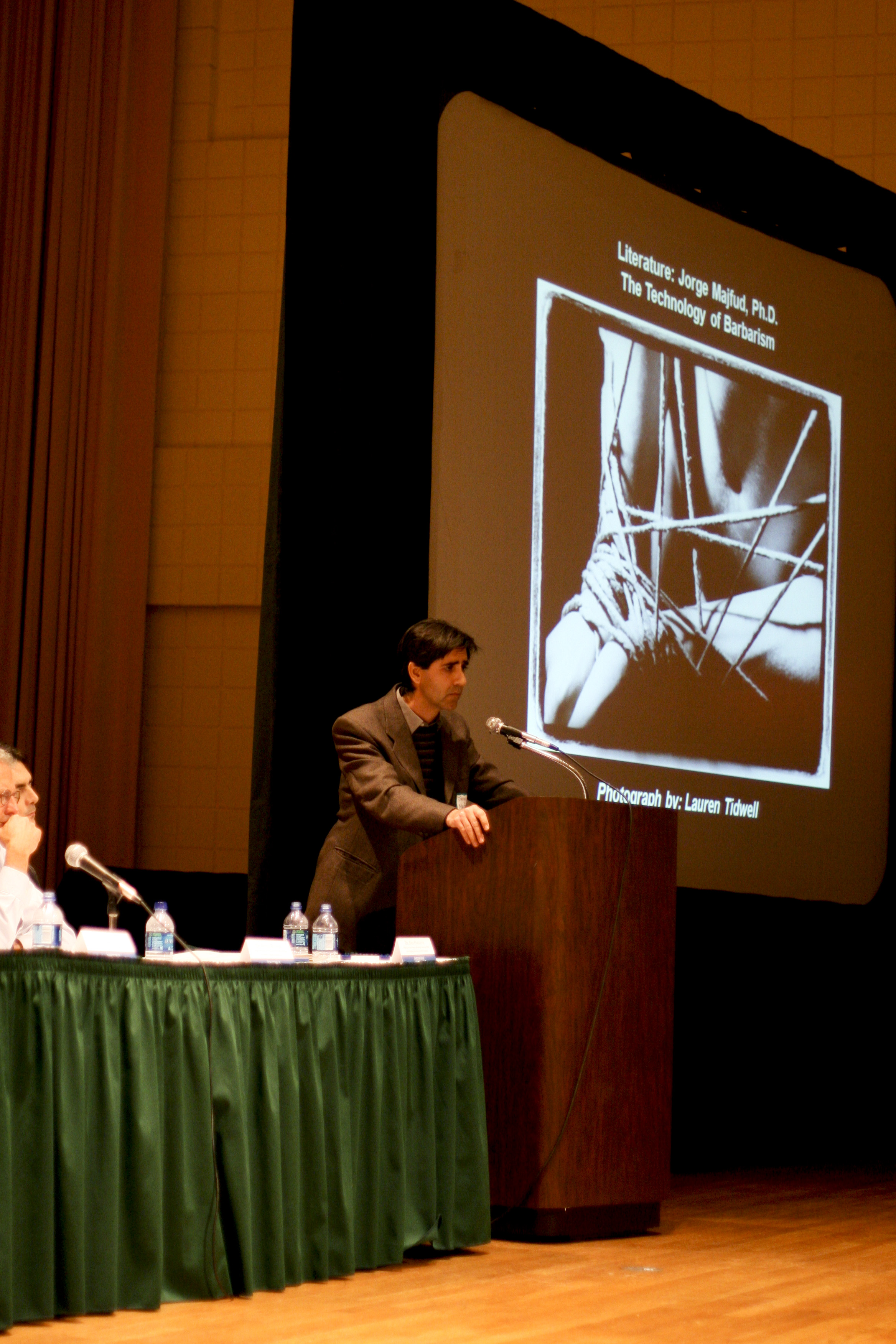
The Intrinsic Dangers of BureaucracyLiterature: Jorge Majfud, Ph.D.
The Technology of BarbarismPhilosopy: Scott Kimbrough, Ph.D.
The Capacity for EvilThe Military: Captain Lee Steele, USN
Abu Ghraib – What Went WrongHistory: Lois Becker, Ph.D.
Everyday Complicity & Resistance in Stalinist russiaThe Sciences: Andy Ouellette, Ph.D.
DNA Profiling and a Universal DNA database
Monday, February 28, 2011
Stand Up/Speak Out: Dismantling Structural and Institutional Racism in Healthcare
Time: Reception at 5:30 p.m., Program at 7:00 p.m.
Location: Florida State College at Jacksonville, Downtown Campus, Advanced Technology Center, T-140
Reservations required due to limited seating.
To RSVP, contact Brenda Sapp at (904) 899-6300 X4113 or bsapp@rrhs.org
Tuesday, March 8, 2011
Panel: Neo-Nazis and Others: the Hate Continues—Hatred and persecution did not disappear with the defeat of Hitler and the end of World War II. According to the Southern Poverty Law Center, there are 932 known hate groups operating across the country, including neo-Nazis, Klansmen, white nationalists, neo-Confederates, racist skinheads, black separatists, border vigilantes and others. And their numbers are growing. Panelists will discuss Jacksonville’s need for a campaign of awareness and action that will unite our community to confront prejudice, hate speech and violence, promote democratic ideals and strengthen pluralism.
Time: Reception at 6:00 p.m.; Program at 7:00 p.m.
Location:Atrium, Florida Coastal School of Law
Moderator: Joanmarie Ilaria Davoli, Associate Professor of Law, Florida Coastal School of Law
Panelists:
Robert Tanen
Associate Regional Director, Florida
Anti-Defamation LeagueMark Brutnell
Special Agent Supervisor
Jacksonville Regional Operations Center
Florida Department of Law EnforcementAlex Silverstein
Special Agent
Federal Bureau of InvestigationBobby Lyle
Sergeant
Intelligence/Special Investigations Unit
Jacksonville Sheriff’s OfficeNareissa L. Smith
Assistant Professor of Law
Florida Coastal School of Law
Informed Consent in Research and Mental Health Medicine

Details TBA

About Remembering for the Future Community Holocaust Initiative

Remembering for the Future is a collaborative partnership of community organizations and individuals that has promoted Holocaust education and remembrance in Northeast Florida since 2004. For more information, call (904) 246-0457.

The Holocaust Collection
Jacksonville Public Library
“Deadly Medicine: Creating the Master Race” Exhibit
Bibliography With Links to the Jacksonville Public Library Online Catalog


<a href="http://jpl.coj.net/progs/main/deadly-medicine.html&quot; target="_blank"><span style="color: #000000;">[/source]

Complicity and Resistance in a Controlled Society

El pase de diapositivas requiere JavaScript.

Pictures: Yoana Kochneva,  Assistant Designer.

JU Hosted Panel Discussion on Lessons and Topics surrounding the Holocaust on Feb. 17

Jacksonville University and Remembering for the Future Community Holocaust Initiative presented “Complicity & Resistance in a Controlled Society” on Thursday, February 17 at 7 p.m. in Terry Concert Hall on campus.

The event, which was moderated by Dr. Douglas Hazzard, dean of the College of Arts and Sciences, was part of the Future’s 2011 lecture series which engages experts and the public in a discussion of some of the most important questions we face today on medical ethics, eugenics, perceptions of disability and diversity.

The following JU faculty and administrators presented at the event:

Dr. Andy Quellette, “DNA Profiling and a Universal DNA Database;” Dr. Nathan Rousseau, “The Intrinsic Dangers of Bureaucracy;” Dr. John Buck, “It’s Only Business: Cooperation & Denial in International Conflict;” Dr. Lois Becker, “Everyday Complicity & Resistance in Stalinist Russia;” Captain Lee Steele, USN, “Abu Ghraib—What Went Wrong;” Dr. Jorge Majfud, “The Technology of Barbarism;” and Dr. Scott Kimbrough, “The Capacity for Evil.”

There was also a photographic works on display, which were created by JU photography program students Jesse Brantman, Elise Gates, Ross Howard, Taylor Middleton, Dustin Mollohan, Suvarna Shah and Lauren Tidwell, under the direction of Ginger Sheridan, assistant professor of photography. Each student interviewed a Complicity and Resistance program panelist, and then created a small series of Modernist, B&W photographs expressing the photographer’s internal response to their speaker’s theme using abstract expressionist vocabulary.

ABOUT REMEMBERING FOR THE FUTURE
Remembering for the Future Community Holocaust Initiative uses the lessons of the Holocaust to confront hatred and discrimination and build understanding and acceptance throughout our community. Working together since 2004, we are a collaborative partnership of Jacksonville’s leading education, humanitarian, non-profit and government organizations, businesses and community leaders.

[read more >>]


Alfonso el Sabio: Primera crónica general de España

Jorge Majfud’s books at Amazon>>


Folleto de un manuscrito de la Estoria de Espa...

Image via Wikipedia

Libros: regreso a las fuentes

Alfonso el Sabio: Primera crónica general de España

Alfonso X el Sabio: Primera crónica general de España que mandó componer Alfonso el Sabio y se continuaba bajo Sancho IV en 1289. Edición de Ramón Menéndez Pidal. Madrid: Gredos, 1955.

En menos de mil páginas, estos volúmenes narran desde la historia romana hasta la peninsular de reyes godos, árabes, y visigodos. Los hechos no se fundan en pruebas, documentos o especulaciones históricas sino en una variada tradición literaria y probablemente oral también. Obviamente, estos textos con ocho siglos de antigüedad, en su gramática casi original, son una fuente inagotable de datos y curiosidades lingüísticas y ortográficas, como el uso de “cuedaron” (quedaron), “quando” (cuando), de “e” en lugar de “y” y de “y” en lugar de “ahí” o las clásicas “Espanna”, “danno”, “señor” o “anno”. Es de sospechar que la “ñ” surgió para evitar la doble ene que tomaba mucho espacio en el valioso papel de las imprentas posteriores. Pero también abundan en otras curiosidades menos formales.

En una mezcla de ficción y realidad mucho más evidente para un lector contemporáneo que las crónicas de nuestro tiempo, los historiadores de Alfonso recorren, como si rescataran, historias de luchas entre persas y moros, de los árabes que conquistaron tierras africanas para su “secta” (278), de luchas entre moros y romanos, sobre la expulsión de los judíos por parte de los godos (folio 176, 284), sobre Gunderigo, el primer rey vándalo que reinó Galicia y Asturias y pobló Lugo (295) y sobre los “bárbaros de Affrica” (308). Con realismo extremo, se relata la entrada luminosa de un grupo de santos a una iglesia, hasta que el obispo se desmayó. Eran “San Pedro et San Paulo” (279).

En esta narración oficial, los godos se distinguen por su valor contra los vándalos, lo que los lleva a conquistar brevemente África y Asia. Como todos los pueblos, los godos fueron valientes porque vencieron, hasta que fueron vencidos (287).

Poco a poco y a través de las tinieblas de mil años, vamos descubriendo detalles sobre virtudes, infortunios y traiciones de reyes y obispos. Por entonces no se usaban los modernos números arábigos de hoy; los años de cada Era se indicaban escribiendo el nombre del número, “seyscientos et quarenta et quatro”. No obstante cada “estoria”, es vaga, sin datos ni fuentes, como si los escribientes del rey tocaran de oído. Por momentos, los mismos redactores encuentran ciertos períodos más bien aburridos y reconocen que “non fallamos ninguna cosa que de contar sea que a la estoria pertenezca”(282).

No hay ideas explícitas ni complejas sino un catálogo de personajes que en su momento no necesitaron presentaciones, como el obispo de Çaragoça o “Sant Alfonso boca doro”, sobrenombre de un arzobispo de Toledo muerto en 674 (283). En una época de épicas tampoco abunda la acción narrativa. Como si el propósito original hubiese sido rescatar hechos aislados o fundar los hechos futuros y no convertirse en un fenómeno de ventas como las cartas del conquistador Hernán Cortés en el siglo XVI o del aprendiz de brujo Harry Potter en el siglo XXI.

Pero si afinamos la lectura vamos descubriendo el realismo de la época, según el cual, en tiempos de Theodisto, natural de Grecia y políglota, “no se encontraba en toda España un hombre malo ni descreído.” Theodisto, no obstante, tenía maneras amables y corazón de lobo: sacó las cosas “verdaderas” de los libros y puso las “falsas” haciendo traducir del griego al árabe libros de ciencia (278). Sólo este dato es evidencia de un rasgo que caracterizará la revolución humanista más tarde, aunque con un objstivo diferente: el autor no es la autoridad; leer no es necesariamente descifrar la verdad univoca que baja del autor, el creador, confundido con Dios. La palabra humana, tanto vela como devela, tanto cubre como descubre.

Por supuesto, las referencias a las Sanctas Escripturas y a la religión son permanentes. La imagen de los hombres buenos en abundancia es idílica. Hasta que en algún momento comenzaron a aparecer algunos hombres malos en España, entre ellos dos herejes, Eluidio y Pelayo, quienes especularon sobre la virginidad de María, enseñando “errores”. Todavía no eran tiempos de Calvino, Torquemada o del General Francisco Franco por lo que los herejes no eran quemados ni ejecutados. Fueron “corridos de Espanna” (281).

A lo largo de estas antiguas páginas también vemos el poco prestigio que tenían unos cuantos reyes. La queja sobre la autoridad parece ser un tópico antiguo, aunque en la Era moderna los españoles y los americanos colonizados la descargarán casi toda en los mandos medios, exculpando pudorosa o estratégicamente al mismo rey.

Aunque Paulo se alzó contra los moros, era un mal rey que el noble pueblo godo no mereció. Su reinado se caracterizó por el caos, donde sus mismos hombres luchan y se matan entre sí hasta que es derrotado y encarcelado junto con sus seguidores. Ante el clamor de su gente, el arzobispo intercede y ruega el perdón del rey Bamba. El simulacro de tropas francesas que debían ir al rescate del rey cristiano es descubierto por Bamba. El rescate fracasa, Bamba perdona la vida de Paulo pero lo encierra. A los franceses y alemanes los perdona y a las dos semanas los extradita a sus tierras.

El rey Bamba expulsa también a los judíos y es representado como sabio y pacificador, a pesar de que dos leguas antes de llegar a Toledo, hace cortar las barbas y sacar los “oios” de Paulo y sus seguidores. Bamba entra triunfante en Toledo y mejora la vida de sus habitantes. En el “anno 717”, ordena poner a la entrada de la ciudad inscripciones de mármol en latín: Vamba… Deo rex. (294). Algo así como el recurrente “Rey por la gracia de Dios” del que echó mano el mismo generalísimo Franco en el siglo XX.

Por varias páginas, los escribas del rey Alfonso detallan los nombres de los arzobispados y los obispos que le han de obedecer a Bamba, a partir de un Concilio hecho por el mismo interesado. La abundancia de nombres, como si fuese un escrito administrativo, demuestra el valor político y administrativo de la Iglesia de la época.

Luego de nueve años de reinado, en el año 722, envenenan al rey Bamba con una yerba en el vino. Como consecuencia el rey pierde la memoria, por lo cual es retirado a un monasterio donde vive siete años más.

Varios datos nos pintan la moral de la época. Por ejemplo, los escribas mencionan a Julian, un arzobispo de Toledo que era de origen iudio. Por su piedad “salió de entre los judíos como sale la roza de entre las espinas” (301). Mencionan también al famoso rey Vitzia. Famoso por licencioso y muy bien reconocido por sus vicios: en el año 740 ordenó que los obispos podrían tener tantas mujeres como quisieran. A juzgar por esta historia oficial, era común mandar sacar los ojos de los enemigos. Lo mismo que hizo Bamba con sus derrotados, hace Vitzia con otros. Otro “pecado” que se le atribuye es haber dejado volver a los judíos y darle más privilegios que a la iglesia (306).

Jorge Majfud

Milenio (México)


Jorge Majfud’s books at Amazon>>

La irrelevancia de la razón “¿Cómo Dios pudo permitir que sucediera esto?”

1963 Spanish peseta coin with the image of Fra...

Image via Wikipedia

La irrelevancia de la razón

“¿Cómo Dios pudo permitir que sucediera esto?”

En 1974 Jorge Luis Borges le comentó a Ernesto Sábato que a su juicio bastaba con un dolor de muelas para negar la existencia de un Dios todopoderoso. Esta observación sería rigurosamente cierta si consideramos que el Todopoderoso es, al mismo tiempo, Todobondadoso. Si Dios permite que ocurra en el mundo un solo gramo de mal es porque quiere que ocurra o no puede evitarlo. Si de verdad existe una lucha del Bien contra el Mal, entonces Dios aún no domina su propia creación o no quiere hacerlo. O es, como dice Isaías (45-6): “Fuera de mí no hay ningún otro. Yo modelo la luz y creo la tiniebla, Yo creo la dicha y la desgracia. Yo soy Yahve, el que hago todo”. También Pedro Abelardo, después de justificar la traición de Judas con las propias Escrituras, escribió, no sin fisuras: “¿quién ignora que el mismo diablo no hace más de lo que Dios le permite? […] El poder lo recibe de Dios; la voluntad, en cambio, le viene de sí mismo”.

La idea de un dios todopoderoso y desprovisto de un solo gramo de maldad es imposible para la lógica. Pero no demuestra su inexistencia, ya que un ser perfecto debe ser in-inteligible para los mortales. Por otra parte, Dios no es una proposición científicamente refutable, al decir de Karl Popper.

De cualquier forma, una discusión teológica es como una partida de ajedrez: sus conexiones con el mundo exterior son irrelevantes. La religión es lo contrario: es una forma de acción, muchas veces política, pocas veces metafísica, aunque con frecuencia se sirve de las interminables e inconducentes discusiones teológicas.

Es extraño que algunos consideren que el ateísmo es una posición científica y no una postura religiosa como cualquier otra. Pero no es menos extraño que los religiosos, que reniegan de cualquier teoría que prescinde de alguna intervención supranatural, no descansan en su absurda obsesión por demostrar la verdad contenida en las Sagradas Escrituras. No aceptan que cualquier página considerada sagrada en cualquier religión deja de ser un objeto de fe en el preciso momento en que se convierte en un hecho científicamente demostrado. Si algo es, o parece absurdo (como poner a todas las especies del planeta en un barco y luego negar siquiera la posibilidad de que los millones de especies que hoy lo habitan fueron consecuencia de alguna evolución) y usted literalmente cree en ello, ¿qué mejor prueba de su santidad?

Más consecuentes son quienes consideran o reconocen que uno no puede comprender (completamente) los designios de Dios.

No obstante, cada vez que en el mundo ocurre una catástrofe, como el terremoto en Japón o el huracán Katrina en Nueva Orléans, se reavivan las discusiones teológicas. En algunos países como Estados Unidos, una poderosa minoría ha secuestrado el discurso social con sus amenazas patoteológicas. En el mejor de los casos, los más civilizados, apenas conocen a alguien preguntan “¿a qué iglesia va usted los domingos?”; no si uno va a alguna iglesia.

Cuando no estoy cansado respondo, “no voy a ninguna iglesia, señora, Dios me libre”. Lo cual no es del todo cierto, porque cuando paso por algún templo que me inspira, entro con permiso.

“¿Entonces, no cree usted en Dios?”.

“Creo que sí, aunque nunca le pido prosperidad ni me persigno para que mi equipo de fútbol gane. Lo único que le pido siempre a Dios es que exista”.

“¿Cómo es posible creer en Dios y no tener iglesia?”, más de una vez me han preguntado en este país, con los ojos más abiertos de lo necesario.

Con frecuencia se cita el momento que en el programa de televisión The Early Show de Nueva York, la periodista Jane Clayson le preguntó a la hija del célebre telepastor Billy Graham sobre los atentados del 11 de setiembre de 2001 en Nueva York:

“¿Cómo pudo Dios permitir que sucediera esto?”, inquirió, lo que recuerda el conocido cuestionamiento sobre Auschwitz.

La hija del pastor respondió:

“Al igual que nosotros, creo que Dios está profundamente triste por este suceso, pero durante años hemos estado diciéndole que salga de nuestras escuelas, que salga de nuestro gobierno y que salga de nuestras vidas. Y siendo el caballero que es, creo que Dios ha resuelto retirarse. ¿Cómo podemos esperar que Dios nos dé Su bendición y Su protección cuando le hemos exigido que nos deje solos?”

En todo el mundo se repitió, no sin emoción y lágrimas, este momento como “una respuesta profunda y sabia que dejó muda a Jane Clayson”.

Sin duda que hay que tener una fe muy profunda para creer que el creador del Universo actúa como un niño resentido unas veces o como un amante celoso otras. Pero esto es una cuestión de opinión. Lo que no es materia de discusión es el hecho de que los terroristas que perpetraron los atentados del 11 de setiembre tenían la misma opinión de Virginia Graham Foreman. Sobre todo, odiaban el tipo de decadencia humanista y secular que por mucho tiempo caracterizó el experimento histórico de este país, que las teocracias odiaron y que las nuevas republicas iberoamericanas intentaron copiar en el siglo XIX. Sus “padres fundadores” no fueron religiosos conservadores como cree la mayoría de los norteamericanos (¿cómo un conservador puede hacer algo revolucionario como fundar un país diferente o una nueva religión?) sino una elite de políticos humanistas que había diseñado y logrado, por primera vez, un gobierno y un Estado separado, por ley y en sus prácticas, de todo tipo de injerencia religiosa. Y por primera vez, un Estado que se fundase, al menos en teoría, en la igualdad como paradigma. No porque odiaran a Dios sino porque creían en el derecho a la libertad de los individuos (antes de excluir a los esclavos) y en un tipo radical, para la época, de democracia moderna como alternativa a las teocracias y las monarquías absolutistas.

Salvo algunos teólogos, los predicadores no necesitan ser racionales. Les basta con un par de aforismos para niños porque saben que los respalda la fe ciega de quienes lo siguen. Más que el Amor los protege el Miedo. Así logran confundir a Dios con sus propias religiones y las opiniones de sus pastores y sacerdotes con la opinión más reciente de Dios.

También Torquemada fue llamado “luz de España y el salvador del país” por enviar a la hoguera a los herejes. También Francisco Franco acuñó monedas que rezaban “Caudillo de España por la gracia de Dios” por el mismo mérito. Lo que prueba que hay amores que matan.

Pero no juzguemos a Dios por sus seguidores.

Claro que el racionalismo de los últimos tres siglos se convirtió en otra forma de fanatismo; también religioso, si se quiere. Pero tampoco fue culpa de la Razón sino de una reacción ciega que terminó negando todo lo irracional y espiritual que también forman parte de la condición humana.

En los países occidentales de hoy, la mayoría con gobiernos e instituciones públicas basadas en las ideas humanistas de libertad y laicidad, ya no se pueden quemar individuos por razones de opinión. Al menos no sin una buena excusa. Esto no fue un logro de ninguna religión sino a pesar de casi todas las religiones del momento. Fue un logro de los humanistas que lentamente liquidaron las teocracias y el fanatismo religioso que poco o nada tenían que ver con Dios.

Jorge Majfud

marzo 2011

Jacksonville University

majfud.org

Milenio (México)


The Importance of Being Called an Idiot

Mario Vargas Llosa

Image via Wikipedia

¿ Cómo definimos la idiotez ideológica? (Spanish)

The Importance of Being Called an Idiot


Jorge Majfud


A few days ago a gentleman recommended that I read a new book about idiocy.  I  believe it was called The Return of the Idiot, The Idiot Returns, or something like that.  I told him that I had read a similar book ten years ago, titled Manual for the Perfect Latinamerican Idiot.

“What did you think?” the man asked me narrowing his eyes, kind of scrutinizing my reaction, kind of measuring the time it took me to respond.  I always take a few seconds to respond.  I also like to observe the things around me, take a healthy distance, control the temptation to exercise my freedom and, kindly, go after the guy.

“What did I think?  Entertaining.  A famous writer who uses his fists against his colleagues as his principal dialectical weapon when he has them within reach, said that it was a book with a lot of humor, edifying… I would not say so much.  Entertaining is sufficient.  Clearly there are better books.”

“Yes, that was the father of one of the authors, the Nobel Vargas Llosa.”

“Mario, he is still called Mario.”

“Fine, but what did you think about the book?” he insisted anxiously.

Perhaps he was not so interested in my opinion as he was in his own.

“Someone asked me the same question ten years ago”, I recalled.  “I thought it deserved to be a best seller.”

“That’s what I said.  And it was, it was; in effect, it was a best seller.  You realized that pretty quick, like me.

“It wasn’t so difficult.  In the first place, it was written by experts on the topic.”

“Undoubtedly”, he interrupted, with contagious enthusiasm.

“Who better to write about idiocy, am I right?  Second, the authors are staunch defenders of the market, above all else.  I sell, I consume, therefore I am.  What other  merit could they have but to turn a book into a sales success?  If it were an excellent book with limited sales it would be a contradiction.  I suppose that for the publisher it’s also not a contradiction that they have sold so many books on the Idiot Continent, right?  In the intelligent and successful countries it did not have the same reception.”

For some reason the man in the red tie sensed some doubts on my part about the virtues of his favorite books.  That meant, for him, a declaration of war or something of the kind.  I made a friendly gesture to bid farewell, but he did not allow me to place my hand on his shoulder.

“You must be one of those who defend those idiotic ideas of which those books speak.  It is incredible that a cultured and educated man like yourself could uphold those stupidities.”

“Could it be that too much studying and researching cause damage?” I asked.

“No, studying doesn’t do damage, of course not.  The problem is that you are separated from reality, you don’t know what it is to live like a construction worker or business manager, like us.”

“Nonetheless, there are construction workers and business managers who think radically differently from you.  Might there not be another factor?  That is, for example, could it be that those who have ideas like yours are more intelligent?”

“Ah, yes, that must be…”

His euphoria had reached climax.  I was going to leave him with that little vanity, but I couldn’t contain myself.  I thought out loud:

“It’s quite strange.  The most intelligent people don’t need idiots like me to realize such obvious things, no?”

“Negative, sir. Negative.”


Translated by Bruce Campbell


The Rebellion of the Readers, Key to Our Century

Portrait of Erasmus of Rotterdam, 1523. Oil an...

Image via Wikipedia

La rebelión de los lectores (Spanish)

The Rebellion of the Readers,

Key to Our Century

Jorge Majfud

Among the most frequented sites for tourists in Europe are the Gothic cathedrals.  Gothic spaces, so different from the Romanesque of centuries before, tend to impress us through the subtlety of their aesthetic, something they share with the ancient architecture of the old Arab empire.  Perhaps what is most overlooked is the reason for the reliefs on the facades.  Although the Bible condemns the custom of representing human figures, these abound on the stones, on the walls and on the stained glass.  The reason is, more than aesthetic, symbolic and narrative.

In a culture of illiterates, orality was the mainstay of communication, of history and of social control.  Although Christianity was based on the Scriptures, writing was least abundant.  Just as in our current culture, social power was constructed on the basis of written culture, while the working classes had to resign themselves to listening.  Books were not only rare, almost original pieces, but were jealously guarded by those who administered political power and the politics of God.  Writing and reading were nearly exclusively the patrimony of the nobility; listening and obeying was the function of the masses.  That is to say, the nobility was always noble because the vulgate was very vulgar.  For the same reason, the masses, illiterate, went every Sunday to listen to the priest read and interpret sacred texts at his whim – the official whim – and confirm the truth of these interpretations in another kind of visual interpretation: the icons and relief sculptures that illustrated the sacred history on the walls of stone.

The oral culture of the Middle Ages begins to change in that moment we call Humanism and that is more commonly taught as the Renaissance.  The demand for written texts is accelerated long before Johannes Gutenberg invented the printing press in 1450.  In fact, Gutenberg did not invent the printing press, but a technique for movable type that accelerated even more this process of reproduction of texts and massification of readers.  The invention was a technical response to a historical need.  This is the century of the emigration of Turkish and Greek scholars to Italy, of the travel by Europeans to the Middle East without the blindness of a new crusade. Perhaps, it is also the moment in which Western and Christian culture turns toward the humanism that survives today, while Islamic culture, which had been characterized by this same humanism and by plurality of non-religious knowledge, makes an inverse, reactionary turn.

The following century, the 16th, would be the century of the Protestant Reform.  Although centuries later it would become a conservative fore, it birth – like the birth of all religion – arises from a rebellion against authority.  In this case, against the authority of the Vatican.  Luther, however, is not the first to exercise this rebellion, but the humanist Catholics themselves who were disillusioned and in disagreement with the arbitrariness of the Church’s political power.  This disagreement was justified by the corruption of the Vatican, but it is likely that the difference was rooted in a new way of perceiving an old theocratic order.

Protestantism, as the word itself says, is – was – a disobedient response to an established power.  One of its particularities was the radicalization of written culture over oral culture, the independence of the reader instead of the obedient listener.  Not only was the Vulgate, the Latin translation of the sacred texts, questioned; the authority of the sermon moved to the direct, or almost direct, reading of the sacred text that had been translated into vulgar languages, the languages of the people.  The use of a dead language like Latin confirmed the hermetic elitism of religion (philosophy and science would abandon this usage long before).  From this moment on, the oral tradition of Catholicism will continually lose strength and authority.  It will have, nevertheless, several rebirths, especially in Franco’s Spain.  Professor of ethics José Luis Aranguren, for example, who made a number of progressive historical observations, was not free from the strong tradition that surrounded him.  In Catolicismo y protestantismo como formas de existencia (Catholicism and Protestantism as Forms of Existence) he was explicit: “Christianity should not be a ‘reader’ but a ‘listener’ of the Word, and ‘hearing it’ is a much as ‘living it.’” (1952)

We can understand that the culture of orality and obedience had a revival with the invention of the radio and of television.  Let’s remember that the radio was the principal instrument of the Nazis in Germany of the pre-war period.  Film and other techniques of spectacle were also important, although in lesser measure.  Almost nobody had read that mediocre little book called Mein Campf (its original title was Against Lying, Stupidity and Cowardice) but everyone participated in the media explosion that was produced with the expansion of radio.  During the entire 20th century, first film and later television were the omnipresent channels of US culture.  Because of them, not only was an aesthetic modeled but, through this aesthetic, an ethics and an ideology, the capitalist ideology.

In great measure, we can consider the 20th century to be a regression to the culture of the cathedrals: orality and the use of the image as means for narrating history, the present and the future.  News media, more than informative have been and continue to be formative of opinion, true pulpits – in form and in content – that describe and interpret a reality that is difficult to question.  The idea of the objective camera is almost uncontestable, like in the Middle Ages when no one or very few opposed the true existence of demons and fantastical stories represented on the stones of the cathedrals.

In a society where the governments depend on popular support, the creation and manipulation of public opinion is more important and must be more sophisticated than in a crude dictatorship.  It is for this reason that television news media have become a battlefield where only one side is armed.  If the main weapons in this war are the radio and television channels, their munitions are the ideolexicons.  For example, the ideolexicon radical, which is encountered with a negative value, must always be applied, by association and repetition, to the opponent.  What is paradoxical is that radical thought is condemned – all serious thought is radical – at the same time that a radical action is promoted against that supposed radicalism.  That is to say, one stigmatizes the critics that go beyond politically correct thinking when these critics point out the violence of a radical action, such as a war, a coup d’etat, the militarization of a society, etc.  In the old dictatorships of our America, for example, the custom was to persecute and assassinate every journalist, priest, activist or unionist identified as radical.  To protest or throw stones was the behavior of radicals; torturing and killing in a systematic manner was the main resource of the moderates.  Today, throughout the world, official discourse speaks of radicals when referring to anyone who disagrees with official ideology.

Nothing in history happens by chance, even though causes are located more in the future than in the past.  It is not by accident that today we are entering into a new era of written culture that is, in great measure, the main instrument of intellectual disobedience of the nations.  Two centuries ago reading meant a lecture or sermon from the pulpit; today it is the opposite: to read means an effort at interpretation, and a text is no longer only a piece of writing but any symbolic organization of reality that transmits and conceals values and meanings.

One of the principal physical platforms for that new attitude is the Internet, and its procedure consists of beginning to rewrite history at the margins of the traditional media of visual imposition.  Its chaos is only apparent.  Although the Intenet also includes images and sounds, these are no longer products that are received but symbols that are searched for and produced in an exercise of reading.

In the measure that the economic powers that be, corporations of all kinds, lose their monopoly on the production of works of art – like film – or the production of that other genre of school desk fiction, the daily sermon where the meaning of reality is managed – the so-called news media – individuals and nations begin to develop a more critical awareness, which naturally is a disobedient state of mind.  Perhaps in the future, we might even be speaking of the end of national empires and the inefficacy of military force.  This new culture leads to a progressive inversion of social control: top-down control is converted to the more democratic control from the bottom up.  The so-called democratic governments and the old style dictatorships do not tolerate this because they are democratic or benevolent but because direct censorship of a process that is unstoppable is not convenient to them.  They can only limit themselves to reacting and delaying as long as possible, by recourse to the old tool of physical violence, the downfall of their sectarian empires.

Translated by Bruce Campbell

Virginia Tech: an ideo-lexical analysis of a tragedy

One of the war memorial pylons on a snowy day ...

Image via Wikipedia

Análisis ideoléxico de una tragedia (Spanish)


Virginia Tech: an ideo-lexical analysis of a tragedy

By Jorge Majfud

Most of the medicines that it is sold as pills cover a certain drug, chemic or compound with a coat that has an attractive color and a sweet taste. In Spanish, popular wisdom uses this characteristic to build a metaphor: “to swallow the pill” has a negative meaning and expresses the action of taking something with the shape or the taste of something else. That means, to believe or accept a truth as an unquestionable event without being conscious of the true implications. In literary tradition this epistemological phenomena is understood with the Troy Horse metaphor, which is also still use to name some computer viruses. An ideo-lexical may be understood as a pill prescribed and imposed by an hegemonic discourse with a seducing violence. For example, the ideo-lexical freedom is covered by a plethora of common and sweetly positive places (freedom, as a universal precept is so).

However, within this sweet and brilliant cover there are the true reasons behind the actions: domination, oppression, violence against sectarian interests, etc. The sweet and brilliant cover annuls the perception of its opposites: the sour and opaque content.

The job of the critic is to break the cover, to discover, to reveal the content of the pill, of the ideo-lexical. Of course, this job has bitter results, just like the center of the pill. Those who are addicted to a drug do not renounce to it just because someone might discover the grave implications of their momentary comfort. In fact, they will try to resist this operation of exposition.

Let us analyze a common ideo-lexical in the dominating discourse of late capitalism: personal responsibility. To start of we notice that its cover is totally sweet and brilliant. Who would be capable of arguing the value of the responsibility of each individual? A possible question would be quickly annulled by a fake alternative: irresponsibility. But we may start by taking the new fake dilemma as the problem by observing that the adjective itself-personal-of this compound ideo-lexical annuls or anesthetizes another one which is less common and harder to appreciate by the senses: the possibility of the existence of a “social responsibility” is never mentioned. It is also never mentioned or accepted-due to a long religious tradition-that there might be “social sins.”

Let us go deeper in a specific case: the tragic massacre which took place at the Virginia Tech University. Those people who—shyly, as ever—placed their accusing finger in the weapons culture from the United States, were criticized in the name of the personal responsibility ideo-lexical. “Weapons are not what kill people-commented a friend of the rifle in a newspaper-people are who kill people. The problem is the people, not the weapons.” The pill shows a high level of obviousness, but there are again some other problems: nobody questioned how some crazy man could kill thirty people with a stone, with a stick or even with a knife.

This logic is expressed by covering an internal contradiction in the discourse. When we talk about drugs, we are blaming the producers, not the consumers. But when we talk about weapons, we are blaming the consumers, not the producers. The reason is to be found, I believe, in the place where power is to be found. In the case of drugs, the producers are the others, not us; in the case of the weapons, the consumers are the other; we are only producing them. The hegemonic discourse never mentions that if there were no drug consumption in the wealthy countries there would be no production to satisfy that demand; if there was no illegality there would also never exist the mafia groups of drug dealers. Or at least, their existence would be minimal, compared to what we have today. But because the others (the producers from the poor countries) are individually responsible, we (the producers of weapons, who are responsible of administrating the law) are legitimized to produce more weapons which should be consumed by the others to back up the law-and to break it.

If someone like the Virginia Tech murder buys a couple of guns more easily and a hundred times faster than you can buy a car and commits a massacre, the responsibility is completely of the madman. We reach then a tragic paradox: a society that is armed to their teeth is entirely in the hands of the crazy people who do not know how to correctly control their personal responsibility. In order to solve this problem, they don’t turn to social responsibility, by fighting the weapons and the economic and moral system that sustains them, but they sell more weapons to the responsible individuals, so that every single one of them may be more capable of performing their own “personal responsibility.” Until somebody else who is exceptionally ill-in a society of saints, demons are very frequent exceptions-may appear again and commits another massacre, bigger this time, because the power of destruction of the weapons is getting more and more perfected, thanks to the high technology and the moral of the responsible individuals.

* Jorge Majfud, Uruguayan writer, he is a Latin American Literature Professor at The University of Georgia, United States.

The Repressed History of the United States

Robert R. Livingston

Image via Wikipedia

La historia reprimida de Estados Unidos (Spanish)


The Repressed History of the United States

Revolution, Egalitarianism and Anti-imperialism

By Jorge Majfud


Taking advantage of another anniversary of the birth of George Washington, president George W. Bush used the occasion to compare the American Revolution of the 18th century with the war in Iraq.  In passing he recalled that the first president, like the latest, had been “George W.”

The technique of associations is proper to advertising.  In accordance with the latter, a fast food chain promotes itself with thin, happy young people or a mouse like Mickey is identified with the police and the legal order, while the only character from this “natural” world that dresses like a worker, the Wolf, is presented as a criminal.  Direct associations are so effective that they even permit the use of the observation of the conical shadow that the Earth projects on the Moon as proof that the Earth is square.  When the defenders of private enterprise mention the great feat of the businessman who managed to complete a space trip in 2004, they exercise the same dialectical acrobatics.  Is this an example in favor of or against private sector efficacy?  Because neither Sputnik nor any of the flights and missions carried out by NASA since 1950 were anything other than achievements of governmental organization.

But let’s get to the main point.

An implicit reading accepts as a fact that the United States is a conservative country, refractory of all popular revolution, an imperial, capitalist monolith, constructed by its successful class – which is to say, by its upper class – from the top down.  Ergo, those engines of material progress must be conserved here and copied over there in other realities, for good or for bad, in order to provoke the same happy effects.  These implicit understandings have been consolidated within the national borders by the omnipresent apparatuses of private diffusion and simultaneously confirmed outside by their very detractors.

Let’s see just how fallacious this is.

If we re-read history, we will find that the American Revolution (financed in part by the other power, France) was an anti-imperialist and egalitarian revolution.  Not only was it a violent revolution against the empire of the other George, the king of England, against this empire’s theft via foreign exchange designed to finance its own wars, but also against the vertical structures of absolutist, aristocratic and estate-based societies of old Europe.  The United States is born on the basis of a radically revolutionary and progressive ideology.  Its first constitution was the political and institutional materialization of an ideology that well into the 20th century was condemned by European conservatives as a popular subversion, responsible for the annihilation of all noble tradition, for the exercise of a social practice that was identified as the “devil’s work”: democracy.  The humanist radicalism of the first drafts of that foundational document (like the proposal to abolish slavery) did not materialize due to the pragmatism that always represents conservatives.  Despite which, nevertheless signified a novel and revolutionary proclamation which many famous Latin Americans, from José Artigas to Simón Bolívar, attempted to copy and adapt, ever frustrated by the feudal culture that surrounded them.

Let’s situate ourselves in the second half of the 18th century: the principles of Enlightenment thought, the new ideas about the rights of the individual and of the nations were as subversive as the most socialist thought could have been under the Military Junta headed by Videla or as the thought of a republican surviving under Franco’s regime.  Paradoxically, while in Latin America anyone with a book by Marx in their home was being kidnapped, tortured and killed, in the universities of the United States Marxism was one of the most commonly used instruments of study and analysis, even by his detractors.  Those colonels and soldiers who justified their crimes by accusing the dead of being Marxist, had never in their lives read a single book by the German philosopher.  We might recall that none other than Octavio Paz, one of the clearest and most conservative Mexican intellectuals, never ceased to recognize the lucidity of that current of thought.  One of my professors, Caudio Williman, a conservative politician from my country was, at the same time, a scholar of Marxism, when this doctrine and its mere mention were prohibited because it represented a threat to Western tradition, never mind that Marxist thought was a large part of that same tradition.  Obviously, all with the consent and complacency of Big Brother.

The Spanish Conquest of the American continent was an undeniably imperialist enterprise, carried out by priests and military men, by the loyal servants of Emperor-King Carlos I.  The first goal of its leaders was the extraction of wealth from the subjugated territories and peoples in order to sustain an aristocratic society and in order to finance its endless imperial wars.  For many of the priests, the goal was the expansion of religion and the ecclesiastical dominance of the Catholic Church.  For the soldiers and adventurers, it was the opportunity to make themselves rich and then return to Europe and buy themselves a title of the nobility that would give them prestige and save them from the curse of labor.  The Spanish conquistadors crossed the territory of what today is the United States and left it behind not only because they did not find mineral wealth there but because the indigenous population was scarce.  It made more sense to occupy Mexico and Perú.

The first Northamerican colonizers were not free of material ambitions nor were they above the despoiling of native peoples, often recurring to the more subtle conquest through land purchase.  Nevertheless, not a minority, they were dispossessed people who fled from the oppressions and absolutisms – religious and of the state – of the societies that resisted change: many migratory movements were motivated by the new dreams of collectivist utopias.  For the majority, to colonize meant to appropriate a small portion of land in order to work it and put down one’s roots there.  From the beginning, this distribution was infinitely more egalitarian than that which was produced in the South.  In Hispanic America, an iron willed economic monopoly was imposed and a stratified and semifeudal society was reproduced, where the boss, the strongman or the landed elite had at their disposal extensions of land as vast as any province in Europe.  Only the southern states of the United States could compare to the social, moral and economic system of Brazil or of the Caribbean, but we know that this system – although not its moral values – was defeated in the War of Secession (1861-1865) by the northern representatives of the century to come.

Within the Latin American fiefdoms the indigenous and African peoples and immigrant workers remained trapped, condemned to exploitation and to working someone else’s land for someone else’s benefit.  Nothing less egalitarian, nothing less revolutionary, nothing less imperialist than this old system which would serve in turn the new empires.  It should not seem strange, therefore, that in Latin American there would persist so many “dangerous subversives” who demanded agrarian reforms (recall the two Mexican revolutions, separated by a century), revolutionary movements of every kind who all called themselves movements of liberation, intellectuals who in their overwhelming majority positioned themselves on the left of the political spectrum because power was rooted in the dominant, conservative classes of a vertical order that favored private interests and defended these with every resource at hand: the Army, the Church, the State, the media of the press, public moral instruction, etc.

One cannot say that the United States emerged as a capitalist country while Latin American suffered the curse of a socialist ideology, or anything of the kind.  No, quite the contrary.  This fact is forgotten due to later history and the interests that dominate economic power in the present.  The rapid development of the United States was not based on economic liberalism nor on capitalist speculation.  It was based on the greater equality of its citizens which was expressed as ideology in the country’s founding and as politics in some of the country’s more democratic institutions, on the law and not on the unpredictable and uncontestable will of the Viceroy, of the Censor, or of the caudillo.  That is to say, democratic egalitarianism made possible and multiplied the development of a nation freed from monopolies and bureaucratic arbitrariness; rebelliously opposed to spoliation by the empire of the moment.  The United States did not become a world power through having been an empire, instead it became an empire through its great initial development.

The result might be paradoxical, but we cannot deny that the initial engine was precisely those values that today are held in contempt or attributed to the failure of other nations: the liberation of the people through an anti-imperialist revolution, the egalitarianism of its ideology, in its practice of workshops, from its foundational economy to the more recent technical revolutions like Microsoft or Hewlett Packard.  All values that are coherent with the humanistic wave initiated centuries before.


Translated by Bruce Campbell
 

What Is an Ideolexicon?

Linguistics logo

Image via Wikipedia

¿Qué es un ideoléxico? (Spanish)

What Is an Ideolexicon?

Jorge Majfud

I have been asked several times to define what I mean by ideolexicon. I have never given the same response, but that is not due to the idea being ambiguous or undefined but quite the contrary.

Although this term is a neologism, I do not believe that at root the idea is original: everything that occurs to us others have already intuited before. It is sufficient to read those ancient Greeks in order to discover there the first indications of Darwin’s theory of evolution (Empedocles), Dalton or Bohr’s atoms (Leucippius or Democritus), Einstein’s mass-energy equivalency (Heraclitus), modern epistemology (idem), Freud’s bicephalic psyche (Plato), Derrida or Lyotard’s poststructuralism (the Sophists), etc.

I suspect that the Italian Antonio Gramsci could have broadened the ideolexicon concept in the 1930s (perhaps he had already done so in his Quaderni del carcere, although I have not been able to find that precise moment among the more than two thousand pages of this disarticulated work). One of Gramsci’s observations with regard to Marxism was the warning of a certain autonomy of the superstructure. That is, if previously it was understood that the infrastructure (the productive, economic order) determined superstructural reality (culture in general), later it was seen that the process could not only be the inverse (Max Weber) but simultaneous or dialectical (Althusser). For me, examples of the first are slavery, modern education, feminism, etc. Humanist ideals that condemned slavery existed centuries before they would be transformed into a social precept. A Marxist explanation is immediate: only when the industry of the developed countries (England and the northern United States) found an economic problem with the slavery system was the new morality (and practice) imposed. The same with universal education: the uniformity of the children’s tunics, the rigorous compliance with schedules do nothing more than to adapt the future worker to the discipline of industry (or the army), the culture of standardization. For which reason today the universities and education in general have begun a reverse process of de-uniformization. Feminist demands are also ancient (and part of humanism), but they do not become a moral exigency until capitalist society and the industrialized communist societies needed new workers and, above all, new female wage workers.

Anyway, we can understand that, although these advances have not been obtained by an ethical conscience but by initial interests of the oppressors (like the universal vote for a people easily manipulable by the caudillo and propaganda), at any rate the road travelled “forward” is not walked backward so easily, even if those interests that made it possible were to change. Power is never absolute; it always must make concessions in order to maintain itself.

In our time, even though the use of brute force like in the times of Attila is not entirely looked down upon, it is no longer possible to lay waste to peoples and oppress other men and women without a legitimation. Much less in a global society that, though still submersed in the traditional networks of information, progressively tends to snatch from sectarian powers the narration of its own history. These legitimations of power may be farcical (they still trust in the fragile memory of obedient nations, or nations terrified by physical and moral violence), but their strength is the power of semantic manipulation to produce a determined reality: when a bomb is dropped from a plane and tens of innocents die, terms are used like “defense,” “liberation,” “collateral effects,” etc. If the same bomb is placed by an individual in a market and it kills the same quantity of innocents, that act is defined as “terrorist,” “barbaric,” “murderous,” etc. From the other side, the ideolexicons will be different: some are imperialists, other rebels or patriots.

In the 19th century, the Argentine D.F. Sarmiento defined José Artigas as “terrorist” (for others he was liberator, rebel), while the general Julio Argentino Roca became a military hero, in multiple bronze statues, because of the ethnic cleansing that his army carried out against the original owners of Patagonia (“There was no battle, it was a parade beneath the Patagonian sun and we achieved 1600 dead and another 10,000 of the rabble. It was the fate of a savage race that was already defeated,” informed the venerated general Roca).

Which is to say, an ideolexicon is a word or a combination of terms (extremist, radical, patriot, normal, democrat, good manners) that has been colonized in its semantics with a politico-ideological purpose. This colonization generally is carried out by a hegemonic culture, but its greatest particularity is rooted in the discursive manipulation of a hegemonic political power that is disputed by resistant ideologies. The qualification of “radical” or “extremist,” by possessing a negative valorization, will be an instrument of struggle: each adversary – the dominant and the marginal – will seek to associate this ideolexicon (whose valorization is not found to be in dispute) with those other ideolexicons whose valorization is unstable, like progressive, feminist, homosexual, liberal, globalization, civilization, etc.

In summary, an ideolexicon is a semantic weapon with a political (or socio-political) usage and at the same time it is the object of dispute of different groups in a society. When one of them is consolidated as a negative or positive value (ex., communism), it comes to be an instrument of colonization of other ideolexicons that are in social and historical dispute.

In its turn, each ideolexicon is composed of a positive semantic field and a negative one whose limits are defined according to the advance and retreat of the social groups in dispute (for example, justice, freedom, equality, etc.). That is, each group will seek to define what is meant and what is not meant by “justice,” “freedom,” at times using classical instruments like deduction and induction, but generally operating a kind of ontological declaration (A is B, B is not C) by way of association or interception of the semantic fields of two or more ideolexicons (racial integration=communism; equality+freedom=justice, etc.). When in the 1950s in the United States racial integration was in dispute, those who opposed this change demonstrated in the streets with placards: “race mixing is communism.” The word “communism” – like “Marxism” in Latin America – had been consolidated in its negative, demonized, values. Its meaning and valorization were not in dispute. When the soldiers of the Latin American oligarchies would murder a priest or a journalist or a unionist, whatever the case they justified themselves by adducing that the victims were Marxists, without having ever read a book by Marx and without having any more idea of what Marxism was than what they had received through strategic daily repetition.

Translated by Bruce Campbell

What good is literature, anyway?

Jorge Majfud’s books at Amazon>>


American Author Ernest Hemingway aboard his Ya...

Image via Wikipedia


¿Para qué sirve la literatura? (I) (Spanish)

À quoi sert la littérature ? (Spanish)

What good is literature, anyway?

I am sure that you have heard many times this loaded query: «Well, what good is literature, anyway?» almost always from a pragmatic businessman or, at worst, from a Goering of the day, one of those pseudo-demigods that are always hunched down in a corner of history, waiting for the worst moments of weakness in order to «save» the country and humankind by burning books and teaching men how to be «real» men. And, if one is a freethinking writer during such times, one gets a beating, because nothing is worse for a domineering man with an inferiority complex than being close to somebody who writes. Because if it is true that our financial times have turned most literature into a hateful contest with the leisure industry, the collective unconscious still retains the idea that a writer is an apprentice sorcerer going around touching sore spots, saying inconvenient truths, being a naughty child at naptime. And if his/her work has some value, in fact he/she is all that. Perhaps the deeper mission of literature during the last five centuries has been precisely those things. Not to mention the ancient Greeks, now unreachable for a contemporary human spirit that, as a running dog, has finally gotten exhausted and simply hangs by its neck behind its owner’s moving car.

However, literature is still there; being troublesome from the beginning, because to say its own truths it only needs a modest pen and a piece of paper. Its greatest value will continue to be the same: not to resign itself to the complacency of the people nor to the temptation of barbarism. Politics and television are for that.

Then, yes, we can say literature is good for many things. But, because we know that our inquisitors of the day are most interested in profits and benefits, we should remind them that a narrow spirit can hardly shelter a great intelligence. A great intelligence trapped within a narrow spirit sooner or later chokes. Or it becomes spiteful and vicious. But, of course, a great intelligence, spiteful and vicious, can hardly understand this. Much less, then, when it is not even a great intelligence.

© Jorge Majfud

¿Para qué sirve la literatura? (II)

xarranca - rayuela (1,2,3,4,5,6,7,8,9,le ciel)

Image by all-i-oli

¿Para qué sirve la literatura? (I)

What good is literature? (II) (English)

À quoi sert la littérature ? (French)

¿Para qué sirve la literatura? (II)

Cada tanto algún político, algún burócrata, algún inteligente inversor resuelve estrangular las humanidades con algún recorte en la educación, en algún ministerio de cultura o simplemente descargando toda la fuerza del mercado sobre las atareadas fábricas de sensibilidades prefabricadas.

Mucho más sinceros son los sepultureros que nos miran a los ojos y, con amargura o simple resentimiento, nos arrojan en la cara sus convicciones como si fueran una sola pregunta: ¿para qué sirve la literatura?

Unos esgrimen este tipo de instrumentos no como duda filosófica sino como una pala mecánica que lentamente ensancha una tumba llena de cadáveres vivos.

Los sepultureros son viejos conocidos. Viven o hacen que viven pero siempre están aferrados al trono de turno. Arriba o abajo van repitiendo con voces de muertos supersticiones utilitarias sobre el progreso y la necesidad.

Responder sobre la inutilidad de la literatura depende de lo que entendamos por utilidad, no por literatura. ¿Es útil el epitafio, la lápida labrada, el maquillaje, el sexo con amor, la despedida, el llanto, la risa, el café? ¿Es útil el fútbol, los programas de televisión, las fotografías que se trafican las redes sociales, las carreras de caballos, el whisky, los diamantes, las treinta monedas de Judas y el arrepentimiento?

Son muy pocos los que se preguntan seriamente para qué sirve el fútbol o la codicia de Madoff. No son pocos (o no han tenido suficiente tiempo) los que preguntan o sentencian ¿para qué sirve la literatura? El futbol es, en el mejor de los casos, inocente. No pocas veces ha sido cómplice de titiriteros y sepultureros.

La literatura, cuando no ha sido cómplice del titiritero, ha sido literatura. Sus detractores no se refieren al respetable negocio de los best sellers de emociones prefabricadas. Nunca nadie ha preguntado con tanta insistencia ¿para qué sirve un buen negocio? A los detractores de la literatura, en el fondo, no les preocupa ese tipo de literatura. Les preocupa otra cosa. Les preocupa la literatura.

Los mejores atletas olímpicos han demostrado hasta dónde puede llegar el cuerpo humano. Los corredores de Formula Uno también, aunque valiéndose de algunos artificios. Lo mismo los astronautas que pisaron la Luna, la pala que construye y destruye. Los grandes escritores a lo largo de la historia han demostrado hasta dónde puede llegar la experiencia humana, la verdaderamente importante, la experiencia emocional; el vértigo de las ideas y la múltiple profundidad de las emociones.

Para los sepultureros sólo la pala es útil. Para los vivos muertos, también.

Para los demás que no han olvidado su condición de seres humanos y se atreven a ir más allá de los estrechos límites de su propia experiencia, para los condenados que deambulan por las fosas comunes pero han recuperado la pasión y la dignidad de los seres humanos, para ellos, es la literatura.

Jorge Majfud

La Republica (Uruguay)

Milenio (Mexico)

El diario (Bolivia)

¿Para qué sirve la literatura? (I)

The Jesus the Emperors Kidnapped

Icon depicting the First Council of Nicaea.

Image via Wikipedia

El Jesús que secuestraron los emperadores (Spanish)


The Jesus the Emperors Kidnapped


Who will lend me a ladder

to climb up the timbering,

to remove the nails from

Jesus the Nazarene?

(Antonio Machado)


Jorge Majfud


A few days ago the president of Venezuela, Hugo Chávez, referred to Jesus as the greatest socialist in history. I am not interested here in making a defense or an attack on his person. I would only like to make a few observations about a typical reaction caused by his words throughout different parts of the world.

Perhaps saying that Jesus was a socialist is like saying that Tutankhamen was Egyptian or Seneca was Spanish. It remains a semantic imprecision. Nevertheless, those who recently have approached me with a look of horror on their faces as a result of the words of the “bad boy,” did they do so on the basis of some reasoning or simply on the basis of the codes imposed by a dominant discourse?

Personally, I have always been uncomfortable with power accumulated in just one man. But although Mr. Chávez is a powerful man in his country, he is not the one responsible for the current state of the world. For an elite few, the best state possible. For most, the source of physical and, above all, moral violence.

If it is a scandal to imagine Jesus to be socialist, why is it not, then, to associate him and compromise him with capitalist culture and ethics? If it is a scandal to associate Jesus with the eternal rebel, why is it not, in contrast, to associate him with the interests of successive empires – with the exception of the ancient Roman empire? Those who do not argue the sacrality of capitalism are, in large number, fervent followers of Jesus. Better said, of a particular and convenient image of Jesus. In certain cases not only followers of his word, but administrators of his message.

All of us, or almost all of us, are in favor of certain economic development. Nonetheless, why is social justice always confused with economic development? Why is that Christian theology that considers economic success, wealth, to be the divine sign of having been chosen to enter Paradise, even if through the eye of a needle, so widely disseminated?

Conservatives are right: it is a simplification to reduce Jesus to his political dimension. But their reasoning becomes manipulation when it denies categorically any political value in his action, at the same time that his image is used and his values are invoked to justify a determined politics. It is political to deny politics in any church. It is political to presume political neutrality. An observer who passively witnesses the torture or rape of another person is not neutral. Even less neutral is he who does not even want to watch and turns his head to pray. Because if he who remains silent concedes, he who is indifferent legitimates.

The confirmation of a status quo that benefits one social class and keeps others submerged is political. The sermon that favors the power of men and keeps women under their will and convenience is political. The mere mention of Jesus or Mohammed before, during and after justifying a war, a killing, a dictatorship, the extermination of a people or of a lone individual is terribly political.

Lamentably, although politics is not everything, everything is political. Therefore, one of the most hypocritical forms of politics is to assert that some social action exists in this world that might be apolitical. We might attribute to animals this marvelous innocence, if we did not know that even communities of monkies and of other mammals are governed not only by a clear negotiation of powers but, even, by a history that establishes ranks and privileges. Which ought to be sufficient to diminish somewhat the pride of those oppressors who consider themselves different from orangutangs because of the sophisticated technology of their power.

Many months ago we wrote about the political factor in the death of Jesus. That his death was contaminated by politics does not take away from his religious value but quite the contrary. If the son of God descended to the imperfect world of men and immersed himself in a concrete society, an oppressed society, acquiring all of the human limitations, why would he have to do so ignoring one of the principle factors of that society which was, precisely, a political factor of resistance?

Why was Jesus born in a poor home and one of scarce religious orientation? Why was he not born in the home of a rich and educated pharisee? Why did he live almost his entire life in a small, peripheral town, as was Nazareth, and not in the capital of the Roman Empire or in the religious capital, Jerusalem? Why did he go to Jerusalem, the center of political power at the time, to bother, to challenge power in the name of the most universal human salvation and dignity? As a xenophobe from today would say: if he didn’t like the order of things in the center of the world, he shouldn’t have gone there to cause trouble.

We must remember that it was not the Jews who killed Jesus but the Romans. Those Romans who have nothing to do with the present day inhabitants of Italy, other than the name. Someone might argue that the Jews condemned him for religious reasons. I am not saying that religious reasons did not exist, but that these do not exlude other, political, reasons: the Jewish upper class, like almost all the upper classes of peoples dominated by foreign empires, found itself in a relationship of privilege that led it to a complacent diplomacy with the Roman Empire. This is what happened also in America, in the times of the Conquest. The Romans, in contrast, had no religious reason for taking care of the problem of that rebel from Nazareth. Their reasons were eminently political: Jesus represented a grave threat to the peaceful order established by the empire.

Now, if we are going to discuss Jesus’ political options, we might refer to the texts canonized after the first Council of Nicea, nearly three hundred years after his death. The theological and political result of this founding Council may be questionable. That is to say, if the life of Jesus developed in the conflict against the political power of his time, if the writers of the Gospels, somewhat later, suffered similar persecutions, we cannot say the same about those religious men who gathered in the year 325 by order of an emperor, Constantine, who sought to stabilize and unify his empire, without leaving aside for this purpose other means, like the assassination of his political adversaries.

Let us suppose that all of this is not important. Besides there are very debatable points. Let us take the facts of the religious documents that remain to us from that historical moment. What do we see there?

The son of God being born in an animal stable. The son of God working in the modest carpintery trade of his father. The son of God surrounded by poor people, by women of ill repute, by sick people, by marginalized beings of every type. The son of God expelling the merchants from the temple. The son of God asserting that it would be easier for a camel to pass through the eye of a needle than for a rich man to ascend to the kingdom of heaven (probably the Greek word kamel did not mean camel but an enormous rope that was used in the ports to tie up the boats, but the translation error has not altered the idea of the metaphor). The son of God questioning, denying the alleged nationalism of God. The son of God surpassing the old and cruel laws, like the penalty of death by stoning of an adulterous woman. The son of God separating the things of Ceasar from the things of the Father. The son of God valuing the coin of a widow above the traditional donations of the rich and famous. The son of God condemning religious pride, the economic and moral ostentation of men. The son of God entering into Jerusalem on a humble donkey. The son of God confronting religious and political power, the pharisees of the Law and the imperial hells of the moment. The son of God defamed and humiliated, dying under military torture, surrounded by a few followers, mostly women. The son of God making an unquestionable option for the poor, for the weak and the marginalized by power, for the universalization of the human condition, on earth as much as in heaven.

A difficult profile for a capitalist who dedicates six days of the week to the accumulation of money and half a day to clean his conscience in church; who exercises a strange compassion (so different from solidarity) that consists in helping the world by imposing his reasons like it or not.

Even though Jesus may be today the principal instrument of conservatives who grasp at power, it is still difficult to sustain that he was not a revolutionary. To be precise he did not die for having been complacent with the political power of the moment. Power does not kill or torture its bootlickers; it rewards them. For the others remains the greater prize: dignity. And I believe that few if any figures in history show more dignity and commitment with all of humanity than Jesus of Nazareth, who one day will have to be brought down from the cross.


Translated by Bruce Campbell


Why the name of Latin America?

Latin America (orthographic projection)

Image via Wikipedia

What does “Latin America” mean?

Why the name of Latin America?

By Jorge Majfud

The essentialist component of the ancestral search for identity as part of nationalistic projects – which kept intellectuals busy for such a long time, being Octavio Paz one of them- has not completely disappeared or has become a commercial relation of struggling signs in a new global context. And as usual, reality is a byproduct of mistakes of their own representations.

What does “Latin” mean? For many years, the typical Latin American – which is another way to say “the stereotypical Latin American” – has been represented by the indigenous person of Aztec, Maya, Inca, or Quechua origin, who preserves their ancestral traditions and mixes them with the Catholic rites. It was the Castilian language and the violence of colonization what these peoples had in common. However, to European and North American eyes, and even to their own eyes, they were monolithically defined as “Latin Americans”. Those who lived in the region of Río de la Plata were called by Anglo Saxons “Southern Europeans”.

If we go back to the ethimology of the Latin word, we will find a great contradiction in this former identification: none of the indigenous cultures found by the Spaniards in the new continent was related with Latin. On the contrary, other regions further south lacked this ethnic and cultural component. The greatest part of their population and culture came from Italy, France, Spain, and Portugal.

In Valiente Mundo Nuevo (Brave New World), Carlos Fuentes says: “We are in the first place a multiracial, policultural continent. For this reason, the term “Latin American”, invented by the French in the 18th century to include themselves in the American territory, is not employed. The most complete description is used instead: Indo-Afro-Iberian-America. But in any case, the Indian and the African components are present, implicit.”

To this objection of the Mexican essayist, Koen de Munter gives an answer of the same kind, observing that the indigenistic discourse has become fashionable as long as it refers to the defense of certain politically harmless, folkloric groups, so as to forget the very many people who massively migrate to cities and blend in a sort of compulsory mixed race groups. This mixed race thing, in countries like Mexico, would only be the central metaphor of a national project that began in the 90s as such. This source believes that we were lucky to be colonized by the Spanish and not by the English, which gave place to this mixed race in the continent. But Koen de Munter understands this discourse as being part some Hispanophile demagogy, a “mixed race ideology” as a result of which the unacceptable conditions of the current Latin American reality are overlooked. According to the author himself, Hispanophile makes these intellectuals forget about the colonial racism of the Spain that fought the Moors and the Jews as they made their way into new continent. In short, rather than mixed races, we should talk about “multiple violation”.

Maybe because the term that had been suggested was too long, Carlos Fuentes decided to use “Iberian America”, being this, in my view, more specific than the one “interestedly” suggested by the French, since it excludes not only the French migration waves to the southern hemisphere and to other regions of the continent in question; it also excludes other immigrants, more numerous and as Latin as the Iberian peoples: the Italians. It would be enough to remember that, by the end of the 19th century, eighty percent of the Buenos Aires population was Italian, as a result of which someone defined the Argentineans –again generalizing- as “Spanish speaking Italians”.

On the other hand, the idea of including the indigenous component (“Indo”) together with the name “America” implies that they are two different things. Similarly lucky has been the prudorous and “politically correct” reference “Afro-American” to refer to a dark- skinned North American who is as African as Clint Eastwood or Kim Basinger. We could think that the indigenous peoples are the ones to vindicate the denomination of “Americans”, but the term has been colonized as the earth, physical space, and cultural space were. Even today, when we say “American” we refer to the people from a specific country: The United States of America. As to this term, it is as important to define what it means as it is to define what it does not mean. And this definition of the semantic frontiers is not only derived from its ethimology, but from a semantic dispute in which the exclusion of all the non- North American has won. A Cuban or a Brazilian could provide a long list of reasons why they too should be called “Americans”, but the definition of this term is not established based on the intellectual will of some, but on the power of cultural and intercultural tradition. Although the first creoles who lived south to the Rio Grand, from Mexico to the Rio de la Plata, called themselves “Americans”, the geopolitical power of the United States grabbed this term, forcing the rest to use an adjective in order to differentiate themselves.

This simplification may also be the result of the predomination of the other´s perspective: the European. Not only Europe and the United States have been historically self-centered and self-loving, but also the colonized peoples have. Few in America, with no important ideological influence, have looked at and studied the indigenous cultures as they have done with the European. That is, our simplified and simplifying definitions of “Latin America” may be the result of the natural confusion that the other´s look projects: all Indians are the same: Mayas, Aztecs, Incas, and Guaranies. Only in today´s Mexican territory, there was – and is- a wide spectrum of cultures that only our ignorance can confuse and group in the term “indigenous”. These differences were usually discussed by going to war or by sacrificing the other.

Anyway, even if Latin America is considered a prolongation of the West (as extreme West), their names and identities have represented a negation, mainly since the 19th century. In July, 1946, Jorge Luis Borges observed, in Sur (South) magazine, this same cultural habit restricted to Argentineans. Nationalists, “however, ignore the Argentineans; they `refer to define them in ways of some external fact, as the Spanish conquerors (let us say) or some imaginary Catholic or Anglo Saxon imperialist tradition.”

Latin American republics were successive literary inventions of the intellectual élite of the 19th century. Defining, prescribing, and naming are not minor details. But reality also exists, and it never completely adapted to their definitions, despite the fertile imagination of violence. The difference between the Conception and the reality of the people were sometimes as big as injustices, exclusions, and violent revolts and rebellions dating back from centuries, which never reached the category of revolutions. What is represented remains weaker than its Representation.

Translated by Cubanow

February 22, 2008

Where Does the Voice of the People Come From?

Lego People

Image by Joe Shlabotnik via Flickr

¿De dónde viene la voz del pueblo? (Spanish)


Where Does the Voice of the People Come From?

Jorge Majfud

If naïve is not the opposite of genius, it is also not its substitute. This is the origin of fables and parables. Or of sophisms like: “I can resist anything, except temptation” (attributed to Oscar Wilde); “a communist is someone who has read Marx; an anti-communist is someone who has understood him” (Ronald Reagan); or Groucho Marx’s smartest bits. The sophism is a miniscule piece of naivety that frequently stands in for or pretends to cover up the absence of a more complex thought.

Lincoln’s hopeful and popular statement, “you can fool all the people part of the time, and part of the people all the time, but not all the people all the time,” is similar to Churchill’s, “never before have so many owed so much to so few.” Perhaps phonetic geometry – “…all the people part of the time, and part of the people all the time, but not all the people all the time” – conspires against historical truth. It depends on the meaning of “part of the time” and “part of the people.” For despots and dictators perhaps a couple of decades might be “so few” but to those who must suffer them a half an hour might be “so much time.”

For centuries, the idea that the Sun revolved around the Earth was unanimous. Ptolemy’s old system – pretty new if we consider that other Greeks believed that in reality the Earth moved around the Sun – was the “vox populi” on cosmology. The calculations that took Ptolemy’s model into account were able to predict eclipses. That cosmological model was overturned, bit by bit, beginning with the Rennaissance. Today heliocentrism is the “vox populi.” It at least sounds ridiculous to say that in reality the Sun revolves around the Earth. Nevertheless, this reality is undeniable. Even a blind man can see it. From the point of view of an earthling, what revolves is the Sun, not the Earth. And if we consider the first Einsteinian principle which holds that there is no privileged point of view nor solitary system of observation in the Universe, there is no reason to deny that the Sun revolves around the Earth. The heliocentric idea is only valid for a (imaginary) point of view outside the solar System, a simpler and more aesthetically accomplished point of view.

One of the first written mentions of vox populi, vox Dei is made by Flaccus Albinus Alcuinus more than a thousand years ago, precisely in order to refute it: …tumultuositas vulgi semper insaniae proxima sit (“…the good sense of the common people is more like madness”). Its pagan and perhaps demagogic roots authorize the people in the name of God but/and are used by a whole range of atheists or anti-clericals. On the other hand, the bureaucracy that has been invented for God in order to assist him in administering his Creation, has practiced historically the opposite slogan: “the power of the king originates from God.” At least from Tutankhamen through to the generalísimos and (not) very Catholic Franco, Videla, Pinochet and the U.S. neo-conservatives. Nor has the Vatican ever taken recourse to the “vox populi” in order to elect the “vox Dei.” How could God have given us intelligence and then demanded from us the conduct of a herd?

Since the times in which feudal and theocratic propaganda reined and in the times of the absolutist monarchs, the “vox populi” was a creation of (1) pulpits and school desks and of (2) popular stories about kings and princesses. Not very different from (2) are the most current soap operas and the magazines about the Rich&Famous where the elegant miseries of the dominant classes are placed on exhibit for the moral consumption of the people. Different from (1), although not by much, the “vox populi” is formed today on the political stage and in the dominant mass media.

Not very different from that first black-and-white Nixon-Kennedy debate. Does the candidate exist who dares to defy the sacred “public opinion”? Yes, only the one who knows that he has no serious likelihood of winning and is not afraid to stick his finger in the wound. But politicians with a chance cannot afford the luxury of making that “vox populi” uncomfortable, for which reason they tend to accommodate themselves to the center – the ideological space created by the media – in the name of pragmatism. If the ultimate goal is angling for votes, does anyone dare to say something that he knows, beforehand, will not be well received by the voting masses? Candidates do not debate; they compete in seduction, as if they were “singing for a dream.”

Now, does all this mean that the people have the authority to impose a behavior on their own candidates? Does it mean that the people have power? In order to respond we must consider whether that public opinion is not frequently created, or at least influenced by the large communication media – a title self-evidently false and at times demagogic – just like in the Middle Ages it was created and influenced from the pulpit and communication was reduced to the sermon and the message was, as today, fear.

Obviously, I am not going to defend freedom of the press in Cuba. But on the other hand the repeated freedom of the press of the self-proclaimed “free world” does not shine under close inspection. I am not referring only to the democratic self-censorship of those who fear losing their jobs, or to the unemployed politicians who must disguise their ideas in order to convince a potential employer. If in the “unfree” countries the press is controlled by the State, who controls the means (or media) and the ends in the free world? The people? Someone who does not belong to the select family of the large media that exercise “world coverage,” who can say what kind of news, what kind of ideas should dominate the air, the land and the seas like our daily bread? When it is said that ours is a free press because it is governed by the free market, is one arguing for or against the freedom of the press and of the people? Who decides which news and which truths should be repeated 24 hours a day by CNN, Fox or Telemundo? Why is it that Paris Hilton crying over a two-week jail stay – and then selling the story of her crime and of her “moral conversion” – is frontpage news but thousands of dead as a result of avoidable injustices are an item alongside the weather prediction?

In order to complete the (self)censorship in our culture, each time that someone dares to examine things closely or scribble out a few questions, they are accused of preferring the times of Stalinism or some corner of Asia where theocracy reigns at its whimsy. This is, also, part of a well-known ideological terrorism about which we must be intellectually alert and resistant.

History demonstrates that big changes have been driven, foreseen and provoked by minorities attentive to the majority. Almost as a rule, national peoples have been more conservative, perhaps owing to the historical structures that have imposed on them a leaden obedience. The idea that “the people are never wrong” is very similar to the demagoguery of “the client is always right,” even though it is written with the other hand. In the best (humanistic) sense, the phrase “vox populi, vox Dei” can refer not to the idea that the people necessarily are right, but to the idea that the people is its own truth. That is to say, every form of social organization has the people as subject and object. Except in a theocracy, where this rationality is a god who regrets having conferred free will on his little creatures. Except in the most orthodox mercantilism, where the end is material progress and the means to the end human flesh and blood.

Translated by Bruce Campbell

March 2008


Patriarchy with a Woman’s Face

This is an alternate crop of an image already ...

Image via Wikipedia

El patriarcado con rostro de mujer (Spanish)

Patriarchy with a Woman’s Face

Jorge Majfud


The same day that Joe Biden is selected as candidate for the vice presidency by the Democratic Party, the campaign of John McCain reproduced several videos of Hillary Clinton sharply attacking Obama. Probably these ads were designed with a selection of Clinton in mind instead of Biden. But even though this expectation was not fulfilled, Republican Party strategists must have thought that such critical work should not be thrown away and chose to put it on the air anyway. Immediately afterward, McCain’s advertising called explicitly for Clinton’s sad supporters to vote for the Republicans, just as the old democratic candidate Joe Lieberman does now, allying himself with his ex-rival from the 2000 elections, George Bush, in support of McCain with the argument for the latter’s greater experience.

Shortly before the Republican candidate was to announce his selection for VP, a radio station called me to talk about this process. At that moment there were three names in play, all men, but considering the electoral market it was my opinion that McCain’s vice presidential candidate would be a woman. Since then we have not stopped hearing women’s groups and Sarah Palin appeal to women’s consciousness in order to gain power. If it is indeed true that there is still a long way to go to eliminate the arbitrary inequalities of power, perhaps one particular woman is not the best substitute for women in general.

There are still feminists today who take pride in Margaret Thatcher for having been a woman of steel in power in one of the old empires, even though women who ordered their black slaves whipped had already been abundant for centuries. It remains paradoxical that it was precisely Ronald Reagan and Margaret Thatcher who put the brakes on the progressive movements, among them the feminists, that appeared in the 1960s and which represented a rebellion of minority groups and of the oppressed (although in reality this was only a consequence of a long historical process initiated, in my view, in the 15th century).

All of that, which was barely the visible and ambiguous face of a deeper historical change, was reversed by the conservative wave that, in my opinion, will be coming to an end in the next decade but which can be slowed down in its movement, depending on the success or failure of some political changes around the world, especially in the United States. In whatever form, even if postponed, inexorable generational change will not depend on any political party. But right now possibility matters.

Sarah Palin is recognized as one of the most conservative among the conservative politicians. She is associated, for example, with “pro-life” groups. The latest slogan prays “Pro-Life, Pro-Palin,” in the assumed ideolexicon suggesting that others are not in favor of life. This defender of life supports unconditionally the war in Iraq and anywhere else it might be necessary. She is a member of the powerful National Rifle Association. She can be seen in photographs posing together with her children, smilling as beautifully as Diana, with a rifle in hand next to a moose she brought down herself, lying in a pool of blood in the snow. It is likely that the fondness for hunting and weapons on the part of the governor of Alaska and “pro-life” conservatives is not for fun or for sport, but out of necessity.

Significantly, the major stir that Sarah Palin has produced in recent days came with revelations of the pregnancy out of wedlock of one of her daughters. The scandal of the revelation, not of the pregnancy, is attributed to leftist press like the New York Times. Nonetheless, the fact must be of interest to conservatives, who are always concerned about the sexual life of sinners. However, the diverse groups of conservative women, among them Jane Swift, the ex-governor of Massachusetts, declared that all of the criticisms of Palin are sexist, since Palin is a woman. It is not sexist that, according to Hillary Clinton, it is acceptable to McCain and the conservatives that a woman receives a lower salary for the same work as a man because women are less educated than men.

From the conservative wing of the U.S. political spectrum, to which Palin belongs, have come theories that can in no way be called progressive and where being feminist is an insult as serious as being gay, liberal or an intellectual. In fact the intellectuals of this ideological region hate intellectuals in general and their books, and with a deep psychological need to police they dedicate themselves to making black lists of people, almost always colleagues, who they subsequently call “dangerous” or “stupid,” as if a stupid intellectual could be dangerous at the same time, the way a stupid president can be. From their pens have come impoverished but well publicized theories, like the theories of the return of patriarchy according to which the fact that a woman complies with the fixed role of stay-at-home mother produces families with many children, and consequently sustains the hegemony of an empire. Toward this end they cite not only the decline of the Roman Empire but the high birth rate of conservative families in the southern states in comparison with the low birth rate of liberal families in the north (e.g., Phillip Longman).

One cannot say that this is a campaign filled with rhetoric because it does not even amount to that much. Everything is reduced to the repetition of six or seven clichés whenever possible and even whenever irrelevant. One of the preferred clichés consists in emphasizing the experience of the candidate and their family values. Question: “What is the central idea of your candidate?” Answer (eyes fixed on the camera, face impassive): “The other candidate does not have the necessary experience.”

Experience is the other supreme virtue that is attributed to Sarah Palin when it is suggested that she has none. Almost as much as George Bush, who has had more than enough experience even before the beginning of his career and who has been so unjustly criticized and attacked by Democrats and avoided by his own party, but recognized by the conservatives for his family values and for his respect for his self-sacrificing wife. A man who from the beginning stood out not only for his incredibly broad political experience but also for his intelligence and his culture, although to these last two faculties one might add the generous virtue of discretion.

In summation and in their own words, conservatives are defenders of the values of the family. That is, authority proceeds from the father and fathers have the biblical right to define what is a family and what are its values. They are respectful and do not invade the private life of gays and lesbians as long as gays and lesbians do not attempt to obtain the same civil rights as decent people. The traditional role of the woman has been established by tradition and questioning that is part of the corruption and lack of values, all characteristics of the “bitter leftists,” liberals, and feminists.

Nevertheless, according to the polls, millions of women who previously supported Hillary Clinton have gone over to the Republican side. The electoral market, like on other occasions, is nourished by the contradictions of its consumers: those women who passionately defend in the media and in the cafes their support for a woman as a strategic advantage for the feminist movement without caring that that woman represents the exact opposite, may signify for the more sophisticated a demonstration of false consciousness, of complete manipulation. Something along the lines of women’s liberation through the consolidation of patriarchy, or the feminization of feminism.

We hope, in this context, that such brilliant masters of political chess will continue then to promise more freedom, democracy, and justice, and to always speak the truth, the whole truth, and nothing but the truth.

Translated by Bruce Campbell


Las raíces del pensamiento indoamericano (I y II)

Es: Túpac Amaru II es ejecutado por el virrey ...

Las raíces del pensamiento indoamericano

Floración, muerte y renacimiento (I)

Según Frantz Fanon, el objetivo de la lucha de liberación no era sólo la desaparición del colonizador sino también la desaparición del colonizado. El nuevo humanismo no sólo se definía por el resultado de esta lucha sino por la lucha misma (Damnés, 173).[1] También en la América Latina del siglo XX las revoluciones y movimientos de liberación se diferenciaban de las revoluciones del siglo de la creación de las nuevas repúblicas. Si en el siglo XIX el objetivo era el desplazamiento del colonizador por la clase criolla, en el siglo XX los movimientos de liberación habían madurado la idea de un cambio moral aparte del cambio estructural. Uno no podía ser la consecuencia del otro. El revolucionario, la vanguardia histórica, podía actuar directamente sobre el estímulo moral —el trabajo voluntario, el desprecio por el valor monetario en el caso de la Cuba de Ernesto Guevara— para provocar un cambio social, pero el hombre nuevo no llegaría sin antes alcanzarse el cambio social. El hombre nuevo es el individuo liberado como opresor y como oprimido, es el individuo hecho pueblo, significa el renacimiento de la humanidad.

Pero el hombre nuevo, la nueva humanidad como en Prometeo y en Quetzalcóatl, nace del sacrificio, de la sangre del mártir que es aquel que ha alcanzado la conciencia pero no la plenitud aun de un estado superior. Quetzalcóatl, según Laurete Séroujé “es el símbolo del viento que arrastra las leyes que someten la materia: él aproxima y reconcilia los opuestos; convierte la muerte en verdadera vida y hace brotar una realidad prodigiosa del opaco dominio cotidiano” (Pensamiento, 151). La poética de Ernesto Cardenal lo versifica así: “un hombre nuevo y un nuevo canto / por eso moriste en la guerrilla urbana” (Oráculo, 21). Esta idea que identifica el sacrificio con la vida plena y opone la sangre al oro, una como representante de la vida sagrada y el otro como caída en el mundo material de la muerte, es común en la literatura de la cultura popular latinoamericana. Lo cual se opone radicalmente a la literatura policial anglosajona donde la sangre —siempre abundante— significa muerte y el beneficio económico o el prestigio social es el premio para quienes resuelven el misterio que amenazó el orden establecido.

En el libro sagrado de los mayas, el Popol Vuh, es común la idea de las parejas generadoras y de la fertilidad de la naturaleza tras el sacrificio del individuo. Antes de que existieran los hombres, por una disputa de pelota, los hermanos Hun-Hunahpú y Vucub-Hunahpú fueron enjuiciados, sacrificados y enterrados en el ‘Puchal Chah’, pista de cenizas donde se tiraban las pelotas en el juego. Le cortaron la cabeza a Hun-Hunahpú y enterraron su cuerpo decapitado junto con su hermano. Luego colgaron la cabeza de las ramas de un árbol de jícara al lado del camino. “Y el árbol, que siempre había sido estéril, se cubrió de pronto de frutos del ‘vach tzima’ o sea, del jícaro” (66).[2]

Una idea semejante relata el mito del Incarrí —o “inca rey”—conocido en el Perú de la colonia hasta mediados del siglo XIX, según el cual la cabeza del Inca ha sido enterrada bajo Cuzco o bajo Lima y se encuentra germinando el resto del cuerpo para renacer un día y volver a reestablecer el orden perdido (Fergunson, 148). Este mito, según Ángel Rama, “por sus características ha nacido dentro de la Colonia, anudando elementos de la mitología prehispánica, alguno de los cuales se encuentran consignados en los textos del Inca Gracilaso de la Vega, con otros que son de fecha posterior” (Transculturación, 170). Lucía Fox Lockert observó que Atahualpa murió en la horca o a garrotazos en 1533 y el pueblo tomó la versión de la decapitación de Tupac Amaru I —al igual que Tupac Amaru II, en 1781—, ocurrida cuarenta años después (Fox, 12). La mitología más antigua, desde México hasta Bolivia, abunda en este principio del sacrificio del cuerpo que produce la vida en el Cosmos. La idea de que el cuerpo sacrificado fecunda la tierra y da vida, se repite en el mito de Pachacámac, cuando éste despedaza al hijo de Pachacama y sus miembros se convierten en semillas. Su sangre, literalmente, fertiliza la tierra (Fergunson, 24). La misma idea persistió en el espacio histórico. Cuando Tupac Amaru se revela en 1780 contra la autoridad de la corona imperial haciendo beber oro derretido al gobernador español, símbolo de la ambición y desacralización del cosmos, los opresores responden con el mismo simbolismo. De igual forma que en un ritual azteca, le cortan la lengua en una plaza pública, tratan en vano de despedazarlo usando cuatro caballos (paradójico símbolo de la opresión) hasta que finalmente le cortan las manos y los pies. Pero el pueblo indígena del Perú, que atemorizado no presenció directamente los hechos, atribuyó a este día una conmoción cósmica: después de una larga sequía se levantó el viento y llovió.[3] El espíritu de Tupac Amaru significa aquí una suerte de Quetzalcóatl, dios del viento, que limpia el camino al dios de la lluvia para provocar la germinación. La muerte del mártir siembra la tierra. Como la muerte de Ernesto Che Guevara, a quien otro imperio cortó las manos, el sacrificio y la sangre derramada en pedazos significan vida y no muerte, siembra y no siega. El profundo significado del asesinato del cautivo argentino se les escapó a los servicios de inteligencia habituados a otros modelos de pensamiento.

Esta idea del sacrificio y el significado de la sangre persistirán especialmente en la Literatura del compromiso. El cubano Nicolás Guillén, en “La sangre numerosa”, inicia su poema con una dedicatoria significativa: “A Eduardo García, miliciano que escribió con su sangre, al morir ametrallado por la aviación yanqui, en abril de 1961, el nombre de Fidel” (Tengo, 112). Luego (con una conjugación peninsular y con remembranzas del antiguo latín, propia de las declamaciones poéticas del continente todavía colonizado) confirma el destino fértil de la sangre del mártir: “no digáis que se ha ido: / su sangre numerosa junto a la Patria queda” (113). Pero el mártir no asciende al cielo de los individuos elegidos por un Dios absoluto sino que florece en la historia, para fecundar el resto de la humanidad, el Cosmos.

(continua)

Jorge Majfud

Jacksonville Univeristy


[1] Esta historia es repetidas veces citada y reescrita por los escritores políticos de la segunda mitad del siglo XX, como el primer G. Cabrera Infante (Vista del amanecer en el trópico), Eduardo Galeano (Memoria del fuego), Carlos Alberto Montaner (Las raíces torcidas de América Latina), etc.

La Republica (Uruguay)

La Republica II (Uruguay)

Milenio (Mexico)

Milenio II (Mexico)

Las raíces del pensamiento indoamericano

Floración, muerte y renacimiento (II)

Como vimos en un estudio más extenso, el pensamiento indoamericano, largamente reprimido por el poder político y la cultura ilustrada, en su ascenso a la conciencia literaria, se encontrará con los intelectuales de izquierda en el siglo XX, aunque su cosmología se opone en casi todos sus aspectos básicos a la cosmología marxista.

En Hora 0 (1969) el poeta nicaragüense Ernesto Cardenal ve la muerte de Sandino como el sacrificio que mantiene vivo el movimiento de la historia —del mundo—: la sangre del elegido riega la tierra y la hace fértil, “el héroe nace cuando muere / y la hierba verde nace de los carbones” (Antología, 78). Cuando escribe el “Epitafio para la tumba de Adolfo Báez Bone” confirma la misma idea: “Te mataron y no nos dijeron dónde enterraron tu cuerpo, / pero desde entonces todo el territorio nacional es tu / sepulcro” (49). En otra metáfora no deja lugar a dudas: “creyeron que te enterraban / y lo que hacían era enterrar una semilla” (50). También el salvadoreño Roque Dalton percibe la misma justificación de la existencia del revolucionario como la muerte necesaria que fecunda la vida por venir: “uno se va a morir […] disperso va a quedar bajo la tierra / y vendrán nuevos hombres […] Para ellos custodiamos el tiempo que nos toca” (Poesía, 23). Por su parte, el argentino Juan Gelman, en versos críticos al esteticismo de Octavio Paz y Lezama Lima, lo puso en estos términos: “¿por qué se pierden en detalles como la muerte personal?” (Hechos, 48). Esta comunión de la tierra con el renacimiento, del sacrificio con la vida es propia del cosmos amerindio. El futuro utópico y el pasado original se encuentran y se confunden en una especie de fin de la historia.

En “La Batalla de los Colores” de Ariel Dorfman, las referencias religiosas al cristianismo son explícitas pero no menos claras son las referencias al sacrificio del hombre-dios amerindio. Cuando los infinitos dibujos que envolvieron en su laberinto a los militares comenzaron a arder, el poder opresor procuró que la muerte de José, el subversivo, fuese ejemplar, “para que todos supieran que así terminan los brujos y creyeran que José ardía entre las pruebas de su herejía (Militares, 154). El uso propagandístico que se rebela contra sus autores, es semejante aquí como lo fue en la muerte de Jesús, en la de Ernesto Che Guevara y en la de otro José mártir, José Gabriel (Tupac Amaru). Pero sobre todo coincide con la tradición mesoamericana. Las referencias a un realismo mágico que se pueden encontrar desde las crónicas de la Conquista desde Pedro Cieza de León recorren el relato y coronan el final. La mayor preocupación del general representante de la dictadura que combatía José fue que nadie pensara que había logrado “introducirse dentro de uno de sus dibujos o quizás repartido a lo largo de cada uno de ellos, reservándose el corazón para los últimos y los sesos para los penúltimos (155). Las imágenes de los pájaros surgidos de esa catástrofe de fuego recuerdan el fuego de Landa Calderón que así pretendió, al comienzo de la Conquista espiritual, vanamente borrar la memoria del pueblo maya. Es el fuego didáctico de Hernán Cortés, el fuego de la memoria reprimida del continente, según la obra de Eduardo Galeano. Es “el camino del fuego” de Ernesto Guevara (Obras, 236). Es el fuego con el que Quetzalcóatl recreó el mundo y el fuego que, según Séroujé “señalan todas la misma nostalgia de liberación” del individuo que va a “trascender su condición terrestre” (169). No es el fuego final de Alejandra en Sobre héroes y tumbas (1961), que de esa forma pretende borrar toda memoria del pecado sexual, del incesto y de su desprecio proyectado en la sociedad; una forma de condena en el infierno cristiano. Es otro fuego, es el fuego que en el siglo XVI mata la carne y salva la memoria del cacique Hatuey en Cuba que, según Bartolomé de las Casas, elige renacer en el infierno donde estará su pueblo antes que el Paraíso de los buenos conquistadores (Destrucción, 88).[1]

También otros elementos de este cuento, como la disolución del individuo —del héroe— en la humanidad de su pueblo, el corazón, el cuerpo repartido por la magia de los dibujos quemados y despedazados, son símbolos de la cosmología amerindia. No faltan las alusiones explícitas al lenguaje y la semiótica cristiana: así también la cultura del continente ha sido travestida por la simbología y el ritual católico (lo explícito) mientras los elementos centrales de la cultura reprimida por la violencia inevitablemente iba a buscar diferentes formas de sobrevivir aún de formas más inadvertidas y por eso más fuertes y permanentes (lo implícito).

De forma más personal —como es más propio de la poesía y del ensayo que de la narrativa y del teatro— el argentino Francisco Urondo, en el poema “Sonrisas” escribió su testamento ideológico confirmando los dos elementos fundaméntales: el futuro utópico, donde el individuo se disuelve en el sacrificio en una comunión con la humanidad y el desprecio de la materia, caída en la desacralización y la inmovilidad del cosmos que ha perdido su espíritu, según la cosmología amerindia (expresada, por ejemplo, en Hombres de maíz, de Miguel Ángel Asturias): “[a] los hombres del futuro: mi testamento: ‘a ellos, / hijos, mujer, dejo todo lo que tengo, es decir, / nada más que el porvenir que / no viviré; dejo la marca / de ese porvenir’” (Poética, 404). En otro poema, en “Solicitada”, confirma la misma idea: “Mi confianza se apoya en el profundo desprecio / por este mundo desgraciado. Le daré / la vida para que nada siga como está” (458).

Uno de los poetas más significativos, Ernesto Che Guevara, en el cual alcanza su cumbre la poética del compromiso, es explícito en este sentido: “En cualquier lugar que nos sorprenda la muerte, bienvenida sea, siempre que este, nuestro grito de guerra, haya llegado hasta un oído receptivo, y otra mano se tienda para empuñar nuestras armas, y otros hombres se apresten a entonar los cantos luctuosos con tableteo de ametralladoras y nuevos gritos de guerra y victoria” (González, 131).

Más recientemente el Subcomandante Marcos, cuyo verdadero nombre es Rafael Sebastian Guillén Vicente, en una entrevista a la cadena Univision de Estados Unidos explicó al periodista Jorge Ramos la razón de su nombre:

Antes de perderse de nuevo entre los maizales y cafetales que parchan la selva lacandona, Marcos me explicó el origen de su nombre de guerra; no es nada nuevo, pero es distinto escucharlo de su boca. “Marcos es el nombre de un compañero que murió, y nosotros siempre tomabamos los nombres de los que morían, en esta idea de que uno no muere sino que sigue en la lucha”, me dijo, medio pensativo pero sin mostrar cansancio.

RAMOS: O sea que hay Marcos para rato?

MARCOS: Sí. Aunque me muera yo, otro agarrará el nombre de Marcos y seguirá, seguirá luchando. (Ramos)

Jorge Majfud

Jacksonville Univeristy


[1] “Après la lutte il n’y a pas seulement disparition du colonialisme mais aussi disparition du colonisé. Cette nouvelle humanité, pour soi et pour les autres, ne peut pas définir un nouvel humanisme. Dans les objectifs et les méthodes de la lutte est préfiguré ce nouvel humanisme” (Damnés, 173).

[2] Hun-Hunahpú significa “tirador de cerbatana”; su hermano era Vucub-Hunahpú, ambos nacieron antes que los hombres. Sus padres eran “Amanecer” y “Puesta del sol” (57) y cada uno de los hijos tuvo dos hijos. A la pelota se jugaba de a dos en dos.

[3] Esta historia es referida de forma similar, entre otros, por escritores contemporáneos tan diferentes y opuestos como Eduardo Galenao en Memoria del fuego (1984) y Carlos Fuentes en El espejo enterrado (1992).

Milenio (Mexico)

Milenio II (Mexico)

La Republica (Uruguay)

La Republica II (Uruguay)

Jorge Majfud’s books at Amazon>>

cine pilitico


The Walled Society

A dune in Sossusvlei, Namibia

Image via Wikipedia

The Walled Society

The Walled Society

With the passing of the years, and thanks to attentive observation of his clients, Doctor Salvador Uriburu had discovered that the majority of the population of Calataid lacked the European origin of which it boasted. In its eyes, in its hands, persisted the African slaves who repaired the walls in the nineteenth century, and surely the older slaves who built the wells in the times of Garama. In its ritual gestures persisted the followers of Kahina, the priestess of the African desert who converted to Judaism before the arrival of Islam. Within the white minority, diversity was also noteworthy, but this had been suspended while they were busy considering themselves the representative (and founding) class of the town. The same blue eyes could be found behind Russian eyelids or behind other Irish ones; the same blonde hair could cover a German cranium or another, Gallegan one. How is it possible, Salvador Uriburu had written, that such a diverse town could be so racist and, at the same time, so overflowing with patriotism, with so much fanatical love for one and the same flag? How can the whole be worshiped and at the same time the parts that comprise it disdained? It can’t. Unless patriotic reverence is nothing more than the necessary lie nourished by one part in order to use the other parts for its own benefit.

In one of his final public appearances, in May of 1967 in the hall of notables of the Liberty Club, Doctor Uriburu had attempted an exercise that bothered the new traditionalists, once they were able to decipher how it questioned things. Salvador Uriburu had drawn, on a blackboard, a series of at least fifteen triangles, circles and squares. When he asked those present how many kinds of drawings they saw there, everyone agreed that they saw three. When he asked that they select one of those three types, everyone chose the group of triangles and the doctor asked them again how many groups they saw in the group of triangles. Everyone said that there were at least two groups: a group of isosceles triangles and a group of right triangles.

“More or less isosceles and more or less right-angled” said one discerningly, noticing that the drawings were not perfect.

“The figures aren’t perfect,” confirmed Salvador Uriburu, “just like human beings.” And like human beings everyone saw first the differences, those that made the figures different, before seeing what they had in common.

“That’s not true,” said someone, “the triangles have something in common among themselves. Each one has three sides, three angles.”

“The circles and the squares also have something in common: they are all geometrical figures. But nobody observed that there was also one unique group of drawings, the group of geometrical figures.”

Salvador Uriburu neither made accusations nor clarified the example, as was his custom. But after months of arguing about the strange and pedantic exposition of the doctor’s little figures, the pastor George Ruth Guerrero arrived at the conclusion that this kind of thinking came to the little doctor from the sect of humanists and, most certainly, the Illuminati.

“The group of geometrical figures,” concluded the pastor with his index finger in the air, “represented humanity and each group of figures represented a race, a religion, a deviation and so on and so forth. The humanists would like to make us believe that the truth does not exist; that the faith of the Moors and of the Jews is the same as the true faith of the Christians, the race of the chosen ones and the race of the sinners, the morality of our fathers and the sodomy of the moderns, the garments of our women and the indecent nudity of the Nigerians.”

They accused the doctor of being a gnostic. It was known, by rumors and magazines from France, that the Heterodox one had conquered the rest of Europe with an extraordinary belief: the truth did not exist; any heresy could be taken as a substitute for the true faith and logical reason. And it was said that someone was trying to introduce all of that in Calataid.

The allusion was direct, but Doctor Uriburu did not respond. The last time he entered the hall of notables, in August of 1967, it was expected that he would say that he was for or against this superstition, that he would define, once and for all, which side he was on. Instead, he came out with another of his figures that had nothing to do with his profession as a scientist, much less as a believer, which demonstrated his irremediable descent into mysticism, into the sect of the Illuminati who, it was said, assembled every Thursday in an unknown chamber of the old cisterns.

“Once there was a man who climbed a mountain of sand,” he said, “and upon arriving at the peak he decided it was the only mountain in the desert. Nevertheless, right away he realized that others had done the same, from other peaks. Then he said that his mountain, the one beneath his feet, was the true one. Then the man, or perhaps it was a woman, decided to come down from his dune and he climbed another one and then another, until he understood (perhaps from atop the highest dune) that there were many dunes, an infinite number relative to his strength. Then, tired, he said that the desert was not one sand dune in particular, but all of the dunes together. He said that there were some tall dunes and other smaller ones, and that just one fistful of sand from any of them didn’t represent one dune in particular but the entire desert, and that nobody, like none of the dunes, was the desert, completely. He also said that the dunes moved, that the true dune which allowed the unique perspective of the desert and of itself changed again and again in size and place, and that to ignore that was to deny an inseparable part of any unique truth.

“Unlike another exhausted traveler, this discovery did not lead him to deny the existence of all of the dunes, only the arbitrary pretense that there was just one in the immensity of the desert. He denied that a handful of sand had less value and less permanence than that arbitrary and pretentious dune. That is to say, he denied some ideas and affirmed others; he was not indifferent to the eternal search for truth. And for that reason he was equally persecuted in the name of the desert, until a sand storm put an end to the dispute.”

An indescribable silence followed the doctor’s new enigma. Then a repressed murmur filled the hall. Someone stood to announce the end of the meeting and reminded everyone of the date of the next one. The bell sounded; everyone rose and left without acknowledging him. He knew that they were also bothered that he would doubt the tolerance and freedom of Calataid, making use of metaphors as if he were a victim of the inquisition or living in the times of the barbarous Nero.

Uriburu remained seated, watching through the window the old men and young lads who rode by on their bicycles and could not see him, with his hands in the pockets of his suit coat, playing with a handful of sand. He lost his mind twenty days later. A strange diagnosis, written in his own hand, concluded that Calataid suffered from “social autism.” Autism, according to the books, is a product of the accelerated growth of the brain which, instead of increasing intelligence reduces it or renders it useless due to the pressure of the encephalic mass against the walls of the craneum. For Doctor Uriburu, who was more concerned with architecture than with biology, the walls of Calataid had provoked the same effect with the growth in the population’s pride. Therefore, it was useless to pretend to cure individuals if the society was sick. In fact, to suppose that society and individuals are two different things is an artifice of the view and of the medicine that identifies bodies, not spirits. And Calataid was incapable of relating two different facts with a common explanation. Even more: it was incapable of recognizing its own memory, engraved scandalously on the stones, in the dank voids of its interiors, and denied or covered over by the most recent invention of a tradition.

Jorge Majfud is a Uruguayan writer who received his Ph.D. from the University of Georgia, and who currently teaches at Lincoln University of Pennsylvania. His essays, story collections, and several novels have been translated into Portuguese, French, English, German, Italian, and Greek. His latest novel is The City of the Moon (Baile del Sol, 2008).