The emperor has no clothes

In a 2007 back cover of Página12, we reflected on the ideolexical concept of being right-wing: «Twenty or thirty years ago in the Southern Cone, it was enough to declare yourself a leftist to go to prison or lose your life in a torture session (…). Being right-wing was not only politically correct but also a necessity for survival. The assessment of this ideolexical concept has changed dramatically. This is demonstrated by a recent trial taking place in Uruguay. Búsqueda has filed a lawsuit against a senator of the republic, José Korzeniak, because it defined him as ‘right-wing…’»

Ideolexics (and, with them, ideological crystallizations) seem to show cycles of 30 years—a generation. But these cycles, beyond a possible social dynamic or psychological nature, such as “the dynamics of the four generations,” are also affected, distorted, and even determined by the gaze of empires (see “The logic of reactionary waves in Latin America”).

Differently, at the epicenter of the Empire, this ideological dynamic has longer cycles (60 years), because they do not depend on external interventions. They depend on the relative power of their ruling class—not on the ruling class of another country. In any case, laws are the expression of the power (plutocracy) or powers (democracy) of a society. In capitalist societies and, even more radically, in the plutocracies of neoliberal and neo-feudal capitalism, power lies in the concentration of money, which is why millionaires buy politicians and their corporations directly write the laws, as in the United States, or decide governments in banana republics.

Since no legal system recognizes the right of one country to write the laws of other sovereign countries, empires and supremacist governments write doctrines, such as the Monroe Doctrine and other treaties, for other peoples to obey as long as it serves the owners of the gun. But these doctrines and this re-ideologization of the colonies have always been dressed up in some sacred excuse, such as God, race, freedom, private property, or democracy. Something that, in the United States, is beginning to dry up, leaving the true reasons for its violence bare and undisguised, such as President Trump’s acknowledgment of invading Venezuela to «make a lot of money with (our) oil«―in his press conference after the kidnapping of President Maduro, he mentioned the word oil 23 times and not once democracy, which is in line with Project 2025 and neo-monarchists like Curtis Yarvin.

American imperialism stems from the Protestant, Calvinist, and privatizing fanaticism of four centuries ago, since the plundering of the “savages who attacked us without provocation” began. Today, its violent behavior of intervention and dispossession is repeated with the same nakedness as in the beginning, as when James Polk ordered an emissary to find a river in Mexico with the same name as the then border, or, if he could not find one, to name another river with the same name in order to provoke a “war of defense” against Mexico and thus take half of its territory. Trump did exactly the same thing by accusing Maduro of drug trafficking and then decreeing that fentanyl was a “weapon of mass destruction,” a decoration used for the invasion of Iraq, the kidnapping of Saddam Hussein, and the appropriation of oil.

Until then, emperors like Bush and Obama kept their tuxedos fairly well ironed. With the Tea Party and then Trump’s first presidency, being fascist, racist, and misogynistic began to be considered a source of pride. That was the beginning of “the rebellion of the masters,” fought, as in medieval battles, by faceless, nameless pawns with nothing to gain or lose except their lives.

In his early years in the White House, Trump still denied being sexist, racist, or imperialist. In his second term, he remained the same as always, but no longer hid it. At a conference in the Oval Office, the mayor-elect of New York was asked if he still thought Trump was a fascist, to which Trump said it was okay: “Tell them yes.”

Mamdani replied yes, to the president’s satisfaction.

A few years ago, we proposed the formula P = d.t, which relates power (P), tolerance (t), and diversity/dissent (d), according to which unchallenged empires have a high tolerance for diversity and dissent when their power (P) is unchallenged, and become intolerant of diversity and dissent when their power begins to decline, a relationship that keeps the equation P-d.t = 0 in equilibrium. Currently, the growing intolerance of dissent, criticism, books and courses on slave and imperial history, or the acceptance of equal rights for different ethnicities, genders, sexes, or social classes is an unmistakable sign of the growing weakness of the American Empire.

Masks and tuxedos are no longer necessary. The CIA launched its operation to kidnap President Maduro to be tried for drug trafficking three weeks after President Trump ordered the release of former Honduran President Juan Orlando Hernández, sentenced to 40 years in prison by a federal jury in the same state for drug trafficking, and 24 hours after meeting with Benjamin Netanyahu, wanted by the International Criminal Court for war crimes and crimes against humanity in Palestine.

In response to the harassment and then bombing of Venezuela (which has already cost the lives of dozens of people and will, over time, lead to more violence), the UN and several presidents have said the same thing: heartfelt statements from foreign ministries that “the US military attack sets a dangerous precedent.”

Haven’t we been setting dangerous precedents for more than 200 years? What is happening that has not happened before? (1) Imperial invasion out of greed for natural resources, only now the excuses are not important; (2) cowardly and submissive local servility; (3) timidity of the region’s leftist leaders; (4) lack of consensus in the face of the most serious violations of international law…

Is this something new? We continue to move toward the “Rebellion of the Masters” through the “Palestinization of the world” like a driver who slowly falls asleep at the wheel. This is just another chapter in a process that will become more radical.

The kidnapping of disobedient leaders is an old imperial practice. Empires have always violated the laws of others, but they were careful to do so within their own fiefdoms (which is why the Guantanamo prison is in Cuba and not in Illinois), but this too has changed. Now, the masked ICE and National Guard agents have extended the Palestinianization of the world within the borders of the United States, accustoming its population to brutality, fear, and the violation of human rights.

The reactionary conflicts of the supremacist and decadent Western empires will continue to add to the old-style interventions: invasions, coups d’état, revolts, and civil wars instigated by secret agencies (CIA-MI6-Mossad). We will continue to see a scenario of growing violence by the United States and Europe-Israel in their backyards—Latin America, Africa, and the Middle East.

The goal is to crush the rise of China and the Global South, but this struggle will bleed the Middle East, Africa, and Latin America more than China, until China has no choice but to intervene in a massive war.

For now, Russia cares about Ukraine and China cares about Taiwan. That is why their reactions to the supremacist re-colonization of the Global South are merely symbolic.

The Global South is alone.

Jorge Majfud, January 3, 2026

La lógica de las olas reaccionarias en América Latina

Cuando Estados Unidos cayó en la mayor depresión económica de su historia, retiró sus fuerzas militares de ocupación de varios países del Caribe y América Central. En su lugar puso a marionetas, todos elegidos por una misma característica psicológica: eran psicópatas desesperados por adular al poder para ser protegidos por el Imperio y violar, sin restricciones, todos los derechos humanos conocidos y por conocer. Fueron los casos de Rafael Trujillo en República Dominicana, Papa Doc Duvalier en Haití, Anastasio Somoza en Nicaragua, Antonio Machado en Cuba, Juan Vicente Gómez en Venezuela, entre otros…

Luego vino la Segunda Guerra Mundial, la que no sólo ayudaría a la economía estadounidense a recuperarse, sino que, al final, siendo la única de los tres aliados que no sufrió destrucción, dejaría a Estados Unidos con una supremacía industrial, bélica, económica y mediática que no se podía comparar con los escombros de Europa y Japón.

Washington prácticamente se olvidó de América Latina, primero con su depresión y luego con la Segunda Guerra. De forma elegante pero estratégica, Roosevelt llamó este período “política del buen vecino”. Como consecuencia directa, muchos países latinoamericanos recuperaron derechos civiles, sindicales, libertad de expresión y una decena de democracias―aunque siempre limitadas. Los países latinoamericanos fueron el principal bloque fundador de las Naciones Unidas. Los psicópatas del Caribe y de América Central permanecieron, pero muchas otras dictaduras amigas cayeron, como la dictadura bananera de Jorge Ubico en Guatemala, la que fue reemplazada por una revolución democrática.

Apenas terminada la Segunda Guerra, donde principal vencedor fue la Unión Soviética, Washington creó la CIA y su nueva estrategia de dominación global como continuación del brutal y genocida Imperio británico. Como los imperios están basados en la ahora de moda psicología del macho alfa, en el planeta no hay lugar para dos lobos líderes de la manada.

El fanatismo capitalista-anglosajón entiende que se debe eliminar toda posible competencia, aunque deban morir miles o millones de subhumanos negros. Esa fue la política desde el siglo XVI. En el siglo XIX, la nueva estrategia repitió viejos tácticas. Una fue la táctica del ajedrez: cada adversario debe asegurarse el dominio de ciertos casilleros. En el caso de Estados Unidos, esos casilleros intocables siempre fueron los países que llamó su “patio trasero”, formalizados con la Doctrina Monroe y actualizada cada una o dos generaciones agregándoles nuevos derechos para el agresor. Es una doctrina, no un tratado o una ley internacional. Es decir, una ley propia para ser aplicada sobre los demás. Los casilleros son los estratégicamente divididos. Los pueblos, peones. En apariencia, se presenta como una lucha entre piezas blancas contra piezas negras, pero ésta es solo una distracción woke, funcional al verdadero poder: el objetivo es la defensa y triunfo del rey, al precio de la muerte de los peones, esas piecitas anónimas, sin rostro, que siempre son enviadas al frente―porque las reglas deben ser respetadas.

En 1952, Stalin les envió tres propuestas diferentes a las tres potencias militares de la OTAN (el sueño de Hitler, que décadas después sería dirigida por dos de sus comandantes) para evitar una guerra fría, proponiéndoles una Alemania unificada, con su sistema de democracia liberal occidental, no desmilitarizada pero independiente de cualquier alianza. Las tres propuestas fueron rechazadas sin mucha discusión.

El conflicto y la guerra siempre fueron un gran negocio para los poderosos: control interno en sus países, ceguera tribal, nacionalista, y lavado de dineros públicos con la privatización de la industria bélica, algo que el mismo presidente y general Eisenhower denunció en 1961 en su mensaje de despedida como el mayor peligro para cualquier democracia.

Poco después de creada la CIA y la demonización del vencedor aliado, herido y exhausto, Washington volvió a poner su mirada matadora en América Latina. Otra vez, debía asegurarse las casillas de la doctrina Monroe. Pero esta vez las invasiones militares estilo Guerras Bananeras fueron pocas. La invasión de marines a República Dominicana en 1965 fue uno de esos casos.

Para continuar haciendo lo mismo que se venía haciendo desde hacía un siglo, se introdujeron dos novedades: para justificar intervenciones e invasiones, ya no se podía declarar que se lo hacia para defender a la civilización de los negros. Luego de la derrota del supremacismo nazi, tan popular en la elite empresarial estadounidense, eso quedaba feo, inapropiado. Se reemplazó la palabra negro por comunista.

La segunda innovación fue reemplazar el Pentágono por la CIA ; se reemplazó los marines por los medios de comunicación. Como bien lo resumió antes de morir en 2007 el poderoso agente Howard Hunt, interventor y destructor de democracias en varios países, desde México, Guatemala hasta Uruguay, “Nuestra principal arma no escupía balas, sino palabras”. Como lo practicó uno de sus amigos, el inventor de la propaganda moderna Edward Bernays y es ley central de toda manipulación de la opinión: nuestras palabras sí, pero siempre por la boca de algún servidor.

¿Resultado? Para los años 60, la decena de democracias recuperadas gracias a la distracción de Washington en los 40 se habían vuelto a perder. La brutalidad del militarismo criollo llegó hasta el Cono Sur. Estas dictaduras no tenían límites económicos ni morales, por lo que podían masacrar a cientos de miles de personas (sobre todo indios, negros, pobres o blancos rebeldes) con la poderosa venia y legitimidad de Washington. Una María Corina Machado nunca hubiese estado 25 años conspirando contra su gobierno y pidiendo una intervención militar en su propio país. El primer día hubiese sido secuestrada, torturada, violada y luego arrojada al mar, como era la norma.

El aparato de propaganda recibió tsunamis dólares y el intervencionismo secreto de los agentes golpistas y propagandistas de la CIA llegó, ya a finales de los 40, al extremo sur, aquellos países por décadas considerados rebeldes y fuera de la manipulación de las trasnacionales estadounidenses: Uruguay, Argentina y Chile. Para los 50 ya habían inoculado ejércitos, gremios, instituciones de educación y elecciones.

Luego del suicidio de la Unión Soviética, los lobbies de Washington comenzaron a buscar un nuevo enemigo de forma desesperada. Lo encontraron en Medio Oriente, por lo que, sobre todo a partir de 2001, descuidaron a América latina una vez más. Ese año también coincide con la catástrofe neoliberal impuesta por (el Consenso de) Washington, la que dejó a casi todos los países quebrados, endeudados y con niños en las calles hurgando la basura.

Como en los 40, los latinoamericanos estaban arrodillados, pero, ahora, tenían las manos libres una vez más. Comenzaron a ocuparse de sus problemas reales sin la masiva propaganda de la CIA y sin el acoso militar de Washington. Una ola de gobiernos de izquierda (más o menos independentistas) subió al poder político. Como consecuencia, el continente vivió una Década dorada, donde los milagros económicos no se vendían en los medios del Norte, como había sido el caso de las dictaduras financiadas de Chile y Brasil que, al tiempo que aumentaban sus PIB también aumentaba la pobreza, las favelas y las villas miserias.

De 2002 a 2012 varios países (como Argentina y Brasil) pagaron casi toda las deudas creadas y nacionalizadas por las dictaduras militares o por las democracias bananeras. Algo que, por entonces, se consideraba un imposible. Como en tiempos del Dollar Diplomacy, los acreedores tampoco querían el pago total sino de los intereses.

Países como Ecuador, Bolivia y Venezuela (el “eje del mal” latinoamericano) experimentaron crecimientos económicos históricos con fuertes inversiones sociales e histórica reducción de la pobreza. Se intentó explicar esto con el boom de las comodities, lo cual fue solo una parte de la bonanza: por siglos, América Latina vivió decenas de bonanza de precios de materias primas. Una de las más conocidas fue la bonanza de Venezuela en los 70, debido a la crisis del petróleo, la que terminó con el aliado de Ronald Reagan, el socialdemócrata Jaime Lusinchi, el giro neoliberal del segundo Andrés Pérez, la sangrienta crisis social del Caracazo en 1989, el salvataje de G. H. Bush, el endeudamiento, el crecimiento acelerado de la pobreza y el inicio de la emigración en los 90.

La Década próspera de América Latina terminó por las mismas razones de siempre. Para 2012 , Washington entendió que China se estaba saliendo del libreto con un desarrollo que recordaba a las primeras décadas de la Unión Soviética. Además de ser comunista, no se la podía bloquear ni quebrar (como hicieron los británicos en el siglo XIX, con algunos cañones y mucho opio) por lo que se volvió a mirar a los casilleros del Sur del ajedrez.

Desde entonces, no sólo (1) los bloqueos económicos, financieros a países como Venezuela se volvieron brutales, sino que (2) se radicalizó las viejas prácticas de la CIA y sus fundaciones satélites para hackear la opinión pública, una vez más.

Como es un área donde la presencia musulmana es irrelevante, se volvió a la retórica ya metastatizada del “peligro del comunismo”. Es más, se llega a las afirmaciones apasionadas de “estamos cansados del comunismo” contra los gobiernos incómodos, como si hubiese existido alguna vez un gobierno comunista en alguno de esos países. Nunca lo hubo, ni siquiera cuando declarados marxistas como Salvador Allende José Mujica o Gabriel Boric fueron electos.

Actualmente, los recursos económicos de la CIA para su principal trabajo son varias veces superiores que durante la Guerra fría. De hecho, son ilimitados. Ni siquiera los congresistas de Estaos Unidos saben cuánto dinero reciben y, menos, cuántas falsas rebeliones y complotes contra independentistas promueven cada día en el mundo. Sabemos, apenas por filtraciones, que su presupuesto son decenas de miles de millones y que poseen hoy más recursos tecnológicos más avanzados del planeta para hackear la psicología de los esclavos voluntarios del sur.

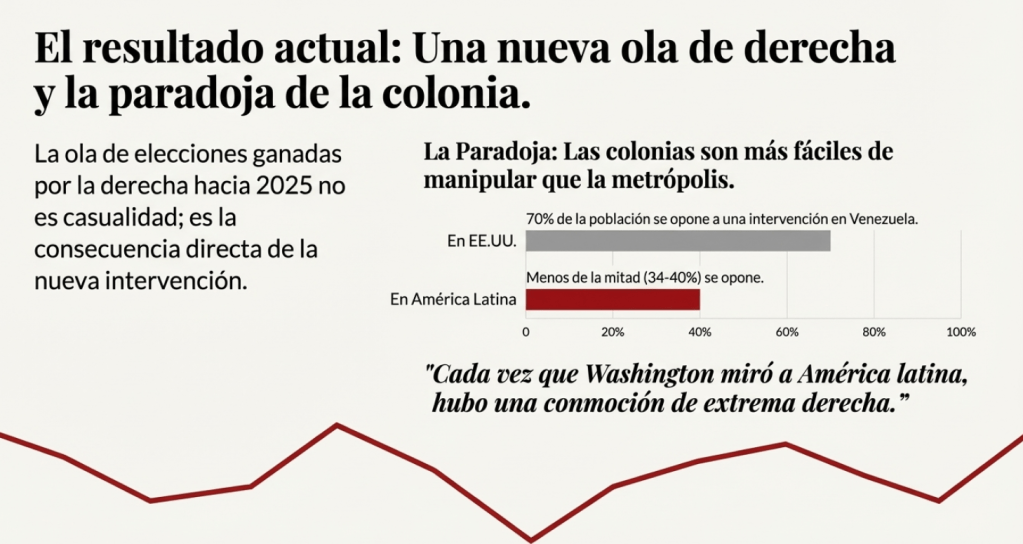
Se puede decir que la ola de elecciones ganadas por la derecha para 2025 tiene múltiples causas, pero nunca se podrá decir que la CIA, las agencias secretas de otros organismos como el Pentágono, la agencias como la DEA o la USAID y el Mossad no tienen nada que ver. Tienen mucho que ver, escuchar, decir y hacer.

Como en el pasado, se da la paradoja de que las colonias son más fáciles de manipular que las metrópolis. Hoy, según las encuestas, el 70 por ciento de los estadounidenses está en contra de cualquier intervención en Venezuela que podría causar una guerra civil u otro gobierno títere. Menos de la mitad (entre 34 y 40 por ciento) de los latinoamericanos lo está. Así piensan y así votan por candidatos admiradores de Hitler, de Pinochet y de Margaret Thatcher. No solo porque todos los títeres neofascistas y supremacistas en los gobiernos tienen ojos azules, supongo. Pero hay miradas que matan: cada vez que Washington miró a América latina, hubo una conmoción de extrema derecha.

De hecho, en este momento te están mirando y escuchando. Pero no te preocupes, no es nada personal y no te van a extorsionar con algún escándalo sexual, porque eso lo reservan a sus servidores más importantes, y tú no eres importante para ellos. La información recabada sirve para la ingeniería global, para el aparato más perfecto de propaganda y manipulación mental que haya conocido la humanidad.

Erik Prince, fundador de Blackwater lo dijo en Off Leash, sin capucha: “Si tantos de estos países en el mundo son incapaces de gobernarse a sí mismos, es hora de que volvamos a ponernos el sombrero imperial, para decir: vamos a gobernar esos países… Sí, hay que volver al colonialismo”.

¿Alguien piensa que el grupo mercenario Blackwater, uno de los socios socio del verdadero poder político financiero, invierte sólo en la bolsa de valores? Por nombrar sólo a uno de la docena de otros psicópatas supremacistas en la punta de la pirámide, como Elon Musk, Larry Ellison, Larry Fink, los muchachos de Palantir, y el resto de la secta que controla el tráfico financiero y acumulan más riqueza que el 90 por ciento de la población mundial.

La estrategia es el acostumbramiento a la violencia, a la barbarie y al despojo. Es decir, a la palestinización del mundo. ¿Y entonces? Bueno, al resto de la humanidad no nos quedan muchos recursos, pero lo que queda es claro. Conciencia, unión y rebelión. Sólo queda resistir―como palestino.

Jorge Majfud, diciembre 2025

Be careful what you wish for

Dear Mr. Musk,

You recently claimed that “empathy [is] a parasitic plague.”

I disagree. Civilizations have existed and thrived in large part due to the guidance and prescriptions of empathy by major spiritual leaders throughout history.

Additionally, execution was not the common form of punishment in the past (except for “criminals” like Jesus during the Roman Empire), contrary to popular belief.

I oppose capital punishment for two reasons:

1. Many of my friends in South Africa would have faced execution after Apartheid.

2. Many members of the current World oligarchy could undergo the same fate as in the French Revolution with the guillotine.

I am against violence in all forms, as you know.

Sincerely,

Jorge Majfud, nov. 2025

I. Model of Inverse Progression

Alternate Variation of History

Although the Western representation of time continues to be a line where the future is forward and the past is backward, reality insists on proving older, more contemplative cultures right: the past is forward and the future is backward, which is why we can only see the former and not the latter. But predicting the future has been more important to humanity than finding the goose that lays the golden eggs.

In the work routine, for example, the most important element in any job application is the resume and the reference letters of the individual or the applying company. In any case, the section on projects and objectives is much smaller and less relevant than the rest, which refers to the applicant’s background, whether ethical or professional. Even though the employer is interested in what the candidate has to contribute in the future, when reading the resume and references, they always focus on analyzing the applicant’s past to form a vague idea of the future. Even artificial intelligence systems that read applications, whose goal is to predict a candidate’s behavior, do so exclusively based on their background.

On a larger scale, sociology and economics do the same: their main tools of understanding and prediction are not in equations but in history. This was already recognized by John Maynard Keynes when, after predicting the tragic consequences of the impositions on defeated Germany in World War I, he failed to foresee the great collapse of markets and economies in 1929. From his obsessive search for a pattern in the stock market, he came to recognize that the unpredictability of the economy is due to the “animal factor” of human psychology. Of course, he did not observe that the animal factor in humans is far more complex and unpredictable than in other animals.

Economists themselves have observed that even today, when one of them manages to predict a crisis, it is due to luck, not to any objective calculation. Out of hundreds and thousands of predictions made by economists before the great crisis of 2008, few specialists were correct. One of them was the economist Nouriel Roubini, who, after becoming famous for his prediction (which he attributed to his intuition, not to a mathematical calculation), continued making predictions that never materialized—even the nose can be wrong.

However, human history is not a succession of chaotic and disconnected events. It not only rhymes but also allows for the identification of certain common elements, certain patterns, such as the cyclical crises of capitalism described by Marx. It is also true that the search for patterns has its dangers, not because patterns do not exist (like the physical and psychological stages of human beings) but because their simplifications often lead to wrong and even opposite conclusions.

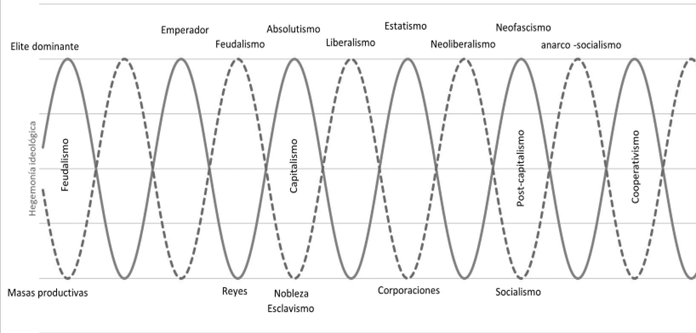
One of the simplest and most general abstractions derived from this study is a model we might call the inverse progression model.

(figure 1)

For reasons of space, for this model of history, we will limit ourselves to considering the last thousand years, analyzing only the last five centuries and focusing in more detail on our time. In this sense, we can observe that each period reacts against the previous one and crystallizes its demands, but, in all cases, it is a matter of opposing ideological narratives that serve the same goal: the accumulation of power in a dominant minority, usually the one percent of the population, through the exploitation of the rest by the exercise of physical coercion first, followed by narrative proselytism and, finally, consolidated by “common sense” and the obvious truths created by the media. Once the economic system convenient to the minority is exhausted by the growing inverse consensus of the majority (Christianity in the time of Constantine) or a new minority with growing power (the capitalist bourgeoisie of the 17th century), it is replaced by the alternative claimed by those below (movements against racism, sexism) and, finally, captured, hijacked, and colonized by the dominant minority. In this way, we can see a continuity between opposing ideologies, such as, for example, feudalism and liberalism, rural slavery and industrial corporatism, monarchical absolutism and Soviet statism.

We start from the axiom that the human condition is the result of a dialectic between a historical component and an ahistorical one that precedes it. We will focus mainly on the observation of the first element of the pair, history, but we will consider its ahistorical component as always present, as are psychic and physiological needs.

On the other hand, this model of reading history is based on another ahistorical component, denied for more than half a century by poststructuralist thought: the dualism of action and reaction in human action and perception. For example, in liberal democracies, elections are almost always decided by a coin toss, that is, by two or three percent of the votes. If not by one percent. In many other aspects of individual and social life, the complexity of reality is often reduced to a pair of opposites, from religions (good-evil, angel-demon, yin-yang), politics (right-left, state-private enterprise, socialism-capitalism, liberal-conservative, rich-poor) to any other aspect of intellectual and emotional life: up-down, white-black, forward-backward, cold-hot, pleasure-pain, inside-outside, euphoria-depression, etc.

In June 2016, in an interview about the possibilities of Donald Trump’s victory in the November elections, we mentioned this pattern and this emotional component in political elections, whereby if a goat were to compete with Mahatma Gandhi, after a certain period of electoral campaigning, the goat would close the supposed logical advantage of the rival candidate.[i] In June 2016, most polls and analysts dismissed a Trump victory. As in the 1844 elections, when everyone laughed at the intellectual shortcomings of candidate James Polk. In 2016, the difference in favor of Hillary Clinton was two percent of the total votes (though Trump was elected president due to the electoral college system inherited from the slaveholding era). In 1844, James Polk won the election by one percent, which ultimately led to a radical change in the history of the world in the following century.[1]

Capitalism emerges as a novelty and reaction (though neither intentional nor planned) against monarchical absolutism, which in turn had arisen as a reaction to feudalism and the power of the landowners. Its economic and ideological system opposes the feudal and absolutist systems while simultaneously drawing from both, and later, it ends up reproducing them with the consolidation of economic and financial corporations, through a radically different culture: the oligopolistic power of transnational corporations served by weaker neocolonial states and protected by central metropolises with almost absolute powers, expressions of democratic political systems indebted to dictatorial economic systems.

The new capitalist class, the bourgeoisie, founds and grounds its revolution in democratic opposition to kings and absolutism, but once it becomes the dominant class, spider-like, it does not abandon the tradition of minority accumulation over the majority. Since its banner is democracy, it cannot abandon it once power is monopolized, but must disguise it to continue the dynamic of appropriating the wealth-power of the majority. In this way, it was possible that throughout the Modern Age, the most brutal empires in the world were democracies. Its ideology, liberalism and more recently neoliberalism, also emerges as a critique of the power of the minority of its time (monarchical absolutism) and becomes the narrative that justifies the dominant power of the new minority, corporate and imperial, articulated by economists functional to the current power with a veneer of science and material objectivity. At the center of the new neoliberal narratives lies a purely ideological and cultural component: the reduction of human existence to a single goal: the pursuit of individual profit at any cost, even at the price of the most radical dehumanization, the simplification of the human being as a producing-consuming machine, and the destruction of the planet. All in the name of democracy and freedom.

Liberals are the continuation of feudal lords, opposed to absolutist kings (to central governments), but they cannot renounce the banner of freedom and democracy, even though they only have the words of these two principles, repeated mechanically like a rosary. By freedom, they mean the freedom of capitalist lords, of the minorities in financial power. By democracy, they mean that electoral system that can be bought every two or four years or, as Edward Bernays, the inventor of modern propaganda, will summarize, that system that tells people what to think for their own good.

In all cases, we will see a progressive divorce between narrative and reality until a new super crisis, a social and civilizational paradigm shift, causes both to collapse. The more words like freedom and democracy are hijacked and repeated, the less relevance they have. A reality creates a dominant narrative-web, and this narrative sustains the reality so that it does not dissolve in its own contradictions. To achieve this, the narrative resorts to religious sermonizing, in our time dominated by mass media.

In this study, we will analyze the most significant moments of the last four centuries of this dynamic. Based on the “Inverse Progression” proposal illustrated earlier, we will begin by projecting the same logic to earlier periods in the following scheme, which, without a doubt, must be adjusted in its details for greater clarity for different readers.

Scheme of Ideological Pairs

PeriodsDominantResistant
MonocraticPolycraticMonocraticPolycratic
Antiquity PolytheismsMonotheisms 
Classical Middle AgesEmpires  Tribes/Provinces
 Confederation Republics CaliphatesDictatorships Empires regional 
Catholic Church  Non-canonical Christianities
 FeudalismMonarchy 
Modern EraCatholic Monarchy  Protestantism Liberalism
 Liberalism FederalismMonarchy Centralism 
Imperialism  Anti-colonialism
 Slavery ConfederationNation, Union 
19th CenturyNation-Empire  Colonies
20th Century Corporate CapitalismState Capitalism 
Fascism Stalinism  Socialism Anarchism
 Liberal CapitalismState Socialism 
State Capitalism  Social Democracies, Unionism
 Neoliberalism NeofeudalismCapitalist Socialism 
21st CenturyMilitarist Capitalism  Cooperative Democracy
 Cooperative DemocracyCommunist Capitalism 

Descriptive Examples

Before we begin, let’s provide a few brief examples. When capitalism emerged, feudalism simultaneously transformed into anti-monarchical liberalism in Europe and, later, into slavery against the central government in the United States. This ideocultural tradition persists today in the Southern principle of “defending state independence,” the same principle that led to the Civil War to maintain slavery over a century ago and later the transformation of slaveholders into CEOs and boards of dominant corporations.

Today, neoliberals repeat the imperial rhetoric of the free market when, in reality, they refer to the earlier school they refuted, mercantilism. Mercantilism was a system of currency accumulation that, to a large extent, practiced the interventionism of imperial states to protect their own economies and destroy those of their colonies through protectionist policies and forced purchases at gunpoint. Not without irony, the ideology of the capitalist free market ended the free market. What we have today, five centuries later, is corporate mercantilism, where corporations are no longer medieval guilds but the same feudal lords who accumulate more power than monarchies. Today, the surplus (capital accumulation) prescribed by the mercantilists of the past does not reside in national governments but in the neo-feudal lords of finance. Conversely, countries manage debts.

In the United States, as in other countries, the competition between two political parties will eventually lead to a role reversal, as with the Southern slaveholding Democrats and the Northern liberal Republicans in the past. The inverse identification of Southern Confederates with the Republican Party, to some extent starting with Franklin D. Roosevelt, or perhaps earlier during the Progressive Era, and of the leftist Democrats, follows this model and leads us to predict that it will eventually reverse again, especially given some demands of the Republican right that align with old demands of the Democratic left. I suspect this crossover and inflection will occur sooner in their disputes over international policy, which have never been very antagonistic. In chapters like “Social Networks Are Right-Wing,” we will provide a more recent case.

If we consider the immediate present and a projection into the future, we can see the case of the United States during Postcapitalism. Only in the last century, the superpower experienced the sine wave of the Inverse Progression in an accelerated manner, with periods of fifty years. During the Great Depression of the 1930s, progressive policies not only migrated from the Republicans to the Democrats but also established the paradigm for the next fifty years. This paradigm strengthened unions, made possible the creation of State Social Security, and allowed government intervention in the economy without major questioning. This cycle ended with the election of Ronald Reagan in 1980 and the triumph of the neoconservative-neoliberal reaction, also a consequence of the global crisis of the 1970s. In all cases, ideological changes were followed by transmutations and travesties of the elites at the top of the social power pyramid to maintain continuity amidst change.

Today, fifty years later, the system is once again in crisis for the third time, with minor symptoms but major causes. For the United States, it is not yet a massive economic crisis, but it is already a crisis of hegemony that will end its monetary privileges and, later, geopolitical ones. As happened with the crisis of the Spanish Empire in 1898, this country will have to turn to deep introspection.

This megacrisis will likely occur in the 2030s or 2040s, and it will be a new opportunity, judging by the dynamics of the Inverse Progression, for new generations to reorganize themselves into a system removed from neoliberalism, from capitalism as an existential framework, and to question the postcapitalist dictatorship with atomized options but with the common factor of a less consumerist and more cooperative politics and philosophy. The death of the capitalist paradigm will not mean the automatic disappearance of its institutions, but rather a new way of seeing and living in the world. Extending the theory of the Inverse Progression, it would not be an exaggeration to predict that, even if the two-party system remains, the current Republican Party, hijacked by the nationalist far-right, could even switch roles again in a few decades and represent these new aspirations that in the past century were associated with the left, while the Democratic Party would return to its 19th-century role of representing the conservative, corporate, and Eurocentric South. But this last point would be a detail.

In the 21st century, another pair begins to invert: a large number of center-left politicians and governments position themselves in favor of the “free market” and trade agreements (which have little to nothing to do with a free market but rather guarantee, in secret agreements like the TPP, the freedom of investors) while other conservative right-wing governments, such as that of Donald Trump, align with the traditional protectionist line of the left. While in the West the neo-feudal model represented by mega-companies and corporations whose powers surpass those of the states signifies not only the death of classical capitalism but also a return to its socioeconomic predecessor, feudalism, in China the system of state capitalism centered on the Communist Party is a confirmation of the monarchical model, where the fiefdoms (the corporations) are subordinated to the State.

Corollary

In a Cartesian graph we can place on the x-axis a progression ranging from (a) absolute government (x=0) to (z) absolute and self-regulated anarchy (x=10) and on the y-axis we distribute the degree of religious fanaticism, starting from (a’) a radically secular or atheist society (y=0) to another (z’) theocratic or sectarian society (y=10). We could speculate that in secular societies with centralized governments, like China, their position would be: x→0; y→0. The Middle Ages or Feudal period could be placed at the top of the curve (x→5; y→10) with a fragmented political power, that of the feudal lords, but not anarchic-democratic. The extreme x→10; y→0 signifies a break with the Middle Ages where the fragmentation of power has surpassed the maximum curve of religious sectarianism to render it ineffective as a ligament (religion, re-ligare) of the concentrated and independent powers of the feudal lords of the Middle Ages or the financial elites of our time. Obviously, the crossing of this critical point (x→5; y→10) cannot occur without a general upheaval, a conflict likely on a global scale.

(figure 2)


[1] We explained this in The Wild Frontier (2021).


[i] Radio Uruguay. (2016). “La teoría de la cabra de Majfud”. 14 de junio de 2016: http://www.youtube.com/watch?v=Y1DXbl2MvIA

From Flies in the Spiderweb: History of the Commercialization of Existence—and Its Means, by Jorge Majfud

Majfud, Jorge. Flies in the Spiderweb: History of the Commercialization of Existence—and Its Means. Humanus, 2023, 2025, p. 17-25

Ideology and Intervention: A Critical Review of Jorge Majfud’s The Wild Frontier

Majfud, Jorge. The Wild Frontier: 200 Years of Anglo-Saxon Fanaticism in Latin America, U.S. Edition, Humanus, 2025.

Jorge Majfud’s The Wild Frontier is a bold and fiercely intellectual account of U.S.-Latin American relations that challenges conventional historical narratives. Rather than offering a detached summary of past events, Majfud invites readers into a searing critique of the cultural, ideological, and political forces that have shaped—and often distorted—the relationship between the Anglo-Saxon North and the Latin American South. His central thesis is unapologetically critical: for over two centuries, the United States has projected an image of moral superiority while pursuing policies rooted in domination, exploitation, and racialized thinking.

Majfud’s approach is far from typical academic writing. The book reads more like an extended political essay or a philosophical reckoning, blending historical documentation with impassioned argument. He delves into major milestones in hemispheric history—beginning with the early 19th century doctrines that legitimized U.S. expansionism—and traces how these ideas have evolved but never disappeared. From the Monroe Doctrine to contemporary neoliberal economic interventions, Majfud makes a compelling case that the same logic of superiority, masked by noble rhetoric, has consistently driven foreign policy decisions in the region.

What truly distinguishes The Wild Frontier is the way it draws connections between past ideologies and current political realities. For example, Majfud explores how 19th-century notions of Manifest Destiny continue to echo in today’s border policies, economic sanctions, and international rhetoric around democracy and human rights. In his view, U.S. foreign policy is not just a series of isolated decisions but part of a larger cultural narrative that positions Anglo-Saxon civilization as a global moral compass—a notion he carefully deconstructs through historical examples and linguistic analysis.

Majfud is especially adept at analyzing the use of language as a political weapon. He argues that words like “freedom,” “development,” and “order” have been systematically used to conceal interventions that served elite interests rather than the common good. Through sharp rhetorical analysis, he shows how such terms gain moral weight while deflecting attention from the violence and dispossession they often accompany. In this sense, the book is not just about what happened, but how those events have been framed and remembered in ways that benefit dominant powers.

Alongside this critique, Majfud brings to life the resistance that has always existed in the shadows of empire. He revives the voices of key Latin American thinkers and activists—José Martí, Augusto Sandino, Eduardo Galeano, and others—who resisted imperial logic and offered alternative visions of regional identity and self-determination. These figures are not merely cited for contrast; they are given space to speak across time, their words highlighting the tension between imposed ideology and lived reality. By placing these voices in conversation with the dominant discourse, Majfud not only reclaims a suppressed intellectual tradition but also emphasizes the intellectual richness and political consciousness that has long defined Latin American resistance.

Another strength of the book is how it tackles the psychological dimension of imperialism. Majfud reflects on how entire societies can internalize myths about their own inferiority or dependency, especially when these myths are reinforced by educational systems, media narratives, and international institutions. This psychological colonization, he suggests, is just as destructive as military invasion or economic exploitation—perhaps even more so, because it can outlast the physical presence of an occupying force.

The translation by Elizabeth Horan deserves recognition as well. She manages to preserve the lyrical and combative tone of Majfud’s prose while making it accessible to English-speaking readers. The complexity of Majfud’s ideas is matched by the rhythm and texture of his language, and Horan’s translation ensures that none of that depth is lost in transition. The result is a book that is both intellectually rigorous and emotionally charged, offering a reading experience that is as moving as it is informative.

Though the book is dense with ideas and historical references, it is never dry. Majfud writes with urgency and conviction, inviting the reader not just to learn, but to reflect, question, and unlearn. The book challenges its audience to confront uncomfortable truths and to recognize how deeply history shapes our present assumptions—about progress, civilization, and justice. It is not a neutral or detached work; it is a call to awareness and, perhaps, a call to action.

For students, educators, and anyone interested in understanding the roots of Latin American political struggles and the role of U.S. foreign policy in shaping them, The Wild Frontier is an essential text. It does more than catalog a history of interventions—it reveals the ideas and ideologies that made such a history possible. Majfud’s work urges readers to rethink the moral narratives that often accompany power and to listen more closely to the voices that history has too often ignored.

Silicon Valley Daily

Daily magazine for entrepreneurs and business owners

The Panama Canal and the Mistreated Treaties

On December 22, 2024, the elected president of the United States, Donald Trump, announced that he would demand that Panama “give him back the canal.” Imperialism is a disease that not only kills those who resist it but also does not let those who carry it within live.

***

Washington DC. January 22, 1903—Secretary of State John Hay and the Colombian commercial attaché in the United States, Tomás Herrán, signed the treaty that would give the United States the right to resume construction of the Panama Canal that the French had abandoned when they were almost halfway done. Colombia would agree to cede a strip of land on its isthmus to the United States for a hundred years in exchange for ten million in a single payment and 250 thousand dollars per year. A few miles off the coast of Panama, the warship Wisconsin remains stranded to provide moral support for the negotiations.

Congress in Washington immediately approved the treaty, but it was rejected in Bogotá. There were doubts about sovereignty and about the benefits derived from this agreement. Mathematics, also practiced in that country, said that it would take the Colombian people 120 years to receive the same compensation that had been offered to be paid in one lump sum to the New Panama Canal Co.

On April 15, the United States envoy, Mr. Beaupre, sent a telegram to the Secretary of State about the mood of the Colombian people. “There is at least one clear fact. If the treaty were put to the free consideration of the people, it would not be approved.” The Colombian Senate voted unanimously against its ratification.

Without ever having set foot outside his country, on August 27, Theo Roosevelt wrote three letters describing the Colombians as “ignorant,” “greedy,” “despicable little men,” and “corrupting idiots and murderers.” Also, “I could never respect a country full of that kind of people […] Trying to deal with Colombia as one deals with Switzerland, Belgium or Holland is simply absurd.” Days later, he sends some packages with dollars to organize a revolt that will be called Revolution.

Problem solved. On November 18, the Hay-Bunau-Varilla treaty was signed in Washington, by which “the United States guarantees the freedom of Panama” in exchange for Panama ceding authority and all rights over the canal, free of any tax. As usual, the Panamanians were not invited to sign the new treaty. The 250 thousand dollars annually previously offered to Colombia would not be paid until a decade after the canal’s opening. There is nothing like having a powerful navy to do good business. The previous Treaty of Peace and Commerce signed by Colombia and the United States in 1846 was also violated. As in Cuba, as in Puerto Rico, article, now article 136 assured Washington the power to intervene in any inconvenient situation. Still, rebellions are symbolic. Washington has decreed that citizens of that country cannot acquire weapons. Imperial practice is old: treaties are signed so the weak will comply.

In the United States, voices are raised against what several congressmen call dishonesty and imperialism. Senator Edward Carmack protests: “The idea of ​​a revolution in Panama is a crude lie; the only man who took up arms was our president.” Senator George Frisbie Hoar, a member of the commission investigating the war crimes that will go unpunished in the Philippines, rejects the versions about the Revolution in Panama and adds: “I hope not to live long enough to see the day when the interests of my country are put above its honor.”

Of course, this matter of honor can be fixed. The president resorts to the old resource of “we were attacked first.” As James Polk did to justify the invasion of Mexico in 1846 or McKinley to occupy Cuba in 1898, Roosevelt invents a story about threats to the security of certain American citizens in the area. Like Henry Kissinger, when he denied in front of television cameras any involvement in the military coup in Chile in 1973, Roosevelt assured Congress and the public that Washington was not involved in the Revolution in Panama. On December 6, 1904, he gave a speech before Congress on the need to once again expand the Monroe Doctrine “to see our neighbors stable, orderly, and prosperous.” Otherwise, “intervention by a civilized nation will be necessary… The United States must, whether it wants to or not, intervene to solve any serious problem by exercising the power of international police.”

In 1906, Roosevelt visited the construction sites in Panama. He would be the first American president to dare to leave his country. On board, the USS Louisiana, Roosevelt wrote to his son Kermit: “With admirable energy, men, and machines work together; the whites supervise the construction sites and operate the machines while tens of thousands of blacks do the hard work where it is not worth the trouble to use machines.”

Despite the hard work of Panamanians, they are portrayed as lazy. Journalist Richard Harding Davis had already echoed the sentiment of the time: “[Panama] has fertile lands, iron, and gold, but it has been cursed by God with lazy people and corrupt men who govern it… These people are a menace and an insult to civilization.”

In 1909, the Senate Foreign Affairs Committee, based on Roosevelt’s boastful statements to a class at a California university, investigated “the unilateral decision of a former president to take Panama from the Republic of Colombia without consulting Congress.” Considering Colombia’s requests to The Hague, the commission will question different protagonists. On November 6, 1903, three days after the revolution in Panama, the State Department sent a cable to its consul in Colombia informing that “the people of Panama, apparently unanimously, have resolved to dissolve their ties with the Republic of Colombia…”

Congressman Henry Thomas Rainey reads the cable from Washington in Congress. Rainey clarifies: “I do not believe any of this is true… When the Revolution occurred, only ten or twelve rebels knew of the plans, apart from the Panama Railroad and Steamship Co. managers.”

It would be necessary to wait until 1977 when Jimmy Carter’s government signed an agreement that the United States would return the canal to Central American country on the last day of 1999, three years before the mandatory rental period expired. A year earlier, at an event in Texas, the former governor of California and future president, Ronald Reagan, would declare: “It does not matter which ram dictator is in power in Panama. We built it! We paid for the canal! It’s ours, and we’re going to keep it.”

Omar Torrijos will be the dictator Reagan alluded to. Torrijos will claim sovereignty over the Canal and will die, like other rebel leaders from the south, in a plane crash.

Imperialism is a disease that not only kills those who resist it but also does not let those who carry it inside live.

Jorge Majfud (from the book La frontera salvaje: 200 años de fanatismo anglosajón en América latina English: https://www.youtube.com/watch?v=d2-ViKbXQ0s )

https://www.commondreams.org/opinion/the-panama-canal

Ruling Over Ashes or Becoming Ashes

On September 4, 2024, a tropical storm descended upon Jacksonville. The conversation with Jill Stein at the Jacksonville University auditorium was scheduled for 5:30 PM, a time when darkness had already fallen due to the storm. To deter attendance, the Democratic Party Committee arranged for Kamala Harris, then a Senate candidate, to deliver a speech on the same campus at Jacksonville University’s Business School, just an hour earlier, leaving attendees with few parking options.

At the conclusion of the talk, an audience member accused me of being “too polite” with Stein. Recognizing him as a known Democratic activist, and by all accounts, a congenial person, I replied, “I’m not a journalist; the purpose here was to delve into Stein’s ideas.”

I’ve always disliked aggressive interviewing styles, like Univisión’s Jorge Ramos’s, preferring instead the nuanced, almost psychoanalytic silences epitomized by Spain’s Jesús Quintero.

After the lecture, we shared a modest meal in a nearby museum hall, reserved by my colleagues, to express gratitude to Jill, former congressman and Green Party coordinator Jason Call, and their team for their efforts to join us. The university’s catering provided the meal, and without servers or additional guests, we engaged in an enriching discussion, details of which I’ll keep private out of respect for the space. However, I can connect one thought to the elections and the global tragedy that envelops us more each day.

Seated beside Jill, I recounted a visit to Deutsche Welle in Berlin, where I dined with a leading journalist who mentioned she was married to Cem Özdemir, then-Green Party leader in Germany and current Minister of Agriculture. Özdemir had accepted my invitation to speak in Florida in late 2019. Still, German police uncovered a plot by the US branch of the violent neo-Nazi group Atomwaffen Division to assassinate him, thwarting his visit.

This marked our alignment with Europe’s Greens, though Jill pointed out a key difference between the Green Parties of the U.S. and Germany: Ukraine. Her stance mirrored mine completely. To convey what Stein suggested that evening, I’ll articulate my viewpoint instead of recounting her words.

When President Biden withdrew U.S. troops from Afghanistan, he left behind millions in military hardware. After two decades of occupation and nearly a decade since supposedly eliminating Osama bin Laden, the U.S. military’s hasty exit was reminiscent of Vietnam. The American investment in Afghanistan amounted to $14 trillion—seven times Brazil’s GDP—not in schools and hospitals but in military dominance that fueled the drug trade and private companies, as evidenced by the Wall Street Journal.

After 20 years, the U.S. reinstated the Taliban, erstwhile CIA allies, after eliminating another former ally, bin Laden. An ideal business scheme: creating more problems to invest in new military solutions.

America’s military failures stem not only from inefficiency but also from the lucrative nature of war losses for private corporations ruling U.S. politics and media narratives. In a previous article, we noted the looming advent of another war, driven by the urgency of a new plan.

Then Russia invaded Ukraine. Many of us believed NATO did everything to provoke this by prompting Zelensky, viewed as Washington’s puppet, to confirm Ukraine’s NATO membership process. NATO, Hitler’s dream realized (two directors were his aides), succeeded again in escalating tensions to extend Western dominance—post-WWII Anglo-Saxon hegemony, avoidable had Stalin’s 1952 “Stalin notes” been considered.

In March 2022, France’s Le Monde labeled Paco Ignacio Taibo II and me as “leftist intellectuals pro-Putin,” although I consistently opposed the invasion and condemned the hypocritical narrative pushing history from that day forward, ignoring the prolonged harassment, massacres in Donbas, and the Western-backed coup against democratically elected Viktor Yanukovych.

I’m not “pro-someone” but “pro-causes,” such as non-interference in sovereign affairs. These interventions perpetuate global South issues—the shared sentiments that September 4th night.

On November 1, Europe’s Greens requested Jill Stein to withdraw from the election and support Kamala Harris to avert Trump’s fascist return. Their concern over Ukraine ignores the genocide in Palestine.

Democrats blame Jill Stein for potential losses but refuse to avert electoral suicide by dismissing millions of Democrats outraged over Palestinian genocide. At every rally, Kamala Harris dismisses protests with, “I’m speaking,” proceeding to recite familiar scripts about unrelated “important issues” like grocery costs.

No greater hypocrisy and arrogance exist. Her husband announces placing a mezuzah at the White House entrance, tolerable privately but ill-timed. Bill Clinton tries appeasing Gaza protests by citing Israel’s “special rights” due to King David’s presence millennia ago.

So, dear Democrats, cease lamenting impending national fascism if you’re the architects of global fascism.

Jorge Majfud, November 1st, 2024.

.

Immigration, History, Politics, and the Latino Vote

2019 Lectures


wnc_2019

IMMIGRATION AND THE LATINO VOTE 

January 30, 2019 4:30 pm McKee 113 

western_carolina_university_logo

WCU Humanities Initiative

WCU welcomes Uruguayan-American scholar and author Jorge Majfud. 

In the first event, Dr. Majfud will join Dr. Benjamin Francis-Fallon (WCU History) in a panel about Immigration and the evolution of the Latino Voting Bloc in the US. 

Join us also the following day, when Dr. Majfud will engage in a dialogue with Dr. Alberto Centeno-Pulido (WCU World Languages) about immigration, racism, and the role of intellectuals in the public sphere as explorers of the human experience.

alberto3 (1)


For more information, contact Alberto Centeno-Pulido at acentenopulido@wcu.edu


Rescuing Memory: the Humanist Interview with Noam Chomsky

by Jorge Majfud

August 8, 2016.

[Pictures Sarah Silbiger]

Originally published in The Humanist, July/August 2016


July / August 2016


Just before twelve thirty on a recent spring afternoon, I found myself on the campus of the Massachusetts Institute of Technology in the building that houses the linguistics and philosophy departments. A group of Japanese students, full of youthful excitement, were waiting outside Noam Chomsky’s eighth-floor office. They approached the door and read the name card on it. They took pictures—lots of pictures—with happy and surprised expressions, but then quickly turned serious. They paused to take a brief moment of silence, which almost felt mystical, and then headed out.


At the age of eighty-seven, the renowned linguist, philosopher, historian, cognitive scientist, and critic Noam Chomsky maintains the same clarity found in any of his books, lectures, or television appearances dating back to the 1970s. While in a face-to-face he might adopt an informal and humorous tone towards relevant topics, he is very much that same serious and detailed thinker who we all recognize from the conferences and different interviews—one of those individuals history will remember for centuries.


Years after having met Chomsky at Princeton University and collaborating with him on the Spanish translation of a book (Ilusionistas, 2012), I was now interested in finding out the roots of his social and political thinking during our meeting. I started by remembering the many letters we had exchanged for the better part of a decade. In one of the letters I had commented about how my son was adjusting to a society that was his but only by birth, noting that he spoke English with a slight Spanish accent. When Chomsky had a chance, he wrote me this:


When I was a boy, we were the only Jewish family in a terribly anti-Semitic neighborhood. Those streets weren’t any fun for us but our parents never found that out. In a way, you avoid telling your parents what happened to you during those days.


I reminded him of this in order to start a dialogue about that world and its universal implications. What follows is a conversation that went beyond what was initially planned.


Jorge Majfud: Before WWII, anti-Semitism and Nazism were much more common in the United States than Americans are willing to accept today. Henry Ford (awarded the Grand Cross of the German Eagle by the Nazi Government), General Motors, Alcoa, and Texaco are just a few examples of supportive U.S. business interests. And after the war, Jews faced serious (and absurd) obstacles in migrating as refugees while many Nazis were granted visas (through Mexico) to help develop NASA programs. What memories do you have of those times when you were a Jewish teenager?


Noam Chomsky: When I was growing up in the 1930s and ’40s anti-Semitism was rampant. It wasn’t like Nazi Germany but it was pretty serious—it was part of life. So, for example, when my father was able to buy a secondhand car in the late 1930s, and he took us to the countryside for a weekend, if we looked for a motel to stay in we had to see if it said “restricted” on it. “Restricted” meant no Jews. You didn’t have to say “no Blacks,” which was something people took for granted. There was also a national policy, which as a child I didn’t know anything about. In 1924 the first major immigration law was passed. Before that, there was an Oriental Exclusion Act, but other than that, European immigrants like my parents were generally admitted in the early years of the twentieth century. But that ended in 1924 with an immigration law that was pretty much directed against Jews and Italians.


JM: Was it connected to the Red Scare?


Chomsky: Well, sort of—in the background. It was right after Woodrow Wilson’s first serious post-World War I repression, which deported thousands of people, effectively destroyed unions and independent press, and so on. Right after that, the anti-immigration law was passed that remained in place until 1960s. And that was the reason why very few people fleeing the rise of fascism in Europe, especially in Germany, could get to the United States. And there were famous incidents like with the MS Saint Louis, which brought a lot of immigrants, mostly Jewish, from Europe. It reached Cuba, with people expecting to be admitted to the United States from there. But the administration of Franklin D. Roosevelt wouldn’t allow them in and they had to go back to Europe where many of them died in concentration camps.


JM: There were cases involving different countries as well.


Chomsky: It’s a lesser-known story, but the Japanese government (after the Russian-Nazi pact, which split Poland) did allow Polish Jews to come to Japan, with the expectation that they would then be sent to the United States. But they weren’t accepted, so they stayed in Japan. There’s an interesting book called The Fugu Plan, written by Marvin Tokayer and Mary Swartz, which describes the circumstances when European Jews came to Japan, a semi-feudal society.


After WWII there were many Jews who remained in refugee camps … President Harr F. Truman called for a commission, it was called the Harrison Commission, to investigate the situation in the camps and it was a pretty gloomy report. There were very few Jews admitted into the United States.


JM: These policies had many other lasting consequences.


Chomsky: Of course. The Zionist movement based in Palestine pretty much took over the camps and instituted the policy that every man and woman between the ages of seventeen and thirty-five should be directed to Palestine—they weren’t allowed to go to the West. A 1998 study was done in Hebrew by an Israeli scholar, Yosef Grodzinsky, and the English translation of the title is Good Human Material. That is what they wanted sent to Palestine for colonization and for the eventual conflict that took place some years later. These policies were somewhat complementary to the U.S. policy of pressuring England to allow Jews to go to Palestine, but not allowing them here. The British politician Ernest Bevin was pretty bitter about it, asking, “if you want to save the Jews, why send them to Palestine when you don’t admit them?” I suspect most likely that more Nazis came to America. I was a student at Harvard during the early 1950s. There was practically no Jewish faculty there.


JM: According to some articles, Franklin Roosevelt, when he was a member of the board at Harvard, considered that there were too many Jews in the college.


Chomsky: There’s an interesting book about that called The Third Reich and the Ivory Tower, written by Stephen H. NorwoodIt has a long discussion about Harvard, and indeed the school’s president, James Conant, did block Jewish faculty. He was the one who prevented European Jews from being admitted to the chemistry department—his field—and also had pretty good relations with the Nazis. When Nazi emissaries came to the United States, they were welcomed at Harvard.


JM: It’s something that was very common at the time, however today nobody seems willing to accept it.


Chomsky: In general, the attitude towards Nazi Germany was not that hostile, especially if you look at the U.S. State Department reports. In 1937 the State Department was describing Adolf Hitler as a “moderate” who was holding off the forces of the right and the left. In the Munich agreement in late 1938, Roosevelt sent his chief adviser Sumner Welles, who came back with a very supportive statement saying that Hitler was someone we could really do business with and so on. That was late 1938. George Kennan is another extreme case. He was the American consul in Berlin until the war between Germany and United States broke out in December 1941. And until then he was writing pretty supportive statements back stressing that we shouldn’t be so hard on the Nazis if they were doing something we didn’t agree with—basically saying they were people we could do business with. The British had an even stronger business interest in Nazi Germany. And Benito Mussolini was greatly admired.


On racism of every color


JM: In addition to anti-Semitism and racism toward African Americans, there were other groups that suffered. For example, during the 1930s, around half a million Mexican Americans were blamed for the Great Depression and deported in various different ways. And most of them were U.S. citizens.


Chomsky: Well, there was a strong nativist tradition—saying, “we have to protect ourselves”—that comes from the founding of the country. If you read Benjamin Franklin, who was one of the leading figures of the Enlightenment in the United States and the most distinguished representative of the movement here, he actually advised that the newly founded republic should block Germans and Swedes, because they were too swarthy—dark.


JM: Why is that pattern of fear historically repeated?


Chomsky: There’s a strange myth of Anglo-Saxonism. When the University of Virginia was founded by Thomas Jefferson, for example, its law school offered the study of “Anglo-Saxon Law.” And that myth of Anglo-Saxonism carries right over into the early twentieth century. Every wave of immigrants who came were treated pretty badly, but when they all finally became integrated, all of us became Anglo-Saxons.


JM: Like the Irish. They were brutally persecuted, suffered violence because of their orange colored hair and their Catholicism, and then became “assimilated,” instead of being “integrated.”


Chomsky: The Irish were treated horribly, even here in Boston. For example, in the late nineteenth century they were treated pretty much like African Americans. You could find signs here in Boston in the restaurants saying “No dogs and Irish.” Finally they were accepted into society and became integrated, became part of the political system, and there were Kennedys, and so on. But the same is true about other waves of immigrants, like the Jews in the 1950s. If you take a look at places like Harvard, it’s striking. In the early 1950s, I think, there were a handful of Jewish professors, three or four. But by the 1960s, there were Jewish deans and administrators. In fact, one of the reasons why MIT became a great university was because they admitted Jews whereas Harvard did not.


JM: We can see changes in certain cases, but we can also see things that repeat themselves, such as now in the case of Mexicans and Muslims.


Chomsky: Yes, and Syrians. There is a horrible crisis there and the United States has admitted virtually none of the refugees. The most dramatic case is the Central Americans. Why are people fleeing from Central America? It’s because of the atrocities the U.S. committed there. Take Boston, where there’s a fairly large Mayan population. These people are fleeing from the highlands of Guatemala, where there was virtual genocide in the early 1980s backed by Ronald Reagan. The region was devastated, and people are still fleeing to this day, yet they send them back. Just a couple of weeks ago, the administration of Barack Obama, which has broken all sorts of records in regards to deportation, picked up a Guatemalan man living here. I think he had been living here for twenty-five years, had a family, a business, and so on. He had fled from the Mayan region and they picked him up and deported him. To me, that’s really sick.


JM: In the case of Guatemala, the story began in 1954 with the CIA military coup organized against the democratically elected President Jacobo Árbenz.


Chomsky: Yes, it basically began in 1954, and there were other awful atrocities in the late ’60s, but the worst happened in the ’80s. There was a really monstrous and almost literal genocide in the Mayan area, specifically under Ríos Montt. By now it has been somewhat recognized by Guatemalan society. In fact, Montt was under trial for some crimes. But the U.S. prohibits people from fleeing here. The Obama administration has pressured Mexico to keep them away from the Mexican border, so that they don’t succeed in reaching U.S. borders. Pretty much the same thing Europeans have done to Turks and Syrians.


JM: Actually, under international law children should not, in principle, be detained when crossing a non-neighboring country’s border. The American Homeland Security Act of 2002 recognizes the same rights. However, this basic law has been broken many times.


Chomsky: A lot of countries break (or go against) the international law… There had been a free and open election in Haiti in the early 1990s and president Jean-Bertrand Aristide won, a populist priest. A few months later came the expected military coup—a very vicious military junta took over, of which the United States was passively supportive. Not openly, of course, but Haitians started to flee from the terror, and they sent them back and on towards Guantanamo Bay. Of course, that is against International Law. But the United States pretended that they were “economic refugees.”


The Spanish War in the basis of Chomsky’s thinking


JM: Let’s go back very quickly to your contact with the Spanish anarchists. How important was the Spanish Civil War for your social thinking and activism?


Chomsky: Quite important. Actually, my first article…


JM: You wrote that article when you were eleven years old.


Chomsky: Ten, actually. It wasn’t about the anarchists; it was about the fall of Barcelona and the spread of fascism over Europe, which was frightening. But a couple of years later I became interested in the anarchist movement.


I had relatives in New York City who I stayed with. And in those days, the area from Union Square down Fourth Avenue had small bookstores, many of which were run by Spanish immigrants who’d fled after Franco’s victory. I spent time in them, and also in the offices of Freie Arbeiter Stimme (Free Worker’s Voice) with anarchists. I picked up a lot of material and talked to people, and it became a major influence. When I wrote about the Spanish Civil War many years later, I used documents that I picked up when I was a child, as a lot hadn’t been published (a lot more resources are available now). I also learned from reading the left-wing press about the Roosevelt administration’s indirect support for Francisco Franco, which was not well known, and still isn’t.


JM: Apparently Roosevelt regretted that decision but it was too late and the fact is that many other big companies like ALCOA, GM, and Texaco were crucial for the defeat of the Second Republic—the only democratic experiment in Spain after centuries if we don’t consider the almost nonexistent First Republic during the nineteenth century. Many big companies collaborated with the Nazis and Franco.


Chomsky:  It was reported in the left-wing press in the late 1930s that the Texas Company (Texaco), headed by the Nazi sympathizer Torkild Rieber, diverted its oil shipments from the Republic, with which it had contracts, to Franco. The State Department denied they knew about it but years later admitted it to be true. You can read it in history books now, but they often suppress the fact that the U.S. government tolerated it. It’s really remarkable because they claim that Roosevelt was impeded by the Neutrality Act. On the other hand, he bitterly condemned a Mexican businessman for sending several guns to the Republic. If you look back, oil was the one commodity that Franco could not receive from the Germans and the Italians, so that was quite significant.


JM: All of that sounds familiar.


Chomsky:  During the terrorist regime in Haiti in the 1990s, the CIA, under the administration of Bill Clinton, was reporting to Congress that oil shipments had been blocked from entering Haiti. That was just a lie. I was there. You could see the oil terminals being built and the ships coming in. And it turned out that Clinton had authorized Texaco, the same company, to illegally ship oil to the military junta during a time that we supposedly were opposing the military junta and supporting democracy instead.


Same company, same story, but the press wouldn’t report it. They must have known it. If you look at the Associated Press wires, there’s a constant flow of information coming in. At that time I happened to have direct access to AP wires. The day the marines landed in Haiti and restored Aristide there was a lot of excitement about the dedication to democracy and so on. But the day before the marines landed, when every journalist was looking at Haiti because it was assumed that something big was happening, the AP wires reported that the Clinton administration had authorized Texaco to ship oil illegally to the military junta. I wrote an article about the marine landing right away, but barely mentioned that, because my article would come out two months later and I assumed by then, “of course, everybody knows.” Nobody knew. There was a news report in the Wall Street Journal, in the petroleum journals, and in some small newspapers, but not in the mainstream press. And it was kind of a repeat of what happened in the late ’30s but this was under Clinton, mind you. These are some pretty ugly stories—not ancient history.


JM: Do you think the Spanish anarchists’ experience, had they not been destroyed by Franco, could be used as an example of a third position (to Stalinism, fascism, and Western capitalism)?


Chomsky: Well, the communists were mainly responsible for the destruction of the Spanish anarchists. Not just in Catalonia—the communist armies mainly destroyed the collectives elsewhere. The communists basically acted as the police force of the security system of the Republic and were very much opposed to the anarchists, partially because Stalin still hoped at that time to have some kind of pact with Western countries against Hitler. That, of course, failed and Stalin withdrew the support to the Republic. They even withdrew the Spanish gold reserves.


JM: The fourth largest in the world.


Chomsky: But before that, the anarchist movement was one of their main enemies… There’s an interesting question, whether the anarchists had alternatives. If they did tend to support the government that had been destroyed, what were the alternatives? There was actually a proposal by Camillo Berneri, an Italian anarchist who was in Spain at the time, which is not a crazy notion in my opinion. He opposed participation in government and was against the formation of an army, meaning a major army to fight Franco. He said they should resort to guerrilla war. Which has a history in Spain.


JM: Particularly at the beginning of the nineteenth century under the French occupation.


Chomsky: Under Napoleon Bonaparte’s occupation, yes. The same method could have been implemented during the Spanish Civil War, a guerrilla war against Franco’s invaders. But Berneri also advocated a political war. Franco’s army was mainly Moorish. They were recruiting people from Morocco to come to Spain. There was an uprising in Morocco at the time led by Abd el-Krim (whose tactics influenced Ho Chi Minh and Che Guevara) that sought independence for Morocco and Northern Africa. Berneri proposed that the anarchists should link up with the effort of Northern Africa to overthrow the Spanish government, carry out land reform, attract the base of the Moorish army, and see if they could undermine Franco’s army through political warfare in Northern Africa combined with guerrilla warfare in Spain. Historians laughed at that, but I don’t think they should have. This was the kind of war that might have succeeded in stopping Spanish fascism.


JM: There were few other successful cases of guerrilla resistance in the world.


Chomsky: There are cases, for example the American Revolution. George Washington’s army lost just about every battle with the British, who had a much better army. The war was basically won by guerrilla forces that managed to undermine the British occupation. The American Revolution was a small part of a major world war going on between France and England, so the French intervened and that was a big factor, but the domestic contribution was basically guerrilla warfare. George Washington hated the guerrillas. He wanted to imitate the British red coat armies, fighting as gentlemen are supposed to fight. There are very interesting books about these events, for instance one by a very well-known American historian named William R. Polk called Violent Politics. It’s a record of what are basically guerrilla wars from the American Revolution right up through the wars in Afghanistan and Iraq. He discusses the Spanish guerrilla war against Napoleon and other cases where the conflict turns into a political war, and the invader, who usually has overwhelming power, loses because they can’t fight the political war. Against this kind of background, I don’t think that the Berneri proposal was that absurd.


***

Our conversation continued informally on other topics: the most important human intellectual capability, the language, which made possible communication, art, and liberation, at the same time made it possible deceiving and consciousness oppression; the current most serious threats to human existence according to him: atomic weapons and the ecologic catastrophe.

In a copy of the original edition of Syntactic Structures of 1957 (book that is considered the most influential in cognitive sciences of the 20th century and one of the most important one hundred books ever published) he wrote for me the legendary sentence “Colorless green ideas dream furiously”, the equivalent to E=mc2 for Linguistics and, below, he added with humor: “Revolutionary new ideas appear infrequently”.

I gave him Memory of Fire by my dear friend Eduardo Galeano, who died almost one year before, and Chomsky remembered him with affection. Right or wrong, both men taught generations to never accept Stockholm syndrome, to never be accomplice to the crimes of arbitrary powers. Both men taught us that memory and history not always are the same thing. And because of that, both –like Galileo, like Einstein– were equally hatred and labeled as “idiots” –in vain.


A child of Uruguayan military dictatorship (1973-1985), Jorge Majfud is a Uruguayan-American writer who obtained his PhD from the University of Georgia. He is the author of numerous books and essay collections, including The Eternal Return of Quetzalcoatl and the novels The Queen of AmericaThe City of the Moon, and Crisis. He currently teaches Latin American Literature and International Studies at Jacksonville University in Florida. His upcoming novel is called Tequila


https://www.facebook.com/plugins/post.php?href=https%3A%2F%2Fwww.facebook.com%2Fpermalink.php%3Fstory_fbid%3D10157075385815183%26id%3D294468630182&width=500
https://www.facebook.com/plugins/comment_embed.php?href=https%3A%2F%2Fwww.facebook.com%2Fpermalink.php%3Fstory_fbid%3D10157075385815183%26id%3D294468630182%26comment_id%3D10157078989975183&include_parent=false
https://www.facebook.com/plugins/comment_embed.php?href=https%3A%2F%2Fwww.facebook.com%2Fpermalink.php%3Fstory_fbid%3D10157075385815183%26id%3D294468630182%26comment_id%3D10157079399160183&include_parent=false

https://www.facebook.com/plugins/comment_embed.php?href=https%3A%2F%2Fwww.facebook.com%2Fpermalink.php%3Fstory_fbid%3D10157075385815183%26id%3D294468630182%26comment_id%3D10157079595510183&include_parent=false

https://www.facebook.com/plugins/comment_embed.php?href=https%3A%2F%2Fwww.facebook.com%2Fpermalink.php%3Fstory_fbid%3D10157075385815183%26id%3D294468630182%26comment_id%3D10157080082940183&include_parent=false

https://www.facebook.com/plugins/comment_embed.php?href=https%3A%2F%2Fwww.facebook.com%2Fpermalink.php%3Fstory_fbid%3D10157075385815183%26id%3D294468630182%26comment_id%3D10157079182030183&include_parent=false
https://www.facebook.com/plugins/comment_embed.php?href=https%3A%2F%2Fwww.facebook.com%2Fpermalink.php%3Fstory_fbid%3D10157075385815183%26id%3D294468630182%26comment_id%3D10157079304035183&include_parent=false
https://www.facebook.com/plugins/comment_embed.php?href=https%3A%2F%2Fwww.facebook.com%2Fpermalink.php%3Fstory_fbid%3D10157075385815183%26id%3D294468630182%26comment_id%3D10157079421580183&include_parent=false
https://www.facebook.com/plugins/comment_embed.php?href=https%3A%2F%2Fwww.facebook.com%2Fpermalink.php%3Fstory_fbid%3D10157075385815183%26id%3D294468630182%26comment_id%3D10157080314575183&include_parent=false
https://www.facebook.com/plugins/post.php?href=https%3A%2F%2Fwww.facebook.com%2Fleigh.gill.10%2Fposts%2F1096954413677003&width=500

https://www.facebook.com/plugins/post.php?href=https%3A%2F%2Fwww.facebook.com%2Fwilliam.gerwig%2Fposts%2F1187415134641926&width=500

https://www.facebook.com/plugins/post.php?href=https%3A%2F%2Fwww.facebook.com%2Farthur.hunterblair%2Fposts%2F1224041960969946&width=500

Spanish Civil War

La Segunda República

(en Español)

La guerra civil española

(English, 52 min)

La casa de Bernarda Alba

  1. España en los ’30
  2. Oliver Law
  3. Antonio Machado
  4. Francisco Franco
  5. La lengua de las mariposas
  6. Entrevista a Juan Goytisolo

Social Robots | NOVA scienceNOW | PBS Video

NOVA scienceNOW

PBS Science

Estamos salvados. Al menos los robots serán capaces de ser seres humanos.

Video:

Social Robots | NOVA scienceNOW | PBS Video.

NOVA scienceNOW Social Robots

Hurricane Katrina and the Hyperreality of the Image

Post-Katrina School Bus

Image by laffy4k via Flickr

Katrina y la hiperrealidad de la imagen (Spanish)

Hurricane Katrina and the Hyperreality of the Image

by Jorge Majfud

Translated by Bruce Campbell

September 2, 2005

In the 16th century, the Dominican brother Bartolomé de las Casas wrote an empassioned chronicle about the brutal conquest by the Spanish Empire of the new world. The denunciation by this Christian convert (which is to say, “of impure blood”) in behalf of a universal humanism, resulted in the Juntas de Valladolid (1550) in which he faced off, before the public and the king, with Ginés de Sepúlveda. Using a biblical quotation taken from Proverbs, Juan Ginés de Sepúlveda and his partisans defended the right of the Empire to enslave indigenous peoples, not only because they did it in the name of the “true faith” but, above all, because the Bible said that the intelligent man must subjugate the idiot. We will not go into who were the intelligent men. What matters now is knowing that over the centuries, a debate resulted among the “chroniclers” (the only literary genre permitted by the Spanish Inquisition in the Americas). As always, only a minority promoted a new ethics based on ethical “principles.” In this case the humanists and defenders of the “natural right” of the indigenous peoples. One had to wait until the 19th century for these “principles” to become reality by the force of “necessity.” In other words, the Industrial Revolution needed wage laborers, not free labor that competed with standardized production and that, besides, had no consumption power. From that point on, as always, “necessity” quickly universalized the “principles,” so that today we all consider ourselves “anti-slavery,” based on ethical “principles” and not by “necessity.”* I have explained this elsewhere, but what is important to me now is to briefly analyze the power of the written text and, beyond this, the power of dialectical (and sometimes sophistic) analysis.

Using the denunciations of father Bartolomé de las Casas, a nascent empire (the British) quickly found writers to create the “black legend” of Spain’s colonial enterprise. Then, like any new empire, it presumed an advanced morality: it presented itself as the champion of the anti-slavery struggle (which – what a coincidence – only became a reality when its industries developed in the 19th century) and pretended to give moral lessons without the necessary authority, which was denied by its own history of brutal oppression, equally as brutal as that of the old Spanish empire.

Shortly after the De las Casas-Supúlveda controversy and following the approval of the New Laws governing treatment of the indians as a consequence (although the laws weren’t worth the paper they were printed on), Guamán Poma Ayala denounced a similar history of rapes, torture and mass murder. But he did it, in contrast, with a collection of drawings, which at the time was a form of chronicle as valid as the written word. These drawing can be studied in detail today, but we would have to say that there impact and interest was minimal in their own time, despite the starkness of the images. In those days, just as during the Middle Ages, images had a special usefulness because the majority of the population did not know how to read. Nevertheless, and for that very reason, it is easy to explain why Guamán Poma’s chronicle was of no great consequence: because the “masses,” the population, didn’t matter as an agent of change. Or it simply didn’t matter. Rebellion might be headed by a cacique, like Tupac Amaru, but the population was not a protagonist of its own story.

Now here’s where I’m going with this: this process has been reversed today. The “masses” are no longer “masses” and have begun to matter: citing Ortega y Gasset, we might say that we had a “rebellion of the masses” but now can longer speak of “masses” but of a population composed of individuals that have started to question, to make demands, and to rebel. Nonetheless, the struggle is rooted on this front: as the masses (now subjects in rebellion) matter in the generation of the story, those who still belong to the old order seek to dominate them with their own language: the image. And often they succeed to perfection. Let’s take a look.

Our Western popular culture is based (at times trapped) in visual codes and a visual sensibility. We know that the culture of the ruling (or dominant) classes continues to be based on the complexities of the written text. Even the experts on images base their studies and theories on the written word. If in Latin America public opinion and sensibility are strongly conditioned by an ideological tradition (formed from the time of the Conquest, in the 16th century, and exploited by opposing political groups in the 20th century), here, in the United States, the relationship with the past is less conflict-oriented, and hence the lack of historical memory can, in some cases, facilitate the work of the proselytizers. We will not get into that issue here. Suffice it to say that the United States is a complex and contradictory country, and therefore any judgement about “Americanness” is as arbitrary and unfair as speaking of “Latinamericanness” without recognizing the great diversity that exists within that mythological construct. We must not forget that all ideology (of the left or of the right, liberal or conservative) sustains itself via a strategic simplification of the reality it analyzes or creates.

I understand that these factors should be taken into account when we want to understand why the image is a basic “text” for capitalist societies: its “consumption” is quick, disposable, and therefore “comfortable.” The problem arises when this image (the sign, the text) ceases to be comfortable and pleasant. When this happens the public reacts, becomes aware. That is to say, the understanding, the awareness, enters through the eyes: a photograph of a girl fleeing the napalm bombs in Viet Nam, for example. For the same reason it was “recommended” to not show the public images of the war in Iraq that included children torn apart by bombs (see the daily papers of the rest of the world in 2003), the coffins of American soldiers returning home, etc. By contrast, the Terri Schiavo case occupied the time and concern of the American public for many weeks, day after day, hour after hour; the president and governor Bush of Florida signed “exceptions” that were rejected by the judiciary, until the poor woman died to rest in peace from so many obscene images of which she was the unknowing and unwilling victim. Despite it all, during thos same weeks hundreds of Iraqis, as well as American soldiers, continued to die and they didn’t even make the news, beyond the publication of the daily statistic. Why? Because they aren’t persons, they are numbers for a sensibility that is only moved by images. And this was proved by the photographs of Abu Graib and with a video that showed an American soldier shooting a wounded man. Those were the only two moments in which the American public reacted with indignation. But we should ask ourselves, does anyone really believe that these things don’t happen in war? Does anyone still believe in that postmodern story about hygienic wars, where there are “special effects” but no blood, death and pain? Yes. Many people do. Lamentably, a majority. And it’s not due to lack of intelligence but to lack of interest.

We can analyze the same process at work with the recent problem of New Orleans. The catastrophe was not grasped when the meteorologists warned of the scale of the tragedy, several days before. Nor was there broad awareness of the problem when reports spoke of tens of dead. Four days after, we knew that the number of dead could rise into the hundreds. Possibly thousands, if we consider those wuo will die for lack of dialysis, lack of insulin and other emergency medicines. But television did not show a single dead person. Anyone can search the pages of the principal daily newspapers of the United States and they will not find an “offensive” image, one of those photographs that we can view in daily papers from other parts of the world: bodies floating, children dying “like in Africa,” violence, rapes, etc. Because if there is one thing in abundance it is digital cameras; but there is even more “modesty.” I am no advocate of morbid gratuitousness, nor of showing blood over and over again unnecessarily: I am an advocate of showing everything. As a U.S. citizen said with reference to the war, “if we were capable of doing it we should be capable of seeing it.”

A natural tragedy like this one (or like the tsunami in Asia) is a disgrace for which we cannot hold anyone responsible. (Let’s set aside, for a moment, the share of responsibility that societies have in the global warming of the oceans.) Nonetheless, the tragedy of New Orleans demonstrates that a superpower like the United States can mobilize tens of thousands of soldiers, the most advanced technology in the world, the most effective machinery of assault in human history in order to remove a foreign president (or dictator), but prove incapable of reaching thousands of victims of Hurricane Katrina, in a city within its own country. In New Orleans, there were acts of vandalism and violence, rapes and general chaos while victims complained that there were no policemen or soldiers to help them, in an area that found itself under martial law. This complaint was made in front of the cameras, and so we can believe that at least the journalists were able to gain access to those places. Some loot because they are opportunists, others out of desperation, as they begin to experience a situation of struggle for survival previously not seen in the most powerful country in the world. On September 1 president G.W. Bush appealed for private aid and on September 2 he said it was not sufficient. There is no lack of resources, of course (the war in Iraq cost more than three hundred billion dollars, ten times more than all the damages produced by the hurricane in this tragedy); the Congress voted for economic aid of ten billion dollars for the victims. But the latter continued to die, trapped in stadiums, on bridges, without shelter, offering up a jarring image for a country whose poor suffer from problems of overeating, where beggars are fined a thousand dollars for asking for things they don’t need (since the State supposedly provides them everything necessary to survive without desperation in case they can’t do so by their own means). Undocumented Hispanics suffer a double tragedy: they will not receive compensation like their neighbors, but rest assured that they will be the first to take up the task of reconstruction. Who else? What other social group in this country has the physical, moral and spiritual toughness to work under conditions of survival and hopelessness? Or do we still believe in fairy tales?

The people of the United States will become aware of the objectives and priorities of this government when they compare its efficiency or inefficiency in different places and moments. But for that to happen they must “see it” on their television sets, in the English-language news media on the Internet, to which they turn out of habit. Because it is of little or no use for them to read it in written texts, since the critical analyses of the New York Times are seemingly useless – a paper that, with a large number of brilliant analysts noting one by one the contradictions of this government, took sides publicly against the the reelection of G. W. Bush. Now, when there is a “fatigue” in public opinion, the majority of the country’s population understands that the intervention in Iraq was a mistake. Of course, as my grandfather used to say, you chirped too late.

U.S. public opinion will become aware of what is happening in New Orleans (and of what is happening beyond the natural phenomenon) when people can see images; a part of what the victims see and tell orally to a public that listens but is unmoved by a dialectical analysis that doesn’t appeal to images or biblical metaphors. The U.S. public will realize what is happening when its sees “raw” images, as long as they don’t confuse those images with the chaos of some underdeveloped country.

The brilliant Brazilian educator, Paulo Freire, exiled by the dictatorship of his country “out of ignorance,” published in 1971 The Pedagogy of the Oppressed with a publishing house in Montevideo, Uruguay. He mentioned there the pedagogical experience of a colleague. The teacher had shown to a student an alley of New York City filled with garbage and asked him what he saw. The boy said that he saw a street in Africa or Latin America. “And why not a street in New York City?” observed the teacher. A short timearlier, in the 1950s, Roland Barthes had done an interesting analysis of a photograph in which a black soldier saluted “patriotically” the flag of the empire that oppressed Africa (the French empire), and concluded, among other things, that the image was conditioned by the (written) text that accompanies it and that it is the latter that confers on the image (ideological) meaning. We might think that the semantic (or semiotic) problem is a bit more complex than this, and arises from other unwritten “texts,” other images, other (hegemonic) discourses, etc. But the “raw” image also has a revelatory, or at least critical, function. What do I mean by “raw”? “Raw” images are precisely those images censored (or repressed, to use a psychoanalytic term) by the dominant discourse. For this reason those of us who use dialectics and analysis related historically to thought and language must recognize, at the same time, the power of those others who control visual language. To dominate or to liberate, to hide or to reveal.

Once, in an African village, a Macua man told me how a sorceress had transformed a sack of sand into a sack of sugar, and how another sorcerer had come flying down from the sky. I asked him if he remembered any strange, recent dream. The Macua man told me he had dreamed that he saw his village from an airplane. “Have you ever flown in a plane?” I asked. Obviously not. He hadn’t even been close to one of those machines. “But you say that you saw it,” I observed. “Yes, but it was a dream,” he told me. Spirits in the bodies of lions, flying men, sand turned into sugar aren’t dreams. Stories like these can be read in the chronicles of the Spaniards who conquered Latin America in the 16th century. We can also see them today in many regions of Central America. My response to my Macua friend was the same as I would give to the more “evolved” U.S. public: we must always be aware that not everything we see is true, nor is can everything true be seen.

*This same principal that I call “necessity” was identified in the 19th century by Bautista Alberdi, when he recognized that laicism in the Rio de la Plata was (and had to be) a consequence of the great diversity of religions, a product of immigration. It was not possible to expel or engage in “ethnic cleansing,” as Spain did in the 15th century, since in Alberdi’s time we were in a different arena of history, and of the concept of “necessary resources.”

Translated by Bruce Campbell

The Fall of an Empire

Bartolome de las casas

Image via Wikipedia

Cómo se derrumba un imperio (Spanish)

The Fall of an Empire


Jorge Majfud

The University of Georgia

The same day that Christopher Columbus left the port of Palos, the third of August of 1492, was the deadline for the Jews of Spain to leave their country, Spain.  In the admiral’s mind there were at least two powerful goals, two irrefutable truths: the material riches of Asia and the perfect religion of Europe.  With the former he intended to finance the reconquest of Jerusalem; with the latter he would legitimate the looting.  The word “oro,” Spanish for “gold,” spilled from his pen in the same way the divine and bloody metal spilled from the ships of the conquistadors who followed him.  That same year, the second of January of 1492, Granada had fallen, the last Arab bastion on the Iberian Peninsula.  1492 was also the year of the publication of the first Castilian grammar (the first European grammar in a “vulgar” language).  According to its author, Antonio de Nebrija, language was the “companion to empire.”  Immediately, the new power continued the Reconquest with the Conquest, on the other side of the Atlantic, using the same methods and the same convictions, confirming the globalizing vocation of all empires.

At the center of power there had to be a language, a religion and a race.  Future Spanish nationalism would be built on the foundation of a cleansing of memory.  It is true that eight centuries before Jews and Aryan Visigoths had called for and later helped Muslims replace Roderick and the rest of the Visigoth kings who had fought for the same purification.  But this was not the principal reason for despising the Jews, because it was not memory that was important but forgetting.  The Catholic monarchs and successive divine royalty finished off (or wanted to) the other Spain, multicultural and mestizo Spain, the Spain where several languages were spoken and several religions were practiced and several races mixed.  The Spain that had been the center of culture, the arts and the sciences, in a Europe submerged in backwardness, in the violent superstitions and provincialism of the Middle Ages.  More and more, the Iberian Peninsula began closing its borders to difference.  Moors and Jews had to abandon their country and emigrate to Barbaria (Africa) or to the rest of Europe, where they integrated to peripheral nations that emerged with new economic, social and intellectual restlessness.1 Within the borders were left some illegitimate children, African slaves who go almost unmentioned in the better known version of history but who were necessary for undignified domestic tasks.  The new and successful Spain enclosed itself in a conservative movement (if one will permit me the oxymoron).  The state and religion were strategically united for better control of Spain’s people during a schizophrenic process of purification.  Some dissidents like Bartolomé de las Casas had to face, in public court, those who, like Ginés de Supúlveda, argued that the empire had the right to invade and dominate the new continent because it was written in the Bible (Proverbs 11:29) that “the foolish shall be servant to the wise of heart.”  The others, the subjugated, are such because of their “inferior intellect and inhumane and barbarous customs.”  The speech of the famous and influential theologian, sensible like all official discourse, proclaimed: “[the natives] are barbarous and inhumane peoples, are foreign to civil life and peaceful customs, and it will be just and in keeping with natural law that such peoples submit to the empire of more cultured and humane nations and princes, so that due to their virtues and the prudence of their laws such peoples might throw off their barbarism and reduce themselves to a more humane life and worship of virtue.”  And in another moment: “one must subjugate by force of arms, if by other means is not possible, those who by their natural condition must obey others but refuse to submit.”  At the time one did not recur to words like “democracy” and “freedom” because until the 19th century these remained in Spain attributes of humanist chaos, anarchy and the devil.  But each imperial power in each moment of history plays the same game with different cards.  Some, as one can see, not so different.

Despite an initially favorable reaction from King Carlos V and the New Laws that prohibited enslavement of native Americans (Africans were not considered subject to rights), the empire, through its propertied class, continued enslaving and exterminating those peoples considered “foreign to civil life and peaceful customs” in the name of salvation and humanization.  In order to put an end to the horrible Aztec rituals that periodically sacrificed an innocent victim to their pagan gods, the empire tortured, raped and murdered en masse, in the name of the law and of the one, true God.  According to Bartolomé de las Casas, one of the methods of persuasion was to stretch the savages over a grill and roast them alive.  But it was not only torture – physical and moral – and forced labor that depopulated lands that at one time had been inhabited by thousands of people; weapons of mass destruction were also employed, biological weapons to be more specific.  Smallpox and the flu decimated entire populations unintentionally at times, and according to precise calculation on other occasions.  As the English had discovered to the north, sometimes the delivery of contaminated gifts, like the clothing of infected people, or the dumping of pestilent cadavers, had more devastating effects than heavy artillery.

Now, who defeated one of the greatest empires in history, the Spanish Empire?  Spain.  As a conservative mentality, cutting across all social classes, clung to a belief in its divine destiny, as the “armed hand of God” (according to Menéndez Pelayo), the empire sank into its own past.  The society of empire fractured and the gap separating the rich from the poor grew at the same time that the empire guaranteed the mineral resources (precious metals in this case) allowing it to function.  The poor increased in number and the rich increased the wealth they accumulated in the name of God and country.  The empire had to finance the wars that it maintained beyond its borders and the fiscal deficit grew until it became a monster out of control.  Tax cuts mainly benefited the upper classes, to such an extent that they often were not even required to pay them or were exempted from going to prison for debt or embezzlement.  The state went bankrupt several times.  Nor was the endless flow of mineral resources coming from its colonies, beneficiaries of the enlightenment of the Gospel, sufficient: the government spent more than what it received from these invaded lands, requiring it to turn to the Italian banks.

This is how, when many countries of America (what is now called Latin America) became independent, there was no longer anything left of the empire but its terrible reputation.  Fray Servando Teresa de Mier wrote in 1820 that if Mexico had not yet become independent it was because of the ignorance of the people, who did not yet understand that the Spanish Empire was no longer an empire, but the poorest corner of Europe.  A new empire was consolidating power, the British Empire.  Like previous empires, and like those that would follow, the extension of its language and the dominance of its culture would be common factors.  Another would be publicity: England did not delay in using the chronicles of Bartolomé de las Casas to defame the old empire in the name of a superior morality.  A morality that nonetheless did not preclude the same kind of rape and criminality.  But clearly, what matters most are the good intentions: well-being, peace, freedom, progress – and God, whose omnipresence is demonstrated by His presence in all official discourse.

Racism, discrimination, the closing of borders, messianic religious belief, wars for peace, huge fiscal deficits to finance these wars, and radical conservatism lost the empire.  But all of these sins are summed up in one: arrogance, because this is the one that keeps a world power from seeing all the other ones.  Or it allows them to be seen, but in distorted fashion, as if they were grand virtues.

Jorge Majfud

The University of Georgia

February 2006.

Translated by Bruce Campbell

(1) It is commonly said that the Renaissance began with the fall of Constantinople and the emigration of Greek intellectuals to Italy, but little or nothing is said of the emigration of knowledge and capital that were forced to abandon Spain.

Propaganda and the Myth of Reconquest

Diego Rivera

Image via Wikipedia

Propaganda and the Myth of Reconquest


By Jorge Majfud

A few days ago a well-known syndicated talk radio personality repeatedly asserted an opinion that is becoming common these days:  illegal immigrants should be denounced as dishonest and criminal, not only because they have entered the U.S. illegally but, mainly, because their objective is the Reconquest.

Let’s analyze the syllogism posited here. Even assuming that illegal workers are Reconquistadors – that’s what they were called – which is to say that they lay claim to vast territories lost by Mexico to Anglo Saxon settlers in the 19th century, one would have to conclude, according to the argument of the angry sophists, that the U.S. is founded on illegitimacy and the actions of alleged criminals.  (Texas was conquered in 1836 and thereby re-established slavery in a Mexican territory where it was illegal; other Western states met the same fate, following a war with Mexico and a payment to the vanquished in the manner of a purchase, because by then money was already a powerful legitimating agent.)

Now, if a reconquest is a crime, then what is a conquest?  In any case it would be understandable to assert that this immigration phenomenon is not politically convenient (although economically it appears to be so). But, dishonest? Criminal?  Would they dare to qualify as criminal the Spanish Reconquest of the Iberian Peninsula?  No, of course not, and not because it wasn1t carried out in a bloody and racist fashion, but because in that case it was a matter of Christians against Muslims – and Jews.

Any conquest, like any reconquest, is a simple political deed that aims to hide behind morality. The legitimacy of the deed always originates from force; propaganda then takes on the task of confusing force with morality, or with exposing the contradictions to analysis. In general, the former is abused by the victors, and the latter is a meager resource of the vanquished.  Much like today, in the Middle Ages propaganda, religious and political, was indispensable.  The nobility, the upper classes, were the ones who produced the greatest quantity of nationalist propaganda, aimed at morally orienting the people. Nevertheless, both in the early years of the Muslim conquest in Spain, and later in the Spanish conquest in the Americas, the upper classes were the first to come to an agreement with the invaders in order to maintain their class and gender privileges.

Propaganda is the hook in the jaw of history.  The idea of a reconquest is a fiction for millions of expatriated workers, the forever disinherited who simply look to survive and feed their economically marginal families by recourse to a hundred-years-old, unjust, anachronistic social tradition.  But it is a strategic fiction for the propagandists who are able to use it to hide the dramatic political rationale – i.e., the rationale of power – that exists behind the moralizing discourse.

Every time I hear someone sermonizing, I lose faith. That faith to which the haranguers of the U.S. extreme right and the caudillos of Latin American liberation lay claim. The more I hear, the less I believe.  But this surely is the fault of my personal inability to enjoy what other people enjoy, like the safety of trenches dug with propaganda and self-indulgence.
Jorge Majfud, The University of Georgia. July 2006.
Translated by Bruce Campbell

The Culture of Hate

The Culture of Hate


On the silent revolution and reaction of our time. The reasons for ultramodern chaos. On the colonization of language and how traditional authority reacts to historical progress using the anachronistic tools of repetition.

Universal Pedagogy of Obedience

The old pedagogical model was synthesized in the phrase “the letters enter with blood.” This was the ideological support that allowed the teacher to strike with a ruler the buttocks or hands of the bad students. When the bad student was able to memorize and repeat what the teacher wanted, the punishment would end and the reward would begin. Then the bad student, having now been turned into “a good man,” could take over teaching by repeating the same methods. It is not by accident that the celebrated Argentine statist and pedagogue, F. Sarmiento, would declare that “a child is nothing more than an animal that must be tamed and educated.” In fact, this is the very method one uses to domesticate any old animal. “Teaching” a dog means nothing more than “making it obedient” to the will of its master, humanizing it. Which is a form of canine degeneration, just like the frequent dehumanization of a man into a dog – I refer to Osvaldo Dragún’s theatrical work.

The social logic of it is not much different. Whoever has power is the one who defines what a particular word means. Social obedience is implicit. In this sense, there are key words that have been colonized in our culture, words like democracy, freedom, justice, patriot, development, civilization, barbarism, etc. If we observe the definition of each one of these words derived from the same power – the same master – we will see that it is only by dint of a violent, colonizing and monopolistic “learning” that the term is applied to a particular case and not to another one, to one appearance and not to another, to one flag and not another – and almost always with the compelling force of the obvious. It is this logic alone that dominates the discourse and headlines of daily newspapers the world over. Even the loser, who receives the semiotic stigma, must use this language, these ideological tools to defend (timidly) any position that differs from the official, established one.

Revolution and Reaction

What we are experiencing at present is a profound crisis which naturally derives from a radical change in system – structural and mental: from a system of representative obedience to a system of progressive democracy.

It is not by accident that this current reaction against the disobedience of nations would take the form of a rennaissance of religious authoritarianism, in the East as much as in the West. Here we might say, like Pi i Margall in 1853, that “revolution is peace and reaction is war.”  The difference in our time is rooted in the fact that both revolution and reaction are invisible; they are camouflaged by the chaos of events, by the messianic and apocalyptic discourses, disguised in the old reading codes inherited from the Modern Era.

The Grand Reactionary Strategy

Now, how does one sustain this reaction against radical democratization, which is the invisible and perhaps inevitable revolution? We might continue observing that one form of attack against this democratization is for the reaction itself to kidnap the very idea of “democracy.” But now let’s mention just a few of the least abstract symptoms.

At the center of the “developed world,” the most important television and radio networks repeat tiresomely the idea that “we are at war” and that “we must confront an enemy that wants to destroy us.” The evil desire of minority groups – minority but growing – is unquestionable. The objective, our destruction, is infinitely improbable; except, that is, for the assistance offered by self-betrayal, which consists in copying all of the defects of the enemy one pretends to combat. Not coincidentally, the same discourse is repeated among muslim peoples – without even beginning to consider anyone outside this simple dichotomy, product of another typical creation of the powers in conflict: the creation of false dilemmas.

In the most recent war, irrigated as always with copious innocent blood, we witnessed the repetition of the old model that is repeated every day and ceaselessly in so many corners of the world. A colonel, speaking from we know not which front, declared to a television channel of the Civilized World, dramatically: “It is on this road where the future of humanity will be decided; it is here where the ‘clash of civilizations’ is unfolding.” Throughout that day, as with all the previous days and all the days after, the words and ideas repeated over and over again were: enemy, war, danger, imminent, civilization and barbarism, etc. To raise doubts about this would be like denying the Holy Trinity before the Holy Inquisition or, even worse, questioning the virtues of money before Calvin, God’s chosen one. Because it is enough for one fanatic to call another fanatic “barbaric” or “infidel” to get others to agree that he needs to be killed. The final result is that it is rare for one of these barbaric people not to die by their own choice; most of those eliminated by the virtue of holy wars are innocents who would never choose to die. As in the time of Herod, the threat of the individual is eliminated by assassinating his entire generation – without ever achieving the objective, of course.

There is no choice: “it is necessary to win this war.” But it turns out that this war will produce no victors, only losers: peoples who do not trade in human flesh. The strangest thing is that “on this side” the ones who favor every possible war are the most radical Christians, when it was none other than Christ who opposed, in word and deed, all forms of violence, even when he could have crushed with the mere wave of his hand the entire Roman Empire – the center of civilization at the time – and his torturers as well. If the “religious leaders” of today had a miniscule portion of the infinite power of Jesus, they would invest it in winning their unfinished wars. Obviously if huge Christian sects, in an historic act of benediction and justification for the insatiable accumulation of wealth, have been able to pass an army of camels through the eye of that particular needle, how could the difficult precept of turning the other cheek present a problem? Not only is the other cheek not offered – which is only human, even though it’s not very Christian – but instead the most advanced forms of violence are brought to bear on distant nations in the name of Right, Justice, Peace and Freedom – and of Christian values. And even though among them there is no recourse to the private relief of Catholic confession, they often practice it anyway after a bombardment of scores of innocents: “we are so sorry…”

On another television program, a report showed Muslim fanatics sermonizing the masses, calling upon them to combat the Western enemy. The journalists asked professors and analysts “how is a Muslim fanatic created?” To which each specialist attempted to give a response by referring to the wickedness of these terrible people and other metaphysical arguments that, despite being useless for explaining something rationally, are quite useful for feeding the fear and desire for combat of their faithful viewers. It never occurs to them to consider the obvious: a Muslim fanatic is created in exactly the same way that a Christian fanatic is created, or a Jewish fanatic: believing themselves to be in possession of the absolute truth, the best morality and law and, above all, to be executors of the will of God – violence willing. To prove this one has only to take a look at the various holocausts that humanity has promoted in its brief history: none of them has lacked for Noble Purposes; almost all were committed with pride by the privileged sons of God.

If one is a true believer one should start by not doubting the sacred text which serves as the foundation of the doctrine or religion. This, which seems logical, becomes tragic when a minority demands from the rest of the nation the same attitude of blind obedience, usurping God’s role in representing God. What operates here is a transference of faith in the sacred texts to faith in the political texts. The King’s minister becomes the Prime Minister and the King ceases to govern. In most of the mass media we are not asked to think; we are asked to believe. It is the advertizing dynamic that shapes consumers with discourses based on simplification and obviousness. Everything is organized in order to convince us of something or to ratify our faith in a group, in a system, in a party. All in the guise of tolerance and diversity, of discussion and debate, where typically a grey representative of the contrarian position is invited to the table in order to humiliate or mock him. The committed journalist, like the politician, is a pastor who directs himself to an audience accustomed to hearing unquestionable sermons and theological opinions as if they were the word of God himself.

These observations are merely a beginning, because we would have to be very naïve indeed if we were to ignore the calculus of material interests on the part of the powerful, who – at least so far – have always decided, thumb up or thumb down, the fate of the innocent masses. Which is demonstrated by simply observing that the hundreds and thousands of innocent victims, aside from the occasional apology for mistakes made, are never the focus of the analysis about the wars and the permanent state of psychological, ideological and spiritual tension. (As an aside, I think it would be necessary to develop a scientific investigation regarding the heart rate of the viewers before and after witnessing an hour of these “informational” programs – or whatever you want to call them, since, in reality, the most informative part of these programs is the advertisements; the informational programming itself is propaganda, from the very moment in which they reproduce the colonized language.)

Dialogue has been cut off and the positions have polarized, poisoned by the hatred distilled by the big media, instruments of traditional power. “They are the incarnation of Evil”; “Our values are superior and therefore we have the right to exterminate them.” “The fate of humanity depends upon our success.” Etcetera.. In order for success to be possible we must first guarantee the obedience of our fellow citizens. But it remains to be asked whether “success in the war” is really the main objective or instead a mere means, ever deferrable, for maintaining the obedience of one’s own people, a people that was threatening to become independent and develop new forms of mutal understanding with other peoples. For all of this, propaganda, which is the propagation of hate, is indispensable. The beneficiaries are a minority; the majority simply obeys with passion and fanaticism: it is the culture of hate that sickens us day after day. But the culture of hate is not the metaphysical origin of Evil, but little more than an instrument of other interests. Because if hatred is a sentiment that can be democratized, in contrast private interests to date have been the property of an elite. Until Humanity understands that the well-being of the other does me no harm but quite the opposite: if the other does not hate, if the other is not oppressed by me, then I will also benefit from the other’s society. But one will have a heck of a time explaining this to the oppressor or to the oppressed; they will quickly come to an agreement to feed off of that perverse circle that keeps us from evolving together as Humanity.

Humanity will resist, as it has always resisted the most important changes in history. Resistance will not come from millions of innocents, for whom the benefits of historical progress will never arrive. For them is reserved the same old story: pain, torture and anonymous death that could have been avoided, at least in part, if the culture of hate had been replaced by the mutual comprehension that one day will be inevitable: the other is not necessarily an enemy that I must exterminate by poisoning my own brothers; what is to the benefit of the other will be to my benefit also.

This principle was Jesus’s conscience, a conscience that was later corrupted by centuries of religious fanaticism, the most anti-Christian Gospel imaginable. And the same could be said of other religions.

In 1866 Juan Montalvo testified to his own bitterness: “The most civilized peoples, those whose intelligence has taken flight to the heavens and whose practices are guided by morality, do not renounce war: their breasts are ever burning, their zealous heart leaps with the impulse for extermination.” And later: “The peace of Europe is not the peace of Jesus Christ, no: the peace of Europe is the peace of France and England, lack of confidence, mutual fear, threat; the one has armies sufficient to dominate the world, and only for that believes in peace; the other extends itself over the seas, controls every strait, rules the most important fortresses on earth, and only for that believes in peace.”

Exits from the Labyrinth

If knowledge – or ignorance – is demonstrated by speaking, wisdom is the superior state in which a man or a woman learns to listen. As Eduardo Galeano rightly recommended to the powerful of the world, the ruler’s job should be to listen more and speak less. Although only a rhetorical recommendation – in the sense that it is useless to give advice to those who will not listen – this remains an irrefutable principle for any democrat. But the discourses of the mass media and of the states, designed for creating soldiers, are only concerned with disciplining according to their own rules. Their struggle is the consolidation of ideological meaning in a colonized language divorced from the everyday reality of the speaker: their language is terribly creative of a terrible reality, almost always through abuse of the paradox and the oxymoron – as one might view the very notion of “communication media.” It is the autistic symptom of our societies that day after day they sink further into the culture of hate. It is information and it is deformation.

In many previous essays, I have departed from and arrived at two presuppositions that seem contradictory. The first: it is not true that history never repeats itself; it always repeats itself; it is only appearances that are not repeated. The second precept, at least four hundred years old: history progresses. That is to say, humanity learns from past experience and in the process overcomes itself. Both human realities have always battled each other. If the human race rememberd better and were less hypocritical, if it had greater awareness of its importance and were more rebellious against its false impotence, if instead of accepting the artificial fatalism of Clash of Civilizations it were to recognize the urgency of a Dialogue of Cultures, this battle would not sow the fields with corpses and nations with hate. The process of history, from its economic roots, is determined by and cannot be contradictory to the interests of humanity. What remains to be known is only how and when. If we accompany it with the new awareness demanded by posterity, we will not only advance a perhaps inevitable process; above all we will avoid more pain and the spilling of blood and death that has tinged the world hate-red in this greatest crisis of history.

© Jorge Majfud

The University of Georgia, November 2006.

Translated by Bruce Campbell


Humanism, the West’s Last Great Utopia

Jean-Paul Sartre and Simone de Beauvoir at Bal...

Image via Wikipedia

El humanismo, la última gran utopía de Occidente (Spanish)

Humanism, the West’s Last Great Utopia

Jorge Majfud

The University of Georgia

One of the characteristics of conservative thought throughout modern history has been to see the world as a collection of more or less independent, isolated, and incompatible compartments.   In its discourse, this is simplified in a unique dividing line: God and the devil, us and them, the true men and the barbaric ones.  In its practice, the old obsession with borders of every kind is repeated: political, geographic, social, class, gender, etc.  These thick walls are raised with the successive accumulation of two parts fear and one part safety.

Translated into a postmodern language, this need for borders and shields is recycled and sold as micropolitics, which is to say, a fragmented thinking (propaganda) and a localist affirmation of  social problems in opposition to a more global and structural vision of the Modern Era gone by.

These regions are mental, cultural, religious, economic and political, which is why they find themselves in conflict with humanistic principles that prescribe the recognition of diversity at the same time as an implicit equality on the deepest and most valuable level of the present chaos. On the basis of this implicit principle arose the aspiration to sovereignty of the states some centuries ago: even between two kings, there could be no submissive relationship; between two sovereigns there could only be agreements, not obedience.  The wisdom of this principle was extended to the nations, taking written form in the first constitution of the United States.  Recognizing common men and women as subjects of law (“We the people…”) was the response to personal and class-based absolutisms, summed up in the outburst of Luis XIV, “l’Etat c’est Moi.”  Later, the humanist idealism of the first draft of that constitution was relativized, excluding the progressive utopia of abolishing slavery.

Conservative thought, on the other hand, traditionally has proceeded in an inverse form: if the regions are all different, then there are some that are better than others.  This last observation would be acceptable for humanism if it did not contain explicitly  one of the basic principles of conservative thought: our island, our bastion is always the best.  Moreover: our region is the region chosen by God and, therefore, it should prevail at any price.  We know it because our leaders receive in their dreams the divine word.  Others, when they dream, are delirious.

Thus, the world is a permanent competition that translates into mutual threats and, finally, into war.  The only option for the survival of the best, of the strongest, of the island chosen by God is to vanquish, annihilate the other.  There is nothing strange in the fact that conservatives throughout the world define themselves as religious individuals and, at the same time, they are the principal defenders of weaponry, whether personal or governmental.  It is, precisely, the only they tolerate about the State: the power to organize a great army in which to place all of the honor of a nation.  Health and education, in contrast, must be “personal responsibilities” and not a tax burden on the wealthiest.  According to this logic, we owe our lives to the soldiers, not to the doctors, just like the workers owe their daily bread to the rich

At the same time that the conservatives hate Darwin’s Theory of Evolution, they are radical partisans of the law of the survival of the fittest, not applied to all species but to men and women, to countries and societies of all kinds.  What is more Darwinian than the roots of corporations and capitalism?

For the suspiciously celebrated professor of Harvard, Samuel Huntington, “imperialism is the logic and necessary consequence of universalism.”  For us humanists, no: imperialism is just the arrogance of one region that imposes itself by force on the rest, it is the annihilation of that universality, it is the imposition of uniformity in the name of universality.

Humanist universality is something else: it is the progressive maturation of a consciousness of liberation from physical, moral and intellectual slavery, of both the opressed and the oppressor in the final instant.  And there can be no full consciousness if it is not global: one region is not liberated by oppressing the others, woman is not liberated by oppressing man, and so on.  With a certain lucidity but without moral reaction, Huntington himself reminds us: “The West did not conquer the world through the superiority of its ideas, values or religion, but through its superiority in applying organized violence.  Westerners tend to forget this fact, non-Westerners never forget it.”

Conservative thought also differs from progressive thought because of its conception of history: if for the one history is inevitably degraded (as in the ancient religious conception or in the conception of the five metals of Hesiod) for the other it is a process of advancement or of evolution.  If for one we live in the best of all possible worlds, although always threatened by changes, for the other the world is far from being the image of paradise and justice, for which reason individual happiness is not possible in the midst of others’ pain.

For progressive humanism there are no healthy individuals in a sick society, just as there is no healthy society that includes sick individuals.  A healthy man is no possible with a grave problem of the liver or in the heart, like a healthy heart is not possible in a depressed or schizophrenic man.  Although a rich man is defined by his difference from the poor, nobody is truly rich when surrounded by poverty.

Humanism, as we conceive of it here, is the integrating evolution of human consciousness that transcends cultural differences.  The clash of civilizations, the wars stimulated by sectarian, tribal and nationalist interests can only be viewed as the defects of that geopsychology.

Now, we should recognize that the magnificent paradox of humanism is double: 1) it consisted of a movement that in great measure arose from the Catholic religious orders of the 14th century and later discovered a secular dimension of the human creature, and in addition 2) was a movement which in principle revalorized the dimension of man as an individual in order to achieve, in the 20th century, the discovery of society in its fullest sense.

I refer, on this point, to the conception of the individual as opposed to individuality, to the alienation of man and woman in society.  If the mystics of the 14th century focused on their self as a form of liberation, the liberation movements of the 20th century, although apparently failed, discovered that that attitude of the monastery was not moral from the moment it became selfish: one cannot be fully happy in a world filled with pain.  Unless it is the happiness of the indifferent.  But it is not due to some type of indifference toward another’s pain that morality of any kind is defined in any part of the world.  Even monasteries and the most closed communities, traditionally have been given the luxury of separation from the sinful world thanks to subsidies and quotas that originated from the sweat of the brow of sinners.  The Amish in the United States, for example, who today use horses so as not to contaminate themselves with the automotive industry, are surrounded by materials that have come to them, in one form or another, through a long mechanical process and often from the exploitation of their fellow man.  We ourselves, who are scandalized by the exploitation of children in the textile mills of India or on plantations in Africa and Latin America, consume, in one form or another, those products.  Orthopraxia would not eliminate the injustices of the world – according to our humanist vision – but we cannot renounce or distort that conscience in order to wash away our regrets.  If we no longer expect that a redemptive revolution will change reality so that the latter then changes consciences, we must still try, nonetheless, not to lose collective and global conscience in order to sustain a progressive change, authored by nations and not by a small number of enlightened people.

According to our vision, which we identify with the latest stage of humanism, the individual of conscience cannot avoid social commitment: to change society so that the latter may give birth, at each step, to a new, morally superior individual.  The latest humanism evolves in this new utopian dimension and radicalizes some of the principles of the Modern Era gone by, such as the rebellion of the masses.  For which reason we can formulate the dilemma: it is not a matter of left or right but of forward or backward.  It is not a matter of choosing between religion or secularism.  It is a matter of a tension between humanism and tribalism, between a diverse and unitary conception of humanity and another, opposed one: the fragmented and hierarchical vision whose purpose is to prevail, to impose the values of one tribe on the others and at the same time to deny any kind of evolution.

This is the root of the modern and postmodern conflict.  Both The End of History and The Clash of Civilizations attempt to cover up what we understand to be the true problem: there is no dichotomy between East and West, between us and them, only between the radicalization of humanism (in its historical sense) and the conservative reaction that still holds world power, although in retreat – and thus its violence.

Translated by Bruce Campbell

The Rebellion of the Readers, Key to Our Century

Portrait of Erasmus of Rotterdam, 1523. Oil an...

Image via Wikipedia

La rebelión de los lectores (Spanish)

The Rebellion of the Readers,

Key to Our Century

Jorge Majfud

Among the most frequented sites for tourists in Europe are the Gothic cathedrals.  Gothic spaces, so different from the Romanesque of centuries before, tend to impress us through the subtlety of their aesthetic, something they share with the ancient architecture of the old Arab empire.  Perhaps what is most overlooked is the reason for the reliefs on the facades.  Although the Bible condemns the custom of representing human figures, these abound on the stones, on the walls and on the stained glass.  The reason is, more than aesthetic, symbolic and narrative.

In a culture of illiterates, orality was the mainstay of communication, of history and of social control.  Although Christianity was based on the Scriptures, writing was least abundant.  Just as in our current culture, social power was constructed on the basis of written culture, while the working classes had to resign themselves to listening.  Books were not only rare, almost original pieces, but were jealously guarded by those who administered political power and the politics of God.  Writing and reading were nearly exclusively the patrimony of the nobility; listening and obeying was the function of the masses.  That is to say, the nobility was always noble because the vulgate was very vulgar.  For the same reason, the masses, illiterate, went every Sunday to listen to the priest read and interpret sacred texts at his whim – the official whim – and confirm the truth of these interpretations in another kind of visual interpretation: the icons and relief sculptures that illustrated the sacred history on the walls of stone.

The oral culture of the Middle Ages begins to change in that moment we call Humanism and that is more commonly taught as the Renaissance.  The demand for written texts is accelerated long before Johannes Gutenberg invented the printing press in 1450.  In fact, Gutenberg did not invent the printing press, but a technique for movable type that accelerated even more this process of reproduction of texts and massification of readers.  The invention was a technical response to a historical need.  This is the century of the emigration of Turkish and Greek scholars to Italy, of the travel by Europeans to the Middle East without the blindness of a new crusade. Perhaps, it is also the moment in which Western and Christian culture turns toward the humanism that survives today, while Islamic culture, which had been characterized by this same humanism and by plurality of non-religious knowledge, makes an inverse, reactionary turn.

The following century, the 16th, would be the century of the Protestant Reform.  Although centuries later it would become a conservative fore, it birth – like the birth of all religion – arises from a rebellion against authority.  In this case, against the authority of the Vatican.  Luther, however, is not the first to exercise this rebellion, but the humanist Catholics themselves who were disillusioned and in disagreement with the arbitrariness of the Church’s political power.  This disagreement was justified by the corruption of the Vatican, but it is likely that the difference was rooted in a new way of perceiving an old theocratic order.

Protestantism, as the word itself says, is – was – a disobedient response to an established power.  One of its particularities was the radicalization of written culture over oral culture, the independence of the reader instead of the obedient listener.  Not only was the Vulgate, the Latin translation of the sacred texts, questioned; the authority of the sermon moved to the direct, or almost direct, reading of the sacred text that had been translated into vulgar languages, the languages of the people.  The use of a dead language like Latin confirmed the hermetic elitism of religion (philosophy and science would abandon this usage long before).  From this moment on, the oral tradition of Catholicism will continually lose strength and authority.  It will have, nevertheless, several rebirths, especially in Franco’s Spain.  Professor of ethics José Luis Aranguren, for example, who made a number of progressive historical observations, was not free from the strong tradition that surrounded him.  In Catolicismo y protestantismo como formas de existencia (Catholicism and Protestantism as Forms of Existence) he was explicit: “Christianity should not be a ‘reader’ but a ‘listener’ of the Word, and ‘hearing it’ is a much as ‘living it.’” (1952)

We can understand that the culture of orality and obedience had a revival with the invention of the radio and of television.  Let’s remember that the radio was the principal instrument of the Nazis in Germany of the pre-war period.  Film and other techniques of spectacle were also important, although in lesser measure.  Almost nobody had read that mediocre little book called Mein Campf (its original title was Against Lying, Stupidity and Cowardice) but everyone participated in the media explosion that was produced with the expansion of radio.  During the entire 20th century, first film and later television were the omnipresent channels of US culture.  Because of them, not only was an aesthetic modeled but, through this aesthetic, an ethics and an ideology, the capitalist ideology.

In great measure, we can consider the 20th century to be a regression to the culture of the cathedrals: orality and the use of the image as means for narrating history, the present and the future.  News media, more than informative have been and continue to be formative of opinion, true pulpits – in form and in content – that describe and interpret a reality that is difficult to question.  The idea of the objective camera is almost uncontestable, like in the Middle Ages when no one or very few opposed the true existence of demons and fantastical stories represented on the stones of the cathedrals.

In a society where the governments depend on popular support, the creation and manipulation of public opinion is more important and must be more sophisticated than in a crude dictatorship.  It is for this reason that television news media have become a battlefield where only one side is armed.  If the main weapons in this war are the radio and television channels, their munitions are the ideolexicons.  For example, the ideolexicon radical, which is encountered with a negative value, must always be applied, by association and repetition, to the opponent.  What is paradoxical is that radical thought is condemned – all serious thought is radical – at the same time that a radical action is promoted against that supposed radicalism.  That is to say, one stigmatizes the critics that go beyond politically correct thinking when these critics point out the violence of a radical action, such as a war, a coup d’etat, the militarization of a society, etc.  In the old dictatorships of our America, for example, the custom was to persecute and assassinate every journalist, priest, activist or unionist identified as radical.  To protest or throw stones was the behavior of radicals; torturing and killing in a systematic manner was the main resource of the moderates.  Today, throughout the world, official discourse speaks of radicals when referring to anyone who disagrees with official ideology.

Nothing in history happens by chance, even though causes are located more in the future than in the past.  It is not by accident that today we are entering into a new era of written culture that is, in great measure, the main instrument of intellectual disobedience of the nations.  Two centuries ago reading meant a lecture or sermon from the pulpit; today it is the opposite: to read means an effort at interpretation, and a text is no longer only a piece of writing but any symbolic organization of reality that transmits and conceals values and meanings.

One of the principal physical platforms for that new attitude is the Internet, and its procedure consists of beginning to rewrite history at the margins of the traditional media of visual imposition.  Its chaos is only apparent.  Although the Intenet also includes images and sounds, these are no longer products that are received but symbols that are searched for and produced in an exercise of reading.

In the measure that the economic powers that be, corporations of all kinds, lose their monopoly on the production of works of art – like film – or the production of that other genre of school desk fiction, the daily sermon where the meaning of reality is managed – the so-called news media – individuals and nations begin to develop a more critical awareness, which naturally is a disobedient state of mind.  Perhaps in the future, we might even be speaking of the end of national empires and the inefficacy of military force.  This new culture leads to a progressive inversion of social control: top-down control is converted to the more democratic control from the bottom up.  The so-called democratic governments and the old style dictatorships do not tolerate this because they are democratic or benevolent but because direct censorship of a process that is unstoppable is not convenient to them.  They can only limit themselves to reacting and delaying as long as possible, by recourse to the old tool of physical violence, the downfall of their sectarian empires.

Translated by Bruce Campbell

Violence of the Master, Violence of the Slave

A Bolivian aymara woman praying

Image via Wikipedia

Violencia del amo, violencia del esclavo (English)

Violence of the Master, Violence of the Slave

Jorge Majfud

For some reason, the phrase “violence begets violence” was popularized the world over at the same time that its implicit meaning was kept restricted to the violence of the oppressed.  That is to say, the master’s violence over the slave is invisible in a state of slavery, just as in a state of oppression the force that sustains it uses every(ideological) means in order not to lose this category of invisibility or – in case of exposure– of naturalness.

Within that invisible or natural frame, the Cuban slave Juan Manzano referred nostalgically to his first masters: “I had there the same Madam Joaquina who treated me like a child, she would dress me, groom me and take care that I not come in contact with the other little black boys at the same table like when with the Marquess Lady Justis I was given my plate at the feet of my Lady the Marquess.”  Then the bad times came, when the young Juan was punished by imprisonment, hunger and torture.  Once the punishment was finished, he ate “without measure” and for this sin he was punished again.  “Not a few times have I suffered by the hand of a black man vigorous whippings,” he recalled in his Autobiography of a Slave (1839), which proves the perfection of the oppression even in a primitive state of production and education.

This type of slavery was abolished in the written laws of almost all of Latin America in the early 19th century.  But slavery of the same kind was continued in practice until the 20th century.  The Ecuadorian Juan Montalvo warned that “the indians are free by law, but how can one deny it? They are slaves by abuse and custom.”  And then: “they give him the stick so he will remember and return for another beating.  And the indian returns, because that is his condition, that when he is whipped, trembling on the ground, he gets up thanking his tormenter: ‘Diu su lu pagui, amu.’ [God bless you, Master] Races oppressed and reviled for three hundred years need eight hundred more to return to themselves.”

For his part, the Bolivian Alcides Arguedas, in Pueblo enfermo (A Sick People, 1909), recognized that the landed elite of his country refused to develop the freight train because the indians carried their harvests from one region to another for free and, as if that were not enough, the honesty of the indians made them incapable of stealing someone else’s oxen.  This example alone would be enough to demonstrate that the ideologies of the dominant classes insinuate themselves into the morality of the oppressed (the way the fact that an illiterate might handle complex grammatical rules demonstrates the existence of an unconscious knowledge). Another Arguedas, the Peruvian José María Arguedas, left us a living portrait of this culture of the indian-servant, the unsalaried freed slave, in Los ríos profundos (Deep Rivers, 1958).

According to the Bolivian Alcides Arguedas, the soldiers would take the indians by the hair and drag them off under threat of the saber to clean their barracks, or steal their sheep in order to maintain army troops as they passed through.  So that it be clear to us that oppression makes use of all possible institutions, in the same book we read a citation from the period which informed, with reference to one of those condemned by history, that “the ox and his seven year old son are impounded by the priest due to the rights of the burial of his wife.”  And further along: “Exasperated, dispirited, physically and morally spent, incapable of attempting the violent assertion of its rights, the indigenous race has given itself over to alcoholism in alarming fashion.  […] The indian is never seen laughing except when he is inebriated.  […] His soul is a repository of rancor accumulated from long ago, since the moment when, the flower of the race sealed up, against its will, in the depth of the mines, he rapidly withered, without provoking mercy in anyone. […] Today, ignorant, degraded, miserable, he is the object of general exploitation and general antipathy.”  Until one day he explodes “listening to his soul replete with hatreds, vents his passions and robs, kills, murders with atrocious brutality.”  And since violence cannot occur with impunity, “the soldiers go out well munitioned; they shoot down as many as they can; they rob, rape, spread fear and terror wherever they go.”  In this culture of oppression, the woman can be no better: “rough and awkward, she feels loved when beaten by the male; otherwise, for her a man has no value.”

A year later, in various articles appearing in daily newspapers of La Paz and collected in the book Creación de la pedagogía nacional (Creation of National Pedagogy), Franz Tamayo responds to some of Arguedas’ conclusions and confirms others:  “work, justice, glory, it is all lies, it is all lies in Bolivia; everyone lies, except the one who does not speak, the one who works and is silent: the indian.”  Then: “Even whites of a certain category spoke of a divine curse, and the priests of the small towns and villages spread rumors among their ignorant indian parishioners of God’s anger at the fallen race and his desire to make it disappear due to its lack of obedience, submissiveness and obsequiousness.” (1910)  Needless to say, instead of Bolivia we could write the name of any other Latin American country and we would not do violence to the truth of the statement.

The master is visualized as a pure and generous being when he concedes an unusual benefit to the slave, as if he possessed a divine power to administer the rights of another.  Perhaps we might accept a certain kindness of the oppressor if we were to consider a particular context.  The point is that we do not demand of the old feudal subjects that they think like us; we demand from ourselves that we not think like the old feudal subjects, as if there existed no historical experience in between.

From a humanistic point of view, the violence of the slave is always engendered by the violence of the master and not the other way around.  But when we impose the idea that the violence of the slave engenders more violence, we are equating what is not equal in order to maintain an order that, in fact and in its discourse, denies the very notion of human equality.

For this reason, just as during the mid-twentieth century reactionaries of all kinds associated, strategically, racial integration with communism in order to justify apartheid as a social system, today also they associate humanist principles with a specific left politics.  Conservatives cannot comprehend that part of their so frequently mentioned personal responsibility is to think globally and collectively.  Otherwise, personal responsibility is just selfishness, which is to say, moral irresponsibility.

If as recently as 1972 Rene Dubos coined the famous phrase, “Think globally, act locally,” reactionary thought has always practiced an inverse moral formula: “Think locally, act globally.”  In other words, think provincially about the interests of your own village, your own class, and act like an imperialist who is going to save civilization as if he were the armed hand of God.

If the masters insist so much on the benefits of competition, why do they demand so much cooperation from the slaves?  Because one needs something more than all the weapons in the world in order to force an entire people into submission: it is the demoralization of the oppressed, the ideology of the master, the fear of the slave and the collaboration of the rest of the people that functions as the fulcrum for the lever of oppression.  Otherwise, one could not comprehend how a few thousand Spanish adventurers conquered, dominated millions of Incans and Aztecs and destroyed centuries old sophisticated cultures.

In many moments of history, from the so-called independence of the American countries to the liberation of the slaves, frequently the only solution was the use of violence.  It remains to be determined whether this resource is always effective or, on occasion, only aggravates the initial problem.

I suspect that there exists historically a coefficient of critical progression that depends on the material possibilities of the moment – technical and economic – and on the mental, moral and cultural maturity of a people.  An ideal state for humanism, in accordance with its development since the 15th century, should be a perfectly anarchic social state.  Nevertheless, to pretend to eliminate the force and violence of the State without having achieved the requisite technical and moral development, would not make us advance toward that utopia but rather the opposite; we would be set back several centuries.  Both a revolutionary advance that aims to by-pass that parameter of critical progression and a conservative reaction lead us to the historical frustration of humanity as a whole. I am afraid that there are recent examples in Latin America where the oppressor even organized the violence of the oppressed in order to legitimate and conserve the oppressor’s privileges.  This refinement of the techniques of domination has a purpose.   At a point in history when the population counts, not only in systems of representative democracy but, even, in some dictatorships, the construction of public opinion is a key chess piece, the most important, in the strategy of the dominant elites.  Not by accident was the poorly-named universalization of the vote in the 19th century a way of maintaining the status quo: with scarce instruction, the population was easy to manipulate, especially easy when it believed that the caudillos were elected by them and not by a previously constructed discourse of the oligarchy, a discourse that included ideolexicons like, fatherland, honor, order and freedom.

Translated by Bruce Campbell

The Repressed History of the United States

Robert R. Livingston

Image via Wikipedia

La historia reprimida de Estados Unidos (Spanish)


The Repressed History of the United States

Revolution, Egalitarianism and Anti-imperialism

By Jorge Majfud


Taking advantage of another anniversary of the birth of George Washington, president George W. Bush used the occasion to compare the American Revolution of the 18th century with the war in Iraq.  In passing he recalled that the first president, like the latest, had been “George W.”

The technique of associations is proper to advertising.  In accordance with the latter, a fast food chain promotes itself with thin, happy young people or a mouse like Mickey is identified with the police and the legal order, while the only character from this “natural” world that dresses like a worker, the Wolf, is presented as a criminal.  Direct associations are so effective that they even permit the use of the observation of the conical shadow that the Earth projects on the Moon as proof that the Earth is square.  When the defenders of private enterprise mention the great feat of the businessman who managed to complete a space trip in 2004, they exercise the same dialectical acrobatics.  Is this an example in favor of or against private sector efficacy?  Because neither Sputnik nor any of the flights and missions carried out by NASA since 1950 were anything other than achievements of governmental organization.

But let’s get to the main point.

An implicit reading accepts as a fact that the United States is a conservative country, refractory of all popular revolution, an imperial, capitalist monolith, constructed by its successful class – which is to say, by its upper class – from the top down.  Ergo, those engines of material progress must be conserved here and copied over there in other realities, for good or for bad, in order to provoke the same happy effects.  These implicit understandings have been consolidated within the national borders by the omnipresent apparatuses of private diffusion and simultaneously confirmed outside by their very detractors.

Let’s see just how fallacious this is.

If we re-read history, we will find that the American Revolution (financed in part by the other power, France) was an anti-imperialist and egalitarian revolution.  Not only was it a violent revolution against the empire of the other George, the king of England, against this empire’s theft via foreign exchange designed to finance its own wars, but also against the vertical structures of absolutist, aristocratic and estate-based societies of old Europe.  The United States is born on the basis of a radically revolutionary and progressive ideology.  Its first constitution was the political and institutional materialization of an ideology that well into the 20th century was condemned by European conservatives as a popular subversion, responsible for the annihilation of all noble tradition, for the exercise of a social practice that was identified as the “devil’s work”: democracy.  The humanist radicalism of the first drafts of that foundational document (like the proposal to abolish slavery) did not materialize due to the pragmatism that always represents conservatives.  Despite which, nevertheless signified a novel and revolutionary proclamation which many famous Latin Americans, from José Artigas to Simón Bolívar, attempted to copy and adapt, ever frustrated by the feudal culture that surrounded them.

Let’s situate ourselves in the second half of the 18th century: the principles of Enlightenment thought, the new ideas about the rights of the individual and of the nations were as subversive as the most socialist thought could have been under the Military Junta headed by Videla or as the thought of a republican surviving under Franco’s regime.  Paradoxically, while in Latin America anyone with a book by Marx in their home was being kidnapped, tortured and killed, in the universities of the United States Marxism was one of the most commonly used instruments of study and analysis, even by his detractors.  Those colonels and soldiers who justified their crimes by accusing the dead of being Marxist, had never in their lives read a single book by the German philosopher.  We might recall that none other than Octavio Paz, one of the clearest and most conservative Mexican intellectuals, never ceased to recognize the lucidity of that current of thought.  One of my professors, Caudio Williman, a conservative politician from my country was, at the same time, a scholar of Marxism, when this doctrine and its mere mention were prohibited because it represented a threat to Western tradition, never mind that Marxist thought was a large part of that same tradition.  Obviously, all with the consent and complacency of Big Brother.

The Spanish Conquest of the American continent was an undeniably imperialist enterprise, carried out by priests and military men, by the loyal servants of Emperor-King Carlos I.  The first goal of its leaders was the extraction of wealth from the subjugated territories and peoples in order to sustain an aristocratic society and in order to finance its endless imperial wars.  For many of the priests, the goal was the expansion of religion and the ecclesiastical dominance of the Catholic Church.  For the soldiers and adventurers, it was the opportunity to make themselves rich and then return to Europe and buy themselves a title of the nobility that would give them prestige and save them from the curse of labor.  The Spanish conquistadors crossed the territory of what today is the United States and left it behind not only because they did not find mineral wealth there but because the indigenous population was scarce.  It made more sense to occupy Mexico and Perú.

The first Northamerican colonizers were not free of material ambitions nor were they above the despoiling of native peoples, often recurring to the more subtle conquest through land purchase.  Nevertheless, not a minority, they were dispossessed people who fled from the oppressions and absolutisms – religious and of the state – of the societies that resisted change: many migratory movements were motivated by the new dreams of collectivist utopias.  For the majority, to colonize meant to appropriate a small portion of land in order to work it and put down one’s roots there.  From the beginning, this distribution was infinitely more egalitarian than that which was produced in the South.  In Hispanic America, an iron willed economic monopoly was imposed and a stratified and semifeudal society was reproduced, where the boss, the strongman or the landed elite had at their disposal extensions of land as vast as any province in Europe.  Only the southern states of the United States could compare to the social, moral and economic system of Brazil or of the Caribbean, but we know that this system – although not its moral values – was defeated in the War of Secession (1861-1865) by the northern representatives of the century to come.

Within the Latin American fiefdoms the indigenous and African peoples and immigrant workers remained trapped, condemned to exploitation and to working someone else’s land for someone else’s benefit.  Nothing less egalitarian, nothing less revolutionary, nothing less imperialist than this old system which would serve in turn the new empires.  It should not seem strange, therefore, that in Latin American there would persist so many “dangerous subversives” who demanded agrarian reforms (recall the two Mexican revolutions, separated by a century), revolutionary movements of every kind who all called themselves movements of liberation, intellectuals who in their overwhelming majority positioned themselves on the left of the political spectrum because power was rooted in the dominant, conservative classes of a vertical order that favored private interests and defended these with every resource at hand: the Army, the Church, the State, the media of the press, public moral instruction, etc.

One cannot say that the United States emerged as a capitalist country while Latin American suffered the curse of a socialist ideology, or anything of the kind.  No, quite the contrary.  This fact is forgotten due to later history and the interests that dominate economic power in the present.  The rapid development of the United States was not based on economic liberalism nor on capitalist speculation.  It was based on the greater equality of its citizens which was expressed as ideology in the country’s founding and as politics in some of the country’s more democratic institutions, on the law and not on the unpredictable and uncontestable will of the Viceroy, of the Censor, or of the caudillo.  That is to say, democratic egalitarianism made possible and multiplied the development of a nation freed from monopolies and bureaucratic arbitrariness; rebelliously opposed to spoliation by the empire of the moment.  The United States did not become a world power through having been an empire, instead it became an empire through its great initial development.

The result might be paradoxical, but we cannot deny that the initial engine was precisely those values that today are held in contempt or attributed to the failure of other nations: the liberation of the people through an anti-imperialist revolution, the egalitarianism of its ideology, in its practice of workshops, from its foundational economy to the more recent technical revolutions like Microsoft or Hewlett Packard.  All values that are coherent with the humanistic wave initiated centuries before.


Translated by Bruce Campbell


The Colonization of Patriotisms

Juan Carlos Onetti

Image via Wikipedia

La colonización intra-nacional de los patriotismos (Spanish)

The Intra-national Colonization of Patriotisms


Jorge Majfud


Once, in a high school class, we asked the teacher why she never talked about Juan Carlos Onetti.  The answer was blunt: that gentleman had received everything from Uruguay (education, fame) and “he had left” for Spain to speak ill of his own country.  That is, an entire country was identified with a government and an ideology, excluding and demoralizing everything else.

Implicitly, it is assumed that there exists a unique – true, honorable – form for the nation and of being Uruguayan (Chinese, Argentine, North American, French).  If one is against that particular idea of country, of fatherland (patria), then one is anti-patriotic, one is a traitor.

A fundamental requirement for the construction of a tradition is memory.  But never all memory, because there is no tradition without forgetting.  Forgetting – always more vast – is indispensable for the adequation of a determined memory to the present-day powers that need to legitimate themselves through a tradition.  If we assume that national symbols and myths are not imposed by God, we are left with no other remedy than to suspect earthly powers.  Which is to say, a tradition is not simple and innocent memory but convenient memory.  The latter tends to be crystalized in symbols and sacred cows, and there is nothing less objective than symbols and cows.

In the Spain of Isabel and Fernando, exclusion was the basis for a previously non-existent fatherland.  The Iberian peninsula was, at the time, the most culturally diverse corner of Europe and comprised of as many countries as the rest of Europe.  Being Spanish became for many, after the Reconquest, an exercise in purification:  one sole language, one sole religion, one sole race.  Almost five hundred years later, Francisco Franco imposed the same idea of nation based at least on the first two categories of purity.  Camilo José Cela recognized it thusly: “Not one single Spaniard is free to see Jewish or Moorish blood run through his veins” (A vueltas con España, 1973); like they say, “nobody is perfect.”  For centuries the intellectuals sought out, obsessively, the “Spanish character,” as if the absence of a concrete character ran the risk of losing the country.  Américo Castro in Los españoles…(1959) observed: “one will not find anything similar to the Spanish fantasy of imagining Spaniards before they existed.”  He then criticized the patriotic writings that praised what was Spanish about Luis Vives, who, even abroad “never forgot Valencia”: he could not forget Valencia because his family, of Jewish origin, had been persecuted and both his parents burned by the Inquisition.  The celebrated priest Manuel García Morente believed that “for the Spanish there is no difference, there is no duality between fatherland and religion” (Idea de la hispanidad, 1947); “there exists no dualism between Caesar and God.”  “Spain is made of Christian faith and Iberian blood.”  “In Spain, Catholic religion constitutes the purpose of a nationality…”  The ultraconservative taste for essences led him to repeated tautologies of this kind: “the patriotic duty” is to be “faithful to the essence of the fatherland.”  Another Spaniard, Julio Caro Baroja (El mito del carácter nacional, 1970), questioned these functional ideas of power: “I consider that everything that speaks of “national character” is a mystical activity.”  “National characters are meant to be established as collective and hereditary.  Thus, at times, one recurs to expressions like ‘bad Spaniard,’ ‘renegade son,’ traitor to the ‘legacy of the fathers’ in order to attack an enemy.”

This strategy of forgetting and exclusion is universal.  We Chileans, Argentines and Uruguayans constructed a tradition to the measure of our own euro-centric and not infrequently racist and genocidal prejudices.  The authors of various ethnic cleansings (Roca, Rivera) are honored even today in the schools and in the names of streets and cities.  Indigenous people were not only expoliated and exterminated; we also ended up whitewashing the memory of the indomitable savages.  Another Spaniard, Américo Castro, reminds us: “When the people are more believers than thinkers […] it becomes unpleasant to doubt.”

Thus, The fatherland is turned into an idea of nation that tends to exclude all other ideas of nation.  For this reason it usually becomes a weapon of negative domination based on the positive sentiments of belonging and familiarity.  In order to consolidate that arbitrariness of traditional power, other semantic instruments are made use of.  Like honor, for example.

Honor is the symbolic tribute that a society imposes, by way of ideological and moral violence, on those individuals who must exercise physical violence in order to defend the sectarian interests of those others who will never risk their own life to do so.  For this reason, a composite and contradictory ideolexicon like “the honor of weapons” has survived for centuries.  There exists no other way to predispose an individual to death for reasons he is in no position to understand or, if he understands them, he is in no position to accept them as his own reasons.  If it is a matter of a soldier (the most common case) the salary will never be sufficient reason to die.  It is necessary to cultivate a motivation beyond death.  In the case of the religious martyr, this function is fulfilled by Paradise; in the case of a secular society that organizes an army through a secular State, there is no alternative but the retribution of an exemplary death: honor, fulfillment of one’s duty, love of country, etc.  All ideolexicons based on positive, unquestionable meanings.

One honors individuals (paradoxically anonymously) because one cannot honor the war that produces seas of nameless dead, nor can one honor the financial and political reasons, the sectarian interests in power.  This is demonstrated when, each day that fallen soldiers are remembered, the motives that led the now heroes to die are never remembered.  One abstracts and decontexualizes in order to consolidate the symbol and confer upon it an absolutely natural character.  It may be that just wars exist (like an action of defense or of liberation), but even so it remains impossible to think that all wars are just or holy.  Then, why is this perturbing element abstracted from the collective conscience?  Any questioning is (must be) interpreted as an affront to the “fallen heroes.”  In this way, the benefit is quadruple: 1) society washes its sins and its bad conscience; 2) the victims of the absurd receive a moral gratification and meaning for their own disgrace; 3) any radical questioning of the sense of past wars is prevented; and 4) a loan is secured against stock for wars yet to come – for a few but in the name of all.


Translated by Bruce Campbell