An Analysis of the Discursive Mechanisms that Organize Social Experience

by Marcelo Valente (Esfera)
In The Narrative of the Invisible, Jorge Majfud proposes a systematic reading of the cultural, political, and symbolic processes that structure what societies take for granted. Based on his own theory of semantic fields, the author examines how collective meanings are formed, how their roots are hidden, and how the narratives that define identities, hierarchies, and conflicts operate, especially in Latin America. His central hypothesis is that what is “visible” in social life is always the partial effect of a deeper conceptual architecture that has been historically constructed and, to a large extent, naturalized.
The Narrative of the Invisible is a theoretical proposal developed by Jorge Majfud to explain how societies produce, distribute, and dispute meanings. This study on the struggle for semantic fields in social narrative was originally published as a thesis by the University of Georgia in 2005. Since then, political and social events and new technologies, such as social media and artificial intelligence, have confirmed the political and historical relevance of the semantic struggle (even over the ever-present weight of production and consumption systems) exposed in this book. No changes have been made to the original study in this new edition. With its successes and errors, the author has decided to deliver this new edition of A Political Theory of Semantic Fields as it was presented in 2005, without revisions and with the intention of maintaining the immediate historical context.
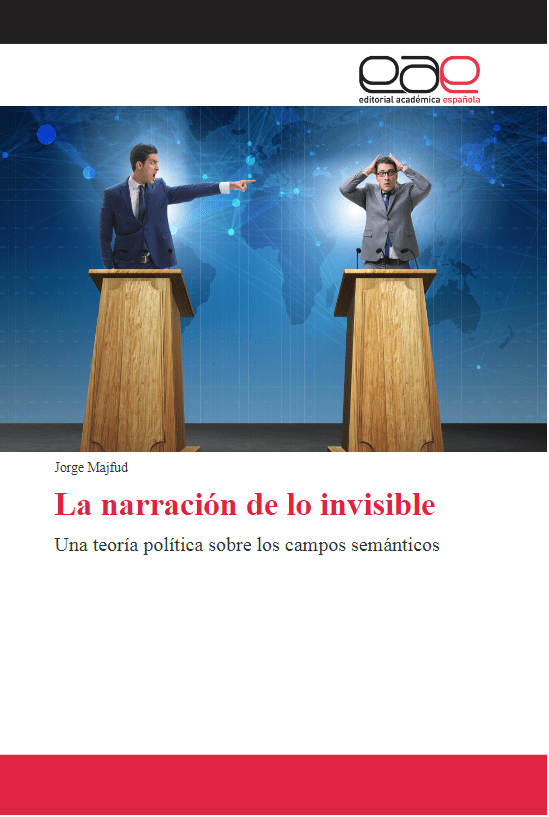
The starting point is the assertion that social reality is not presented directly, but mediated by narrative structures that precede events and condition their interpretation. This mediation, the author points out, is twofold: on the one hand, it is formed by a historical set of concepts, values, and imaginaries; on the other, it is actualized in concrete discourses that reinforce, correct, or challenge those structures. The invisibility alluded to in the title refers to that deep level of cultural assumptions that orders what can be said and thought.
Majfud articulates his proposal based on what he calls “semantic field theory,” an analytical tool through which he studies not only explicit meanings, but also their negations, associations, exclusions, and effects of meaning. In this perspective, an idea is never defined solely by its direct formulation, but by the network of relationships it maintains with a broader set of socially shared notions. The notion of “field” points precisely to this network of links that determines the reading of a word, a conflict, or an identity. The “semantic” dimension is not limited to language, but encompasses practices, institutions, and representations that shape the social world.
On this theoretical basis, the author examines a series of cultural and political debates, with a special emphasis on Latin America, where he identifies the way in which certain diagnoses are repeated, consolidated, and acquire the force of self-evident truths. One of the cases he analyzes—present in various passages of the book—is that of “Latin American failure,” a recurring topic in both critical and conservative discourses. For Majfud, this category is a paradigmatic example of how a concept laden with history is transformed into an apparently objective fact. The idea of “failure” thus acquires a descriptive status that obscures the conditions of its production, from its colonial roots to contemporary geopolitical relations.
The author also reviews the ways in which different Latin American thinkers have interpreted this diagnosis. He focuses on the explanations of Eduardo Galeano and Carlos Alberto Montaner, two opposing ideological visions that nevertheless share the same starting point: the acceptance of a failed destiny. Majfud shows how both discourses reorganize the semantic field of the continent, one emphasizing colonial heritage and the violence of empires, the other emphasizing cultural and political traditions that would be incapable of articulating a sustained modernizing project. What is relevant for the author is not the empirical validity of each argument, but the mechanism by which the category of “failure” operates as a conceptual core that orders and limits possible interpretations of the past and the future.

A discourse is defined not only by what it affirms, but also—and often more powerfully—by what it discards, minimizes, or renders irrelevant.
This reading introduces one of the central themes of the book: the idea that societies construct their interpretations based on “fundamental negations.” A discourse is defined not only by what it affirms, but also—and often more powerfully—by what it discards, minimizes, or renders irrelevant. Majfud shows, for example, how certain historical explanations support their arguments by rendering invisible external factors such as geopolitical constraints, international financial pressures, or structural inequalities in the global system. Conversely, other narratives emphasize these elements but omit internal components, such as local political disputes or cultural tensions. The author’s analysis highlights this interplay of absences and presences that shapes the common sense of an era.
Another of the book’s core themes is the examination of the “narrative devices that consolidate social identities.” Majfud explores how the figures of “the other,” “the enemy,” “the people,” or “the nation” are constructed, and how these concepts function as organizing axes of the collective imagination. The author observes that these figures do not operate as fixed categories, but are reconfigured according to political circumstances, changing their content without losing their structuring function. The idea of “national identity,” for example, can articulate progressive or conservative, inclusive or exclusive discourses, depending on how the semantic fields that sustain it are rearranged.
The book also focuses on the relationship between “language and power,” pointing out that the dispute over meanings is one of the main ways in which political conflicts manifest themselves.
The book also focuses on the relationship between “language and power,” pointing out that the dispute over meanings is one of the main ways in which political conflicts manifest themselves. For Majfud, the struggle to impose a particular reading of reality is inseparable from the struggle to transform or preserve social structures. This political dimension of language is not limited to explicit public debates, but manifests itself in the way institutions, the media, educational systems, and even everyday life reproduce particular meanings and discourage others. The author emphasizes that the stability of a social order depends largely on the stability of the narratives that legitimize it.
Within this conceptual architecture, Majfud also introduces the notion of “ideolexicon,” understood as the set of ideological discourses that operate under the guise of positive, open, or neutral categories. The author identifies forms of implicit violence that manifest themselves in narratives that naturalize hierarchies or inequalities, such as 19th-century social Darwinism, certain libertarian currents of the 20th century, or the languages of contemporary neoliberalism. In his approach, the “ideolexico” does not act as an explicitly political statement, but as a semantic device that structures social interpretation by presenting ideological postulates as rational or inevitable evidence. This dimension is integrated into his theory of semantic fields and reinforces the idea that the dispute over meanings also includes discourses that are perceived as non-ideological.
Within his conceptual architecture, Majfud also introduces the notion of ideolexico, understood as the set of ideological discourses that operate under the guise of positive, open, or neutral categories.
Within this reflection, Majfud gives central importance to the role of “historical memory.” He asserts that a society does not only remember the events of the past, but also the interpretations it has inherited about them. These interpretations, he points out, function as filters that organize our understanding of the present. The author examines historical episodes in Latin America to show how different narratives can make certain elements visible and hide others, structuring a selective perception that conditions expectations, fears, and collective projects.
A notable aspect of the book is the way it combines historical analysis, philosophical reflection, and cultural criticism. The “invisibility” that the author seeks to narrate is not metaphysical, but social: it is the everyday mechanisms that define what is considered normal, inevitable, or natural. For Majfud, this naturalization is one of the most persistent and difficult elements to question in social life, because it is rooted in unconscious practices, cultural habits, and institutional devices that are rarely problematized.
Majfud argues that understanding the mechanisms of meaning production is a fundamental step in questioning the apparent inevitability of certain social orders.
The text progresses in an argumentative and cumulative manner, using historical examples, intellectual references, and critical readings of public discourses. In several chapters, Majfud compares modes of thought and explanatory models, showing how societies create interpretive frameworks that then function as seemingly neutral criteria for evaluating their own trajectory. The author emphasizes that this circularity—the way in which a diagnosis becomes both cause and consequence at the same time—is one of the main challenges for critical thinking.
In the final section of the book, Majfud returns to the political dimension of his theoretical proposal. He argues that understanding the mechanisms of meaning production is a fundamental step in questioning the apparent inevitability of certain social orders. Although the text does not prescribe solutions or promote ideological programs, it emphasizes the importance of denaturalizing established categories. For the author, the critical task consists of examining the “semantic fields” that sustain our beliefs, detecting their omissions, and exploring alternatives that allow us to imagine other ways of organizing collective life.
Overall, La narración de lo invisible offers a systematic reflection on how the meanings that structure social experience are produced, disputed, and transformed. Its main contribution lies in showing that visible reality is sustained by a broader conceptual framework that is historically constituted and, to a large extent, imperceptible. Through the articulation of theory and case analysis, Majfud develops a perspective that allows us to understand how discourses influence our perception of the world and how that perception, in turn, conditions political and cultural action. The result is a study that proposes a rethinking of the relationship between language, power, and memory from a perspective that privileges the complexity of symbolic processes and the historicity of social narratives.
Marcelo Valenti, Esfera Comunicacional


 Escritos Críticos
Debe estar conectado para enviar un comentario.