The Privatization of God

Blaise Pascal first explained his wager in Pen...

Image via Wikipedia

The Privatization of God


by Jorge Majfud

The University of Georgia

Custom-made for the consumer

In the 17th century, the mathematics genius Blaise Pascal wrote that men never do evil with greater pleasure than when they do it with religious conviction. This idea – from a deeply religious man – has taken a variety of different forms since. During the last century, the greatest crimes against humanity were promoted, with pride and passion, in the name of Progress, of Justice and of Freedom. In the name of Love, Puritans and moralists organized hatred, oppression and humiliation; in the name of Life, leaders and prophets spilled death over vast regions of the planet. Presently, God has come to be the main excuse for excercises in hate and death, hiding political ambitions, earthly and infernal interests behind sacred invocations. In this way, by reducing each tragedy on the planet to the millenarian and simplified tradition of the struggle between Good and Evil, of God against the Devil, hatred, violence and death are legitimated. There is no other way to explain how men and women are inclined to pray with fanatical pride and hypocritical humility, as if they were pure angels, models of morality, all the while hiding gunpowder in their clothing, or a check made out to death. And if the leaders are aware of the fraud, their subjects are no less responsible for being stupid, no less culpable for their criminal metaphysical convictions, in the name of God and Morality – when not in the name of a race, of a culture – and from a long tradition, recently on exhibit, custom-fit to the latest in hatred and ambition.

Empire of the simplifications

Yes, we can believe in the people. We can believe that they are capable of the most astounding creations – as will be one day their own liberation – and also of incommensurable stupidities, these latter always concealed by a complacent and self-interested discourse that manages to nullify criticism and any challenge to bad conscience. But, how did we come to such criminal negligence? Where does so much pride come from in a world where violence grows daily and more and more people claim to have heard the voice of God?

Political history demonstrates that a simplification is more powerful and better received by the vast majority of a society than is a problematization. For a politician or for a spiritual leader, for example, it is a show of weakness to admit that reality is complex. If one’s adversary expunges from a problem all of its contradictions and presents it to the public as a struggle between Good and Evil, the adversary undoubtedly is more likely to triumph. In the final analysis, the primary lesson of our time is grounded in commercial advertising or in permissive submission: we elect and we buy that which solves our problems for us, quickly and cheaply, even though the problem might be created by the solution, and even though the problem might continue to be real while the solution is never more than virtual. Nonetheless, a simplification does not eliminate the complexity of the problem in question, but rather, on the contrary, produces greater problems, and sometimes tragic consequences. Denying a disease does not cure it; it makes it worse.

Why don’t we talk about why?

Let’s try now to problematize some social phenomenon. Undoubtedly, we will not plumb the full depths of its complexity, but we can get an idea of the degree of simplification with which it is treated on a daily basis, and not always innocently.

Let’s start with a brief example. Consider the case of a man who rapes and kills a young girl. I take this example not only because it is, along with torture, one of the most abhorrent crimes imaginable, but because it represents a common criminal practice in all societies, even those that boast of their special moral virtues.

First of all, we have a crime. Beyond the semantics of “crime” and “punishment,” we can evaluate the act on its own merits, without, that is, needing to recur to a genealogy of the criminal and of his victim, or needing to research the origins of the criminal’s conduct. Both the rape and the murder should be punished by the law, and by the rest of society. And period. On this view, there is no room for discussion.

Very well. Now let’s imagine that in a given country the number of rapes and murders doubles in a particular year and then doubles again the year after that. A simplification would be to reduce the new phenomenon to the criminal deed described above. That is to say, a simplification would be to understand that the solution to the problem would be to not let a single one of these crimes go unpunished. Stated in a third way, a simplification would be to not recognize the social realities behind the individual criminal act. A more in-depth analysis of the first case could reveal to us a painful childhood, marked by the sexual abuse of the future abuser, of the future criminal. This observation would not in any way overturn the criminality of the deed itself, just as evaluated above, but it would allow us to begin to see the complexity of a problem that a simplification threatens to perpetuate. Starting from this psychological analysis of the individual, we could certainly continue on to observe other kinds of implications arising from the same criminal’s circumstances, such as, for example, the economic conditions of a specific social underclass, its exploitation and moral stigmatization by the rest of society, the moral violence and humiliation of its misery, its scales of moral value constructed in accordance with an apparatus of production, reproduction and contradictory consumption, by social institutions like a public education system that helps the poor less than it humiliates them, certain religious organizations that have created sin for the poor while using the latter to earn Paradise for themselves, the mass media, advertising, labor contradictions… and so on.

We can understand terrorism in our time in the same way. The criminality of an act of terrorism is not open to discussion (or it shouldn’t be). Killing is always a disgrace, a historical curse. But killing innocents and on a grand scale can have no justification or pardon of any kind. Therefore, to renounce punishment for those who promote terrorism is an act of cowardice and a flagrant concession to impunity.

Nevertheless, we should also remember here our initial caveat. Understanding a social and historical phenomenon as a consequence of the existence of “bad guys” on Earth is an extremely naive simplification or, to the contrary, an ideologically astute simplification that, by avoiding integrated analysis – historical, economic, political – exempts the administrators of the meaning of “bad”: the good guys.

We will not even begin to analyze, in these brief reflections, how one comes to identify one particular group and not others with the qualifier “terrorist.” For that let it suffice to recommend a reading of Roland Barthes – to mention just one classic source. We will assume the restricted meaning of the term, which is the one assumed by the press and the mainstream political narratives.

Even so, if we resort to the idea that terrorism exists because criminals exist in the world, we would have to think that in recent times there has been an especially abundant harvest of wicked people. (An idea explicitly present in the official discourse of all the governments of countries affected by the phenomenon.) But if it were true that in our world today there are more bad people than before, surely it isn’t by the grace of God but via historical developments that such a phenomenon has come to be. No historical circumstance is produced by chance, and therefore, to believe that killing terrorists will eliminate terrorism from the world is not only a foolish simplification but, by denying a historical origin for the problem, by presenting it as ahistorical, as purely a product of Evil, even as a struggle between two theological “essences” removed from any social, economic and political context, provokes a tragic worsening of the situation. It is a way of not confronting the problem, of not attacking its deep roots.

On many occasions violence is unavoidable. For example, if someone attacks us it would seem legitimate to defend ourselves with an equal degree of violence. Certainly a true Christian would offer the other cheek before instigating a violent reaction; however, if he were to respond violently to an act of aggression no one could deny him the right, even though he might be contradicting one of the commandments of Christ. But if a person or a government tells us that violence will be diminished by unleashing violence against the bad guys – affecting the innocent in the process – not only does this deny the search for a cause for the violence, it also will serve to strengthen it, or at least legitimate it, in the eyes of those who suffer the consequences.

Punishing those responsible for the violence is an act of justice. Claiming that violence exists only because violent people exist is an act of ignorance or of ideological manipulation.

If one continues to simplify the problem, insisting that it consists of a conflict produced by the “incompatibility” of two religious views – as if one of them had not been present for centuries – as if it were a matter of a simple kind of war where victory is achieved only with the total defeat of the enemy, one will drag the entire world into an intercontinental war. If one genuinely seeks the social origin and motivation of the problem – the “why” – and acts to eliminate and attenuate it, we will most assuredly witness a relaxing of the tension that is currently escalating. We will not see the end of violence and injustice in the world, but at least misfortune of unimaginable proportions will be avoided.

The analysis of the “origin of violence” would be useless if it were produced and consumed only within a university. It should be a problem for the headlines, a problem to be discussed dispassionately in the bars and in the streets. At the same time, we will have to recognize, once again, that we need a genuine dialogue. Not a return to the diplomatic farce, but a dialogue between peoples who have begun dangerously to see one another as enemies, as threats – a disagreement, really, based on a profound and crushing ignorance of the other and of oneself. What is urgent is a painful but courageous dialogue, where each one of us might recognize our prejudice and our self-centeredness. A dialogue that dispenses with the religious fanaticism – both Muslim and Christian – so in vogue these days, with its messianic and moralizing pretensions. A dialogue, in short, to spite the deaf who refuse to hear.

The True God

According to the true believers and the true religion, there can be only one true God, God. Some claim that the true God is One and he is Three at the same time, but judging by the evidence, God is One and Many more. The true God is unique but with different politics according to the interests of the true believers. Each one is the true God, each one moves the faithful against the faithful of other gods, which are always false gods even though each one is someone’s true God. Each true God organizes the virtue of each virtuous people on the basis of true customs and the true Morality. There is only one Morality based on the true God, but since there is more than one true God there is also more than one true Morality, only one of which is truly true.

But, how do we know which one is the true truth? The proper methods for proof are disputable; what is not disputed is the current practice: scorn, threats, oppression and, when in doubt, death. True death is always the final and inevitable recourse of the true truth, which comes from the true God, in order to save the true Morality and, above all, the true believers.

Yes, at times I have my doubts about what is true, and I know that doubt has been condemned by all religions, by all theologies, and by all political discourses. At times I have my doubts, but it is likely that God does not hold my doubt in contempt. He must be very busy concerning himself with so much certainty, so much pride, so much morality, behind so many ministers who have taken control of his word, holding Him hostage in a building somewhere so as to be able to conduct their business in public without obstacles.

Jorge Majfud

Translated by Bruce Campbell.

Monthly Review (New York)

Propaganda and the Myth of Reconquest

Diego Rivera

Image via Wikipedia

Propaganda and the Myth of Reconquest


By Jorge Majfud

A few days ago a well-known syndicated talk radio personality repeatedly asserted an opinion that is becoming common these days:  illegal immigrants should be denounced as dishonest and criminal, not only because they have entered the U.S. illegally but, mainly, because their objective is the Reconquest.

Let’s analyze the syllogism posited here. Even assuming that illegal workers are Reconquistadors – that’s what they were called – which is to say that they lay claim to vast territories lost by Mexico to Anglo Saxon settlers in the 19th century, one would have to conclude, according to the argument of the angry sophists, that the U.S. is founded on illegitimacy and the actions of alleged criminals.  (Texas was conquered in 1836 and thereby re-established slavery in a Mexican territory where it was illegal; other Western states met the same fate, following a war with Mexico and a payment to the vanquished in the manner of a purchase, because by then money was already a powerful legitimating agent.)

Now, if a reconquest is a crime, then what is a conquest?  In any case it would be understandable to assert that this immigration phenomenon is not politically convenient (although economically it appears to be so). But, dishonest? Criminal?  Would they dare to qualify as criminal the Spanish Reconquest of the Iberian Peninsula?  No, of course not, and not because it wasn1t carried out in a bloody and racist fashion, but because in that case it was a matter of Christians against Muslims – and Jews.

Any conquest, like any reconquest, is a simple political deed that aims to hide behind morality. The legitimacy of the deed always originates from force; propaganda then takes on the task of confusing force with morality, or with exposing the contradictions to analysis. In general, the former is abused by the victors, and the latter is a meager resource of the vanquished.  Much like today, in the Middle Ages propaganda, religious and political, was indispensable.  The nobility, the upper classes, were the ones who produced the greatest quantity of nationalist propaganda, aimed at morally orienting the people. Nevertheless, both in the early years of the Muslim conquest in Spain, and later in the Spanish conquest in the Americas, the upper classes were the first to come to an agreement with the invaders in order to maintain their class and gender privileges.

Propaganda is the hook in the jaw of history.  The idea of a reconquest is a fiction for millions of expatriated workers, the forever disinherited who simply look to survive and feed their economically marginal families by recourse to a hundred-years-old, unjust, anachronistic social tradition.  But it is a strategic fiction for the propagandists who are able to use it to hide the dramatic political rationale – i.e., the rationale of power – that exists behind the moralizing discourse.

Every time I hear someone sermonizing, I lose faith. That faith to which the haranguers of the U.S. extreme right and the caudillos of Latin American liberation lay claim. The more I hear, the less I believe.  But this surely is the fault of my personal inability to enjoy what other people enjoy, like the safety of trenches dug with propaganda and self-indulgence.
Jorge Majfud, The University of Georgia. July 2006.
Translated by Bruce Campbell

The History of Immigration

Cesar Chavez Estrada

Image by Troy Holden via Flickr

The History of Immigration


by Jorge Majfud


One of the typical – correction: stereotypical – images of a Mexican has been, for more than a century, a short, drunk, trouble-maker of a man who, when not appearing with guitar in hand singing a corrido, was portrayed seated in the street taking a siesta under an enormous sombrero. This image of the perfect idler, of the irrational embodiment of vice, can be traced from old 19th century illustrations to the souvenirs that Mexicans themselves produce to satisfy the tourist industry, passing through, along the way, the comic books and cartoons of Walt Disney and Warner Bros. in the 20th century. We know that nothing is accidental; even the defenders of “innocence” in the arts, of the harmless entertainment value of film, of music and of literature, cannot keep us from pointing out the ethical significance and ideological function of the most infantile characters and the most “neutral” storylines. Of course, art is much more than a mere ideological instrument; but that does not save it from manipulation by one human group for its own benefit and to the detriment of others. Let’s at least not refer to as “art” that kind of garbage.

Ironies of history: few human groups, like the Mexicans who today live in the U.S. – and, by extension, all the other Hispanic groups, – can say that they best represent the spirit of work and sacrifice of this country. Few (North) Americans could compete with those millions of self-abnegating workers who we can see everywhere, sweating beneath the sun on the most suffocating summer days, in the cities and in the fields, pouring hot asphalt or shoveling snow off the roads, risking their lives on towering buildings under construction or while washing the windows of important offices that decide the fate of the millions of people who, in the language of postmodernity, are known as “consumers.” Not to mention their female counterparts who do the rest of the hard work – since all the work is equally “dirty” – occupying positions in which we rarely see citizens with full rights. None of which justifies the racist speech that Mexico’s president, Vicente Fox, gave recently, declaring that Mexicans in the U.S. do work that “not even black Americans want to do.” The Fox administration never retracted the statement, never recognized this “error” but rather, on the contrary, accused the rest of humanity of having “misinterpreted” his words. He then proceeded to invite a couple of “African-American” leaders (some day someone will explain to me in what sense these Americans are African), employing an old tactic: the rebel, the dissident, is neutralized with flowers, the savage beast with music, and the wage slaves with movie theaters and brothels. Certainly, it would have sufficed to avoid the adjective “black” and used “poor” instead. In truth, this semantic cosmetics would have been more intelligent but not completely free of suspicion. Capitalist ethics condemns racism, since its productive logic is indifferent to the races and, as the 19th century shows, slave trafficking was always against the interests of industrial production. Hence, anti-racist humanism has a well-established place in the hearts of nations and it is no longer so easy to eradicate it except through practices that hide behind elaborate and persuasive social discourses. Nevertheless, the same capitalist ethics approves the existence of the “poor,” and thus nobody would have been scandalized if instead of “blacks,” the Mexican president had said “poor Americans.” All of this demonstrates, meanwhile, that not only those in the economic North live off of the unhappy immigrants who risk their lives crossing the border, but also the politicians and ruling class of the economic South, who obtain, through millions of remittances, the second most important source of revenue after petroleum, by way of Western Union to the “madre pobre,” from the blood and sweat of those expelled by a system that then takes pride in them, and rewards them with such brilliant discourses that serve only to add yet another problem to their desperate lives of fugitive production.

Violence is not only physical; it is also moral. After contributing an invaluable part of the economy of this country and of the countries from which they come – and of those countries from which they were expelled by hunger, unemployment and the disfavor of corruption – the nameless men, the unidentified, must return to their overcrowded rooms for fear of being discovered as illegals. When they become sick, they simply work on, until they are at death’s door and go to a hospital where they receive aid and understanding from one morally conscious part of the population while another tries to deny it to them. This latter part includes the various anti-immigrant organizations that, with the pretext of protecting the national borders or defending the rule of law, have promoted hostile laws and attitudes which increasingly deny the human right to health or tranquility to those workers who have fallen into illegality by force of necessity, through the empire of logic of the same system that will not recognize them, a system which translates its contradictions into the dead and destroyed. Of course we can not and should not be in favor of any kind of illegality. A democracy is that system where the rules are changed, not broken. But laws are a product of a reality and of a people, they are changed or maintained according to the interests of those who have power to do so, and at times these interests can by-pass the most fundamental Human Rights. Undocumented workers will never have even the most minimal right to participate in any electoral simulacrum, neither here nor on the other side of the border: they have been born out of time and out of place, with the sole function of leaving their blood in the production process, in the maintenance of an order of privilege that repeatedly excludes them and at the same time makes use of them. Everyone knows they exist, everyone knows where they are, everyone knows where they come from and where they’re going; but nobody wants to see them. Perhaps their children will cease to be ill-born wage slaves, but by then the slaves will have died. And if there is no heaven, they will have been screwed once and forever. And if there is one and they didn’t have time to repeat one hundred times the correct words, they will be worse off still, because they will go to Hell, posthumous recognition instead of attaining the peace and oblivion so desired.

As long as the citizens, those with “true human” status, can enjoy the benefits of having servants in exchange for a minimum wage and practically no rights, threatened day and night by all kinds of haunts, they will see no need to change the laws in order to recognize a reality installed a posteriori. This seems almost logical. Nonetheless, what ceases to be “logical” – if we discard the racist ideology – are the arguments of those who accuse immigrant workers of damaging the country’s economy by making use of services like hospitalization. Naturally, these anti-immigrant groups ignore the fact that Social Security takes in the not insignificant sum of seven billion dollars a year from contributions made by illegal immigrants who, if they die before attaining legal status, will never receive a penny of the benefit. Which means fewer guests at the banquet. Nor, apparently, are they able to understand that if a businessman has a fleet of trucks he must set aside a percentage of his profits to repair the wear and tear, malfunctions and accidents arising from their use. It would be strange reasoning, above all for a capitalist businessman, to not send those trucks in for servicing in order to save on maintenance costs; or to send them in and then blame the mechanic for taking advantage of his business. Nevertheless, this is the kind and character of arguments that one reads in the newspapers and hears on television, almost daily, made by these groups of inflamed “patriots” who, despite their claims, don’t represent a public that is much more heterogeneous than it appears from the outside – millions of men and women, overlooked by simplistic anti-American rhetoric, feel and act differently, in a more humane way.

Of course, it’s not just logical thinking that fails them. They also suffer from memory loss. They have forgotten, all of a sudden, where their grandparents came from. Except, that is, for that extremely reduced ethnic group of American-Americans – I refer to the indigenous peoples who came prior to Columbus and the Mayflower, and who are the only ones never seen in the anti-immigrant groups, since among the xenophobes there is an abundance of Hispanics, not coincidentally recently “naturalized” citizens. The rest of the residents of this country have come from some part of the world other than where they now stand with their dogs, their flags, their jaws outthrust and their hunter’s binoculars, safeguarding the borders from the malodorous poor who would do them harm by attacking the purity of their national identity. Suddenly, they forget where a large part of their food and raw materials come from and under what conditions they are produced. Suddenly they forget that they are not alone in this world and that this world does not owe them more than what they owe the world.

Elsewhere I have mentioned the unknown slaves of Africa, who if indeed are poor on their own are no less unhappy for fault of others; the slaves who provide the world with the finest of chocolates and the most expensive wood without the minimal recompense that the proud market claims as Sacred Law, strategic fantasy this, that merely serves to mask the one true Law that rules the world: the law of power and interests hidden beneath the robes of morality, liberty and right. I have in my memory, etched with fire, those village youths, broken and sickly, from a remote corner of Mozambique who carried tons of tree trunks for nothing more than a pack of cigarettes. Cargo worth millions that would later appear in the ports to enrich a few white businessmen who came from abroad, while in the forests a few dead were left behind, unimportant, crushed by the trunks and ignored by the law of their own country.

Suddenly they forget or refuse to remember. Let’s not ask of them more than what they are capable of. Let’s recall briefly, for ourselves, the effect of immigration on history. From pre-history, at each step we will find movements of human beings, not from one valley to another but crossing oceans and entire continents. The “pure race” proclaimed by Hitler had not emerged through spontaneous generation or from some seed planted in the mud of the Black Forest but instead had crossed half of Asia and was surely the result of innumerable crossbreedings and of an inconvenient and denied evolution (uniting blonds with blacks) that lightened originally dark faces and put gold in their hair and emerald in their eyes. After the fall of Constantinople to the Turks, in 1453, the wave of Greeks moving into Italy initiated a great part of that economic and spiritual movement we would later know as the Rennaissance. Although generally forgotten, the immigration of Arabs and Jews would also provoke, in the sleepy Europe of the Middle Ages, different social, economic and cultural movements that the immobility of “purity” had prevented for centuries. In fact, the vocation of “purity” – racial, religious and cultural – that sunk the Spanish Empire and led it to bankrupcy several times, despite all of the gold of the Americas, was responsible for the persecution and expulsion of the (Spanish) Jews in 1492 and of the (Spanish) Arabs a century later. An expulsion which, paradoxically, benefited the Netherlands and England in a progressive process that would culminate in the Industrial Revolution. And we can say the same for our Latin American countries. If I were to limit myself to just my own country, Uruguay, I could recall the “golden years” – if there were ever years of such color – of its economic and cultural development, coinciding, not by accident, with a boom in immigration that took effect from the end of the 19th until the middle of the 20th century. Our country not only developed one of the most advanced and democratic educational systems of the period, but also, comparatively, had no cause to envy the progress of the most developed countries of the world, even though its population lacked, due to its scale, the geopolitical weight enjoyed by other countries at the time. At present, cultural immobility has precipitated an inverted migration, from the country of the children and grandchildren of immigrants to the country of the grandparents. The difference is rooted in the fact that the Europeans who fled from hunger and violence found in the Río de la Plata (and in so many other ports of Latin America) the doors wide open; their descendants, or the children and grandchildren of those who opened the doors to them, now enter Europe through the back door, although they appear to fall from the sky. And if indeed it is necessary to remember that a large part of the European population receives them happily, at a personal level, neither the laws nor general practice correspond to this good will. They aren’t even third class citizens; they are nothing and the management reserves the right to deny admission, which may mean a kick in the pants and deportation as criminals.

In order to obscure the old and irreplaceable Law of interests, it is argued – as Orian Fallaci has done so unjustly – that these are not the times of the First or Second World War and, therefore, one immigration cannot be compared to another. In fact, we know that one period can never be reduced to another, but they can indeed be compared. Or else history and memory serve no purpose. If tomorrow in Europe the same conditions of economic necessity that caused its citizens to emigrate before were to be repeated, they would quickly forget the argument that our times are not comparable to other historical periods and, hence, it’s reasonable to forget.

I understand that in a society, unlike a controlled laboratory experiment, every cause is an effect and viceversa – a cause cannot modify a social order without becoming the effect of itself or of something else. For the same reason, I understand that culture (the world of customs and ideas) influences a given economic and material order as much as the other way around. The idea of the determining infrastructure is the base of the Marxist analytical code, while the inverse (culture as a determinant of socio-economic reality) is basic for those who reacted to the fame of materialism. For the reasons mentioned above, I understand that the problem here lies in the idea of “determinism,” in either of the two senses. For its part, every culture promotes an interpretive code according to its own Interests and, in fact, does so to the measure of its own Power. A synthesis of the two approaches is also necessary for our problem. If the poverty of Mexico, for example, were only the result of a cultural “deformity” – as currently proposed by the theorists and specialists of Latin American Idiocy – the new economic necessities of Mexican immigrants to the United States would not produce workers who are more stoic and long-suffering than any others in the host country: the result would simply be “immigrant idlers.” And reality seems to show us otherwise. Certainly, as Jesus said, “there is none more blind than he who will not see.”


Translated by Bruce Campbell


Why Culture Matters


Why Culture Matters

https://web.archive.org/web/20201021181353/https://judolphinmedia.com/14437/editorial/the-oldest-enemy-of-civilization/

In September of 2006, in Lewisburg, Tennessee, a neighborhood group protested because the public library was investing resources in the purchase of books in Spanish.  Of the sixty thousand volumes, only one thousand were published in a language other than English.  The annual budget, totalling thirteen thousand dollars, dedicates the sum of one hundred and thirty dollars to the purchase of books in Spanish. The buying spree representing one percent of the budget enraged some of the citizens of Tennessee, causing them to take the issue to the authorities, arguing that a public service, sustained through taxes charged to the U.S. populace, should not promote something that might benefit illegal workers.

Thus, the new conception of culture surpasses that distant precept of the ancient library of Alexandria.  That now almost completely forgotten library achieved the height of its development in second century Egypt.  Its backward administrators had the custom of periodically sending investigators throughout the world in order to acquire copies of texts from the most distant cultures.  Among its volumes there were copies of Greek, Persian, Indian, Hebrew and African texts.  Almost all of those decades-long efforts were abruptly brought to an end, thanks to a fire caused by the enlightene ships of the emperor Julius Caesar.  Nearly a thousand years later, another deliberately-set fire destroyed the similarly celebrated library of Córdoba, founded by the caliph Al-Hakam (creator of the University and of free education), where the passion for knowledge brought together Jews, Christians and Arabs with texts from the most diverse cultures known in the period.  Also in this period, the Spanish caliphs were in the habit of dispatching seekers throughout the world in order to expand the library’s collection of foreign books.  This library was also destroyed by a fanatic, al-Mansur, in the name of Islam, according to his own interpretation of the common good and superior morality.

The Tennessee anecdote represents a minority in a vast and heterogeneous country.  But it remains significant and concerning, like a sneeze on a passenger train.  Also significant is the idea, assumed there, that the Spanish language is a foreign language, when any half-way educated person knows that before English it was Spanish that was spoken in what today is the United States; that Spanish has been there, in many states of the Union for more than four hundred years; that Spanish and Latino culture are neither foreign nor an insignificant minority: more than forty million “Hispanics” live in the United States and the number of Spanish-speakers in the country is roughly equivalent to the number of Spanish speakers living in Spain.  If those who become nervous because of the presence of that “new culture” had the slightest historical awareness, they would neither be nervous nor consider their neighbors to be dangerous foreigners.  The only thing that historically has always been dangerous is ignorance, which is why the promotion of ignorance can hardly be considered synonymous with security and progress – even by association, as with the reigning method of propaganda, which consists of associating cars with women, tomatoes with civil rights, the victory of force with proof of the Truth or a million dollars with Paradise.

Jorge Majfud

The University of Georgia, October 2006.

The Culture of Hate

The Culture of Hate


On the silent revolution and reaction of our time. The reasons for ultramodern chaos. On the colonization of language and how traditional authority reacts to historical progress using the anachronistic tools of repetition.

Universal Pedagogy of Obedience

The old pedagogical model was synthesized in the phrase “the letters enter with blood.” This was the ideological support that allowed the teacher to strike with a ruler the buttocks or hands of the bad students. When the bad student was able to memorize and repeat what the teacher wanted, the punishment would end and the reward would begin. Then the bad student, having now been turned into “a good man,” could take over teaching by repeating the same methods. It is not by accident that the celebrated Argentine statist and pedagogue, F. Sarmiento, would declare that “a child is nothing more than an animal that must be tamed and educated.” In fact, this is the very method one uses to domesticate any old animal. “Teaching” a dog means nothing more than “making it obedient” to the will of its master, humanizing it. Which is a form of canine degeneration, just like the frequent dehumanization of a man into a dog – I refer to Osvaldo Dragún’s theatrical work.

The social logic of it is not much different. Whoever has power is the one who defines what a particular word means. Social obedience is implicit. In this sense, there are key words that have been colonized in our culture, words like democracy, freedom, justice, patriot, development, civilization, barbarism, etc. If we observe the definition of each one of these words derived from the same power – the same master – we will see that it is only by dint of a violent, colonizing and monopolistic “learning” that the term is applied to a particular case and not to another one, to one appearance and not to another, to one flag and not another – and almost always with the compelling force of the obvious. It is this logic alone that dominates the discourse and headlines of daily newspapers the world over. Even the loser, who receives the semiotic stigma, must use this language, these ideological tools to defend (timidly) any position that differs from the official, established one.

Revolution and Reaction

What we are experiencing at present is a profound crisis which naturally derives from a radical change in system – structural and mental: from a system of representative obedience to a system of progressive democracy.

It is not by accident that this current reaction against the disobedience of nations would take the form of a rennaissance of religious authoritarianism, in the East as much as in the West. Here we might say, like Pi i Margall in 1853, that “revolution is peace and reaction is war.”  The difference in our time is rooted in the fact that both revolution and reaction are invisible; they are camouflaged by the chaos of events, by the messianic and apocalyptic discourses, disguised in the old reading codes inherited from the Modern Era.

The Grand Reactionary Strategy

Now, how does one sustain this reaction against radical democratization, which is the invisible and perhaps inevitable revolution? We might continue observing that one form of attack against this democratization is for the reaction itself to kidnap the very idea of “democracy.” But now let’s mention just a few of the least abstract symptoms.

At the center of the “developed world,” the most important television and radio networks repeat tiresomely the idea that “we are at war” and that “we must confront an enemy that wants to destroy us.” The evil desire of minority groups – minority but growing – is unquestionable. The objective, our destruction, is infinitely improbable; except, that is, for the assistance offered by self-betrayal, which consists in copying all of the defects of the enemy one pretends to combat. Not coincidentally, the same discourse is repeated among muslim peoples – without even beginning to consider anyone outside this simple dichotomy, product of another typical creation of the powers in conflict: the creation of false dilemmas.

In the most recent war, irrigated as always with copious innocent blood, we witnessed the repetition of the old model that is repeated every day and ceaselessly in so many corners of the world. A colonel, speaking from we know not which front, declared to a television channel of the Civilized World, dramatically: “It is on this road where the future of humanity will be decided; it is here where the ‘clash of civilizations’ is unfolding.” Throughout that day, as with all the previous days and all the days after, the words and ideas repeated over and over again were: enemy, war, danger, imminent, civilization and barbarism, etc. To raise doubts about this would be like denying the Holy Trinity before the Holy Inquisition or, even worse, questioning the virtues of money before Calvin, God’s chosen one. Because it is enough for one fanatic to call another fanatic “barbaric” or “infidel” to get others to agree that he needs to be killed. The final result is that it is rare for one of these barbaric people not to die by their own choice; most of those eliminated by the virtue of holy wars are innocents who would never choose to die. As in the time of Herod, the threat of the individual is eliminated by assassinating his entire generation – without ever achieving the objective, of course.

There is no choice: “it is necessary to win this war.” But it turns out that this war will produce no victors, only losers: peoples who do not trade in human flesh. The strangest thing is that “on this side” the ones who favor every possible war are the most radical Christians, when it was none other than Christ who opposed, in word and deed, all forms of violence, even when he could have crushed with the mere wave of his hand the entire Roman Empire – the center of civilization at the time – and his torturers as well. If the “religious leaders” of today had a miniscule portion of the infinite power of Jesus, they would invest it in winning their unfinished wars. Obviously if huge Christian sects, in an historic act of benediction and justification for the insatiable accumulation of wealth, have been able to pass an army of camels through the eye of that particular needle, how could the difficult precept of turning the other cheek present a problem? Not only is the other cheek not offered – which is only human, even though it’s not very Christian – but instead the most advanced forms of violence are brought to bear on distant nations in the name of Right, Justice, Peace and Freedom – and of Christian values. And even though among them there is no recourse to the private relief of Catholic confession, they often practice it anyway after a bombardment of scores of innocents: “we are so sorry…”

On another television program, a report showed Muslim fanatics sermonizing the masses, calling upon them to combat the Western enemy. The journalists asked professors and analysts “how is a Muslim fanatic created?” To which each specialist attempted to give a response by referring to the wickedness of these terrible people and other metaphysical arguments that, despite being useless for explaining something rationally, are quite useful for feeding the fear and desire for combat of their faithful viewers. It never occurs to them to consider the obvious: a Muslim fanatic is created in exactly the same way that a Christian fanatic is created, or a Jewish fanatic: believing themselves to be in possession of the absolute truth, the best morality and law and, above all, to be executors of the will of God – violence willing. To prove this one has only to take a look at the various holocausts that humanity has promoted in its brief history: none of them has lacked for Noble Purposes; almost all were committed with pride by the privileged sons of God.

If one is a true believer one should start by not doubting the sacred text which serves as the foundation of the doctrine or religion. This, which seems logical, becomes tragic when a minority demands from the rest of the nation the same attitude of blind obedience, usurping God’s role in representing God. What operates here is a transference of faith in the sacred texts to faith in the political texts. The King’s minister becomes the Prime Minister and the King ceases to govern. In most of the mass media we are not asked to think; we are asked to believe. It is the advertizing dynamic that shapes consumers with discourses based on simplification and obviousness. Everything is organized in order to convince us of something or to ratify our faith in a group, in a system, in a party. All in the guise of tolerance and diversity, of discussion and debate, where typically a grey representative of the contrarian position is invited to the table in order to humiliate or mock him. The committed journalist, like the politician, is a pastor who directs himself to an audience accustomed to hearing unquestionable sermons and theological opinions as if they were the word of God himself.

These observations are merely a beginning, because we would have to be very naïve indeed if we were to ignore the calculus of material interests on the part of the powerful, who – at least so far – have always decided, thumb up or thumb down, the fate of the innocent masses. Which is demonstrated by simply observing that the hundreds and thousands of innocent victims, aside from the occasional apology for mistakes made, are never the focus of the analysis about the wars and the permanent state of psychological, ideological and spiritual tension. (As an aside, I think it would be necessary to develop a scientific investigation regarding the heart rate of the viewers before and after witnessing an hour of these “informational” programs – or whatever you want to call them, since, in reality, the most informative part of these programs is the advertisements; the informational programming itself is propaganda, from the very moment in which they reproduce the colonized language.)

Dialogue has been cut off and the positions have polarized, poisoned by the hatred distilled by the big media, instruments of traditional power. “They are the incarnation of Evil”; “Our values are superior and therefore we have the right to exterminate them.” “The fate of humanity depends upon our success.” Etcetera.. In order for success to be possible we must first guarantee the obedience of our fellow citizens. But it remains to be asked whether “success in the war” is really the main objective or instead a mere means, ever deferrable, for maintaining the obedience of one’s own people, a people that was threatening to become independent and develop new forms of mutal understanding with other peoples. For all of this, propaganda, which is the propagation of hate, is indispensable. The beneficiaries are a minority; the majority simply obeys with passion and fanaticism: it is the culture of hate that sickens us day after day. But the culture of hate is not the metaphysical origin of Evil, but little more than an instrument of other interests. Because if hatred is a sentiment that can be democratized, in contrast private interests to date have been the property of an elite. Until Humanity understands that the well-being of the other does me no harm but quite the opposite: if the other does not hate, if the other is not oppressed by me, then I will also benefit from the other’s society. But one will have a heck of a time explaining this to the oppressor or to the oppressed; they will quickly come to an agreement to feed off of that perverse circle that keeps us from evolving together as Humanity.

Humanity will resist, as it has always resisted the most important changes in history. Resistance will not come from millions of innocents, for whom the benefits of historical progress will never arrive. For them is reserved the same old story: pain, torture and anonymous death that could have been avoided, at least in part, if the culture of hate had been replaced by the mutual comprehension that one day will be inevitable: the other is not necessarily an enemy that I must exterminate by poisoning my own brothers; what is to the benefit of the other will be to my benefit also.

This principle was Jesus’s conscience, a conscience that was later corrupted by centuries of religious fanaticism, the most anti-Christian Gospel imaginable. And the same could be said of other religions.

In 1866 Juan Montalvo testified to his own bitterness: “The most civilized peoples, those whose intelligence has taken flight to the heavens and whose practices are guided by morality, do not renounce war: their breasts are ever burning, their zealous heart leaps with the impulse for extermination.” And later: “The peace of Europe is not the peace of Jesus Christ, no: the peace of Europe is the peace of France and England, lack of confidence, mutual fear, threat; the one has armies sufficient to dominate the world, and only for that believes in peace; the other extends itself over the seas, controls every strait, rules the most important fortresses on earth, and only for that believes in peace.”

Exits from the Labyrinth

If knowledge – or ignorance – is demonstrated by speaking, wisdom is the superior state in which a man or a woman learns to listen. As Eduardo Galeano rightly recommended to the powerful of the world, the ruler’s job should be to listen more and speak less. Although only a rhetorical recommendation – in the sense that it is useless to give advice to those who will not listen – this remains an irrefutable principle for any democrat. But the discourses of the mass media and of the states, designed for creating soldiers, are only concerned with disciplining according to their own rules. Their struggle is the consolidation of ideological meaning in a colonized language divorced from the everyday reality of the speaker: their language is terribly creative of a terrible reality, almost always through abuse of the paradox and the oxymoron – as one might view the very notion of “communication media.” It is the autistic symptom of our societies that day after day they sink further into the culture of hate. It is information and it is deformation.

In many previous essays, I have departed from and arrived at two presuppositions that seem contradictory. The first: it is not true that history never repeats itself; it always repeats itself; it is only appearances that are not repeated. The second precept, at least four hundred years old: history progresses. That is to say, humanity learns from past experience and in the process overcomes itself. Both human realities have always battled each other. If the human race rememberd better and were less hypocritical, if it had greater awareness of its importance and were more rebellious against its false impotence, if instead of accepting the artificial fatalism of Clash of Civilizations it were to recognize the urgency of a Dialogue of Cultures, this battle would not sow the fields with corpses and nations with hate. The process of history, from its economic roots, is determined by and cannot be contradictory to the interests of humanity. What remains to be known is only how and when. If we accompany it with the new awareness demanded by posterity, we will not only advance a perhaps inevitable process; above all we will avoid more pain and the spilling of blood and death that has tinged the world hate-red in this greatest crisis of history.

© Jorge Majfud

The University of Georgia, November 2006.

Translated by Bruce Campbell


Complicity and Resistance in a Controlled Society

El pase de diapositivas requiere JavaScript.

Pictures: Yoana Kochneva,  Assistant Designer.

JU Hosted Panel Discussion on Lessons and Topics surrounding the Holocaust on Feb. 17

Jacksonville University and Remembering for the Future Community Holocaust Initiative presented “Complicity & Resistance in a Controlled Society” on Thursday, February 17 at 7 p.m. in Terry Concert Hall on campus.

The event, which was moderated by Dr. Douglas Hazzard, dean of the College of Arts and Sciences, was part of the Future’s 2011 lecture series which engages experts and the public in a discussion of some of the most important questions we face today on medical ethics, eugenics, perceptions of disability and diversity.

The following JU faculty and administrators presented at the event:

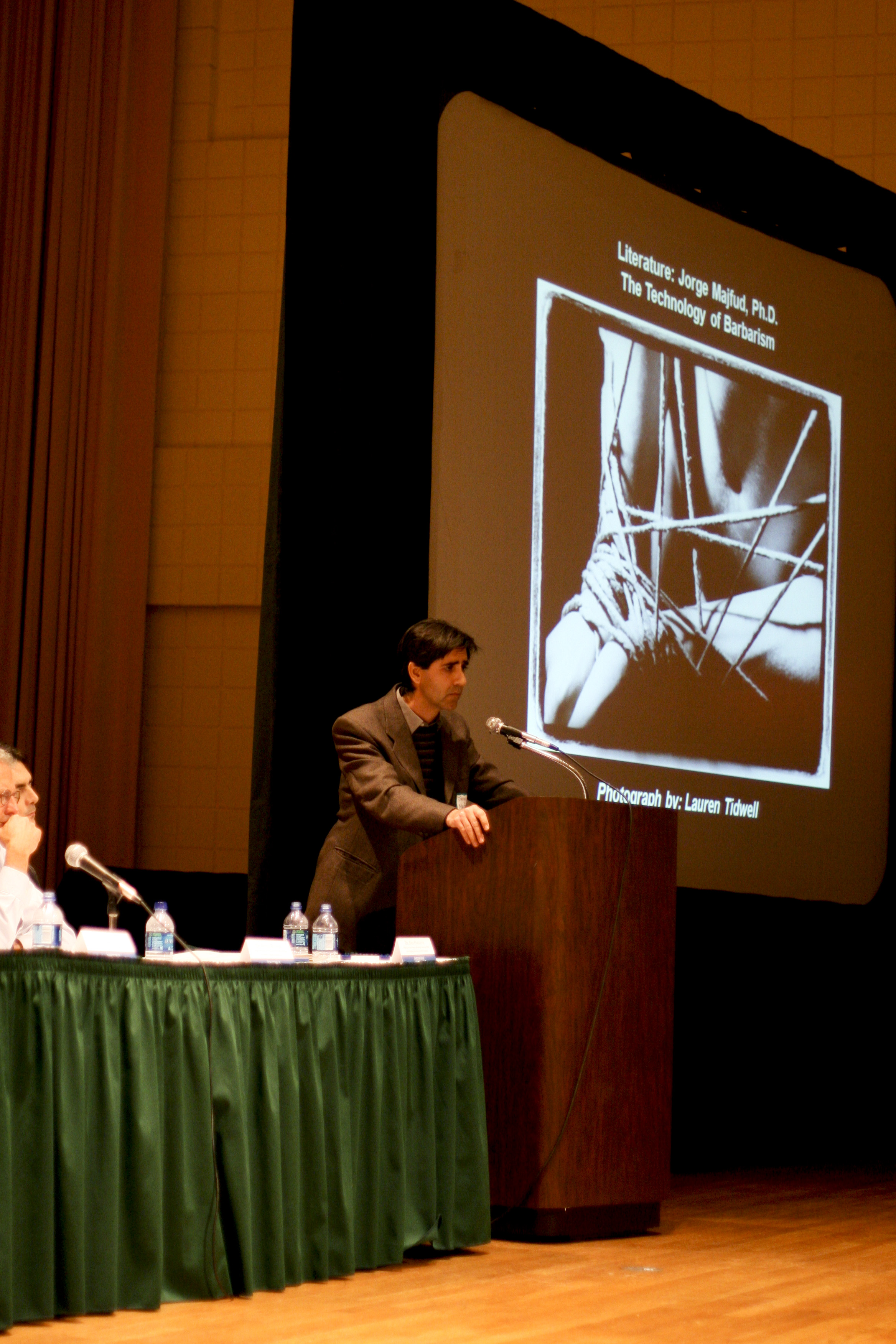
Dr. Andy Quellette, “DNA Profiling and a Universal DNA Database;” Dr. Nathan Rousseau, “The Intrinsic Dangers of Bureaucracy;” Dr. John Buck, “It’s Only Business: Cooperation & Denial in International Conflict;” Dr. Lois Becker, “Everyday Complicity & Resistance in Stalinist Russia;” Captain Lee Steele, USN, “Abu Ghraib—What Went Wrong;” Dr. Jorge Majfud, “The Technology of Barbarism;” and Dr. Scott Kimbrough, “The Capacity for Evil.”

There was also a photographic works on display, which were created by JU photography program students Jesse Brantman, Elise Gates, Ross Howard, Taylor Middleton, Dustin Mollohan, Suvarna Shah and Lauren Tidwell, under the direction of Ginger Sheridan, assistant professor of photography. Each student interviewed a Complicity and Resistance program panelist, and then created a small series of Modernist, B&W photographs expressing the photographer’s internal response to their speaker’s theme using abstract expressionist vocabulary.

ABOUT REMEMBERING FOR THE FUTURE
Remembering for the Future Community Holocaust Initiative uses the lessons of the Holocaust to confront hatred and discrimination and build understanding and acceptance throughout our community. Working together since 2004, we are a collaborative partnership of Jacksonville’s leading education, humanitarian, non-profit and government organizations, businesses and community leaders.

[read more >>]


The Slow Suicide of the West

Cover of "The Rage and the Pride: Interna...

Cover via Amazon

El lento suicidio de Occidente (Spanish)

The Slow Suicide of the West

Jorge Majfud

The West appears, suddenly, devoid of its greatest virtues, constructed century after century, preoccupied now only with reproducing its own defects and with copying the defects of others, such as authoritarianism and the preemptive persecution of innocents. Virtues like tolerance and self-criticism have never been a weakness, as some now pretend, but quite the opposite: it was because of them that progress, both ethical and material, were possible. Both the greatest hope and the greatest danger for the West can be found in its own heart. Those of us who hold neither “Rage” nor “Pride” for any race or culture feel nostalgia for times gone by, times that were never especially good, but were not so bad either.

Currently, some celebrities from back in the 20th century, demonstrating an irreversible decline into senility, have taken to propagating the famous ideology of the “clash of civilizations” – which was already plenty vulgar all by itself – basing their reasoning on their own conclusions, in the best style of classical theology. Such is the a priori and 19th century assertion that “Western culture is superior to all others.” And, if that were not enough, that it is a moral obligation to repeat it.

From this perspective of Western Superiority, the very famous Italian journalist Oriana Fallaci wrote, recently, brilliant observations such as the following: “If in some countries the women are so stupid as to accept the chador and even the veil, so much the worse for them. (…) And if their husbands are so idiotic as to not drink wine or beer, idem.” Wow, that is what I call intellectual rigor. “How disgusting!” – she continued writing, first in the Corriere della Sera and later in her best seller The Rage and the Pride (Rizzoli International, 2002), referring to the Africans who had urinated in a plaza in Italy – “They piss for a long time these sons of Allah! A race of hypocrites.” “Even if they were absolutely innocent, even if there were not one among them who wished to destroy the Tower of Pisa or the Tower of Giotto, nobody who wished to make me wear the chador, nobody who wished to burn me on the bonfires of a new Inquisition, their presence alarms me. It makes me uneasy.” Summing up: even if these blacks were completely innocent, their presence makes her uneasy anyway. For Fallaci, this is not racism; it is “cold, lucid, rational rage.” And, if that were not enough, she offers another ingenious observation with reference to immigrants in general: “And besides, there is something else I don’t understand. If they are really so poor, who gives them the money for the trip on the planes or boats that bring them to Italy? Might Osama bin Laden be paying their way, at least in part?” …Poor Galileo, poor Camus, poor Simone de Beauvoir, poor Michel Foucault.

Incidentally, we should remember that, even though the lady writes without understanding – she said it herself – these words ended up in a book that has sold a half million copies, a book with no shortage of reasoning and common sense, as when she asserts “I am an atheist, thank God.” Nor does it lack in historical curiosities like the following: “How does one accept polygamy and the principle that women should not allow photographs to be taken of them? Because this is also in the Q’uran,” which means that in the 7th century Arabs were extremely advanced in the area of optics. Nor is the book lacking in repeated doses of humor, as with these weighty arguments: “And, besides, let’s admit it: our cathedrals are more beautiful than the mosques and synagogues, yes or no? Protestant churches are also more beautiful.” As Atilio says, she has the Shine of Brigitte Bardot. As if what we really needed was to get wrapped up in a discussion of which is more beautiful, the Tower of Pisa or the Taj Mahal. And once again that European tolerance: “I am telling you that, precisely because it has been well defined for centuries, our cultural identity cannot support a wave of immigration composed of people who, in one form or another, want to change our way of life. Our values. I am telling you that among us there is no room for muezzins, for minarets, for false abstinence, for their screwed up medieval ways, for their damned chador. And if there were, I would not give it to them.” And finally, concluding with a warning to her editor: “I warn you: do not ask me for anything else ever again. Least of all that I participate in vain polemics. What I needed to say I have said. My rage and pride have demanded it of me.” Something which had already been clear to us from the beginning and, as it happens, denies us one of the basic elements of both democracy and tolerance, dating to ancient Greece: polemics and the right to respond – the competition of arguments instead of insults.

But I do not possess a name as famous as Fallaci – a fame well-deserved, we have no reason to doubt – and so I cannot settle for insults. Since I am native to an under-developed country and am not even as famous as Maradona, I have no other choice than to take recourse to the ancient custom of using arguments.

Let’s see. The very expression “Western culture” is just as mistaken as the terms “Eastern culture” or “Islamic culture,” because each one of them is made up of a diverse and often contradictory collection of other “cultures.” One need only think of the fact that within “Western culture” one can fit not only countries as different as the United States and Cuba, but also irreconcilable historical periods within the same geographic region, such as tiny Europe and the even tinier Germany, where Goethe and Adolf Hitler, Bach and the skin-heads, have all walked the earth. On the other hand, let’s not forget also that Hitler and the Ku Klux Klan (in the name of Christ and the White Race), Stalin (in the name of Reason and atheism), Pinochet (in the name of Democracy and Liberty), and Mussolini (in his own name), were typical recent products and representatives of the self-proclaimed “Western culture.” What is more Western than democracy and concentration camps? What could be more Western that the Universal Declaration of Human Rights and the dictatorships in Spain and Latin America, bloody and degenerate beyond the imagination? What is more Western than Christianity, which cured, saved and assassinated thanks to the Holy Office? What is more Western than the modern military academies or the ancient monasteries where the art of torture was taught, with the most refined sadism, and by the initiative of Pope Innocent IV and based on Roman Law? Or did Marco Polo bring all of that back from the Middle East? What could be more Western than the atomic bomb and the millions of dead and disappeared under the fascist, communist and, even, “democratic” regimes? What more Western than the military invasions and suppression of entire peoples under the so-called “preemptive bombings”?

All of this is the dark side of the West and there is no guarantee that we have escaped any of it, simply because we haven’t been able to communicate with our neighbors, who have been there for more than 1400 years, with the only difference that now the world has been globalized (the West has globalized it) and the neighbors possess the main source of energy that moves the world’s economy – at least for the moment – in addition to the same hatred and the same rencor as Oriana Fallaci. Let’s not forget that the Spanish Inquisition, more of a state-run affair than the others, originated from a hostility to the moors and jews and did not end with the Progress and Salvation of Spain but with the burning of thousands of human beings.

Nevertheless, the West also represents Democracy, Freedom, Human Rights and the struggle for women’s rights. At least the effort to attain them, and the most that humanity has achieved so far. And what has always been the basis of those four pillars, if not tolerance?

Fallaci would have us believe that “Western culture” is a unique and pure product, without the Other’s participation. But if anything characterizes the West, it has been precisely the opposite: we are the result of countless cultures, beginning with the Hebrew culture (to say nothing of Amenophis IV) and continuing through almost all the rest: through the Caldeans, the Greeks, the Chinese, the Hindus, the southern Africans, the northern Africans and the rest of the cultures that today are uniformly described as “Islamic.” Until recently, it would not have been necessary to remember that, while in Europe – in all of Europe – the Christian Church, in the name of Love, was persecuting, torturing and burning alive those who disagreed with the ecclesiastical authorities or committed the sin of engaging in some kind of research (or simply because they were single women, which is to say, witches), in the Islamic world the arts and sciences were being promoted, and not only those of the Islamic region but of the Chinese, Hindus, Jews and Greeks. And nor does this mean that butterflies flew and violins played everywhere. Between Baghdad and Córdoba the geographical distance was, at the time, almost astronomical.

But Oriana Fallacia not only denies the diverse and contradictory composition of any of the cultures in conflict, but also, in fact, refuses to acknowledge the Eastern counterpart as a culture at all. “It bothers me even to speak of two cultures,” she writes. And then she dispatches the matter with an incredible display of historical ignorance: “Placing them on the same level, as if they were parallel realities, of equal weight and equal measure. Because behind our civilization are Homer, Socrates, Plato, Aristotle and Phidias, among many others. There is ancient Greece with its Parthenon and its discovery of Democracy. There is ancient Rome with its grandeur, its laws and its conception of the Law. With its sculpture, its literature and its architecture. Its palaces and its amphitheaters, its aqueducts, its bridges and its roads.”

Is it really necessary to remind Fallaci that among all of that and all of us one finds the ancient Islamic Empire, without which everything would have burned – I am talking about the books and the people, not the Coliseum – thanks to centuries of ecclesiastical terrorism, quite European and quite Western? And with regard to the grandeur of Rome and “its conception of the Law” we will talk another day, because here there is indeed some black and white worth remembering. Let’s also set aside for the moment Islamic literature and architecture, which have nothing to envy in Fallaci’s Rome, as any half-way educated person knows.

Let’s see, and lastly? “Lastly – writes Fallaci – there is science. A science that has discovered many illnesses and cures them. I am alive today, for the time being, thanks to our science, not Mohammed’s. A science that has changed the face of this planet with electricity, the radio, the telephone, the television… Well then, let us ask now the fatal question: and behind the other culture, what is there?”

The fatal answer: behind our science one finds the Egyptians, the Caldeans, the Hindus, the Greeks, the Chinese, the Arabs, the Jews and the Africans. Or does Fallaci believe that everything arose through spontaneous generation in the last fifty years? She needs to be reminded that Pythagoras took his philosophy from Egypt and Caldea (Iraq) – including his famous mathematical formula, which we use not only in architecture but also in the proof of Einstein’s Special Theory of Relativity – as did that other wise man and mathematician Thales. Both of them traveled through the Middle East with their minds more open than Fallaci’s when she made the trip. The hypothetical-deductive method – the basis for scientific epistemology – originated among Egyptian priests (start with Klimovsky, please), zero and the extraction of square roots, as well as innumerable mathematical and astronomical discoveries, which we teach today in grade school, were born in India and Iraq; the alphabet was invented by the Phoenicians (ancient Lebanese), who were also responsible for the first form of globalization known to the world. The zero was not an invention of the Arabs, but of the Hindus, but it was the former who brought it to the West. By contrast, the advanced Roman Empire not only was unfamiliar with zero – without which it would be impossible to imagine modern mathematics and space travel – but in fact possessed an unwieldy system of counting and calculation that endured until the late Middle Ages. Through to the early Renaissance there were still businessmen who used the Roman system, refusing to exchange it for Arabic numerals, due to racial and religious prejudices, resulting in all kinds of mathematical errors and social disputes. Meanwhile, perhaps it is better to not even mention that the birth of the Modern Era began with European cultural contact – after long centuries of religious repression – first with Islamic culture and then with Greek culture. Or did anyone think that the rationalism of the Scholastics was a consequence of the practice of torture in the holy dungeons? In the early 12th century, the Englishman Adelard of Bath undertook an extensive voyage of study through the south of Europe, Syria and Palestine. Upon returning from his trip, Adelard introduced into under-developed England a paradigm that even today is upheld by famous scientists like Stephen Hawking: God had created Nature in such a way that it could be studied and explained without His intervention. (Behold the other pillar of the sciences, rejected historically by the Roman Church.) Indeed, Adelard reproached the thinkers of his time for having allowed themselves to be enthralled by the prestige of the authorities – beginning with Aristotle, clearly. Because of them he made use of the slogan “reason against authority,” and insisted he be called “modernus.” “I have learned from my Arab teachers to take reason as a guide – he wrote – but you only adhere to what authority says.” A compatriot of Fallaci, Gerardo de Cremona, introduced to Europe the writings of the “Iraqi” astronomer and mathematician Al-Jwarizmi, inventor of algebra, of algorithms, of Arabic and decimal calculus; translated Ptolemy from the Arabic – since even the astronomical theory of an official Greek like Ptolemy could not be found in Christian Europe – as well as dozens of medical treatises, like those of Ibn Sina and Irani al-Razi, author of the first scientific treatise on smallpox and measles, for which today he might have been the object of some kind of persecution.

We could continue listing examples such as these, which the Italian journalist ignores, but that would require an entire book and is not the most important thing at the moment.

What is at stake today is not only protecting the West against the terrorists, home-grown and foreign, but – and perhaps above all – protecting the West from itself. The reproduction of any one of its most monstrous events would be enough to lose everything that has been attained to date with respect to Human Rights. Beginning with respect for diversity. And it is highly probable that such a thing could occur in the next ten years, if we do not react in time.

The seed is there and it only requires a little water. I have heard dozens of times the following expression: “the only good thing that Hitler did was kill all those Jews.” Nothing more and nothing less. And I have not heard it from the mouth of any Muslim – perhaps because I live in a country where they practically do not exist – nor even from anyone of Arab descent. I have heard it from neutral creoles and from people of European descent. Each time I hear it I need only respond in the following manner in order to silence my interlocutor: “What is your last name? Gutiérrez, Pauletti, Wilson, Marceau… Then, sir, you are not German, much less a pure Aryan. Which means that long before Hitler would have finished off the Jews he would have started by killing your grandparents and everyone else with a profile and skin color like yours.” We run the same risk today: if we set about persecuting Arabs or Muslims we will not only be proving that we have learned nothing, but we will also wind up persecuting those like them: Bedouins, North Africans, Gypsies, Southern Spaniards, Spanish Jews, Latin American Jews, Central Americans, Southern Mexicans, Northern Mormons, Hawaiians, Chinese, Hindus, and so on.

Not long ago another Italian, Umberto Eco, summed up a sage piece of advice thusly: “We are a plural civilization because we permit mosques to be built in our countries, and we cannot renounce them simply because in Kabul they throw Christian propagandists in jail […] We believe that our culture is mature because it knows how to tolerate diversity, and members of our culture who don’t tolerate it are barbarians.”

As Freud and Jung used to say, that act which nobody would desire to commit is never the object of a prohibition; and as Boudrillard said, rights are established when they have been lost. The Islamic terrorists have achieved what they wanted, twice over. The West appears, suddenly, devoid of its greatest virtues, constructed century after century, preoccupied now only with reproducing its own defects and with copying the defects of others, such as authoritarianism and the preemptive persecution of innocents. So much time imposing its culture on the other regions of the planet, to allow itself now to impose a morality that in its better moments was not even its own. Virtues like tolerance and self-criticism never represented its weakness, as some would now have it, but quite the opposite: only because of them was any kind of progress possible, whether ethical or material. Democracy and Science never developed out of the narcissistic reverence for its own culture but from critical opposition within it. And in this enterprise were engaged, until recently, not only the “damned intellectuals” but many activist and social resistance groups, like the bourgeoisie in the 18th century, the unions in the 20th century, investigative journalism until a short time ago, now replaced by propaganda in these miserable times of ours. Even the rapid destruction of privacy is another symptom of that moral colonization. Only instead of religious control we will be controlled by Military Security. The Big Brother who hears all and sees all will end up forcing upon us masks similar to those we see in the East, with the sole objective of not being recognized when we walk down the street or when we make love.

The struggle is not – nor should it be – between Easterners and Westerners; the struggle is between tolerance and imposition, between diversity and homogenization, between respect for the other and scorn and his annihilation. Writings like Fallaci’s The Rage and the Pride are not a defense of Western culture but a cunning attack, an insulting broadside against the best of what Western culture has to offer. Proof of this is that it would be sufficient to swap the word Eastern for Western, and a geographical locale or two, in order to recognize the position of a Taliban fanatic. Those of us who have neither Rage nor Pride for any particular race or culture are nostalgic for times gone by, which were never especially good or especially bad.

A few years ago I was in the United States and I saw there a beautiful mural in the United Nations building in New York, if I remember correctly, where men and women from distinct races and religions were visually represented – I think the composition was based on a somewhat arbitrary pyramid, but that is neither here nor there. Below, with gilded letters, one could read a commandment taught by Confucius in China and repeated for millennia by men and women throughout the East, until it came to constitute a Western principle: “Do unto others as you would have them do unto you.” In English it sounds musical, and even those who do not know the language sense that it refers to a certain reciprocity between oneself and others. I do not understand why we should scratch that commandment from our walls – founding principle for any democracy and for the rule of law, founding principle for the best dreams of the West – simply because others have suddenly forgotten it. Or they have exchanged it for an ancient biblical principle that Christ took it upon himself to abolish: “an eye for an eye and a tooth for a tooth.” Which at present translates as an inversion of the Confucian maxim, something like: do unto others everything that they have done to you – the well-known, endless story.

Translated by Bruce Campbell

Jorge Majfud,

Originally publish in La República, Montevideo, January 8, 2003

https://www.commondreams.org/views/2019/09/08/slow-suicide-west

The Slow Suicide of the West [El lento suicidio de Occidente]


https://www.commondreams.org/views/2019/09/08/slow-suicide-west
https://mronline.org/2006/11/14/majfud141106-html/: The Slow Suicide of the West

Leer más: The Slow Suicide of the West

Rock Democracies, Paper Freedoms, Scissors Securities

Hernán Cortés briefly established his own auth...

Image via Wikipedia

Democracias de piedra, Libertades de papel, seguridades de tijera

Rock Democracies, Paper Freedoms, Scissors Securities

Jorge Majfud

The University of Georgia

Ten years ago, contradicting the postmodernist wave, we developed in Crítica de la pasión pura (Critique of Pure Passion) the idea of morality as a form of collective conscience.  In the same way that a school of fish or a swarm of bees acts and develops as one body, in the same way that James Lovelock understood Gaia – Planet Earth – as one living body, we could also understand Humanity as one conscience in development, with some common and basic values that transcend cultural differences.

These values are based, overwhelmingly, on the renunciation of the individual in favor of the group, on the conscience that supercedes the more primitive precept of the survival of the fittest, as mere individuals in competition.  That is how the representation of the hero and of any other positive figure emerges throughout history.

The problem, the betrayal, is produced when these values become myths at the service of classes and sects in power.  The worst thing that can happen to freedom is for it to be turned into a statue.  The “conflicts of interests,” normally presented as natural, from a broader perspective would represent a pathology.  A culture that supports and legitimizes this betrayal of the conscience of the species should be seen – to use the same metaphor – as a self-destructive phobia of that species conscience.

Probably a form of radical democracy will be the next step humanity is ready to take.  How will we know when this step is being produced?  We need signs.

One strong sign will be when the administration of meaning ceases to lie in the hands of elites, especially of political elites.  Representative democracy represents what is reactionary about our times.  But direct democracy will not come about through any brusque revolution, led by individuals, since it is, by definition, a cultural process where the majority begins to claim and share social power.  When this occurs, the parliaments of the world will be what the royals of England are today: an onerous adornment from the past, an illusion of continuity.

Every time “public opinion” changes brusquely after an official speech, after an electoral campaign, after a bombardment of advertising – power that always flows from the money of a minority – we must understand that that next step remains far from being consolidated.  When publics become independent of the speeches, when the speeches and social narrations no longer depend on the powerful minorities, we will be able to think about certain advance toward direct democracy.

Let’s look briefly at this problematic of the struggle over meaning.

There are words with scarce social interest and others that are disputed treasure, territory claimed by different antagonistic groups.  In the first category we can recognize words like umbrella, glycemia, fame, hurricane, nice, anxiety, etc.  In the second category we find terms like freedom, democracy and justice (we will call these ideolexicons).  Reality and normal are also highly conflictive terms, but generally they are restricted to philosophical speculation.  Unless they are instruments – like the definition of normal – they are not direct objectives of social power.

The eternal struggle for social power creates a partisan culture made visible by the so-called political parties.  In general, it is these same parties that make possible the continuity of a particular social power by creating the illusion of a possible change.  Because of this culture, we tend to adopt a position with respect to each social problem instead of a dispassionate analysis of it.  Ideological loyalty or self love should not be involved in these cases, but we cannot deny that they are fundamental pieces of the dialectical dispute and they weigh on us all.

All conflict is established in a present time but recurs obsessively to a prestigious, consolidated past.  Recurring to that same history, each antagonistic group, whether in Mexico or in the United States, will seek to conquer the semantic field with different narrations, each one of which will have as a requirement the unity and continuity of that narrative thread.  Rarely do the groups in dispute prove something; generally they narrate.  Like in a traditional novel, the narration does not depend so much on facts external to the story as on the internal coherence and verisimilitude possessed by that narration.  For that reason, when one of the actors in the dispute – a congressional representative, a president – recognizes an error, this becomes a greater crack in the story than if reality contradicted him every day.  Why?  Because the imagination is stronger than reality and the latter, generally speaking, cannot be observed except through a discourse, a narration.

The difference lies in which interests are moved by each narration.  A slave receiving lashes of the whip and giving thanks for the favor received is not the same as another version of the facts which questions that concept of justice.  Perhaps objectivity does not exist, but the presumption of reality and, therefore, of a possible truth will always exist.

One of the more common methods used to administer or dispute the meaning of each term, of each concept, is semantic association.  It is the same resource that allows advertising to freely associate a shaving cream with economic success or an automotive lubricant with sexual success.

When the value of racial integration found itself in dispute in the social discourse of the 1950s and 1960s in the United States, various groups of southern whites marched through the streets carrying placards that declared: Race mixing is communism (Time, August 24, 1959).  The same placard in Poland would have been a declaration in favor of racial integration, but in the times of McCarthy it meant quite the contrary: the word communism had been consolidated as a negative ideolect.  The meaning was not disputed.  Anything that might be associated with that demon was condemned to death or at least to failure.

Recent history tells us that that association failed, at least in the collective narration about the value of “racial integration.”  So much so that today the banner of diversity is used as an inarguable axiom.  Which is why the new racists must integrate to their own purposes narratives of diversity as a positive value in order to develop a new narration against immigrants.

In other cases the mechanism is similar.  Recently, a U.S. legislator, criticized for calling Miami “third world,” declared that he is in favor of diversity as long as a single language and a single culture is imposed on the entire country, (World Net Daily, December 13) and there are no “extensive ethnic neighborhoods where English is not spoken and that are controlled by foreign cultures.” (Diario de las Américas, November 11)

All hegemonic power needs a moral legitimation and this is achieved by constructing a narration that integrates those ideolexicons that are not in dispute.  When Hernán Cortés or Pizarro cut off hands and heads they did it in the name of divine justice and by order of God.  Incipiently the idea of liberation began to emerge.  The messianic powers of the moment understood that by imposing their own religion and their own culture, almost always by force, they were liberating the primitive Americans from idolatry.

Today the ideolexicon democracy has been imposed in such a way that it is even used to name authoritarian and theocratic systems. Minority groups that decide every day the difference between life and death for thousands of people, if indeed in private they don’t devalue the old argument of salvation and divine justice, tend to prefer in public the less problematic banner of democracy and freedom.  Both ideolexicon are so positive that their imposition is justified even if it is intravenously.

Because they imposed a culture by force the Spanish conquistadors are remembered as barbaric.  Those who do the same today are motivated, this time for sure, by good reasons: democracy, freedom – our values, which are always the best.  But jast as the heroes of yesterday are today’s barbarians, the heroes of today will be the barbarians of tomorrow.

If morality and its most basic extracts represent the collective conscience of the species, it is probable that direct democracy will come to signify a form of collective thought.  Paradoxically, collective thinking is incompatible with uniform thinking.  This for reasons noted previously: uniform thinking can be the result of a sectarian interest, a class interest, a national interest.  In contrast, collective thinking is perfected in the diversity of all possibilities, acting in benefit of Humanity and not on behalf of minorities in conflict.

In a similar scenario, it is not difficult to imagine a new era with fewer sectarian conflicts and absurd wars that only benefit seven powerful riders, while entire nations die, fanatically or unwilling, in the name of order, freedom and justice.

February 2007

Translated by Bruce Campbell

Humanism, the West’s Last Great Utopia

Jean-Paul Sartre and Simone de Beauvoir at Bal...

Image via Wikipedia

El humanismo, la última gran utopía de Occidente (Spanish)

Humanism, the West’s Last Great Utopia

Jorge Majfud

The University of Georgia

One of the characteristics of conservative thought throughout modern history has been to see the world as a collection of more or less independent, isolated, and incompatible compartments.   In its discourse, this is simplified in a unique dividing line: God and the devil, us and them, the true men and the barbaric ones.  In its practice, the old obsession with borders of every kind is repeated: political, geographic, social, class, gender, etc.  These thick walls are raised with the successive accumulation of two parts fear and one part safety.

Translated into a postmodern language, this need for borders and shields is recycled and sold as micropolitics, which is to say, a fragmented thinking (propaganda) and a localist affirmation of  social problems in opposition to a more global and structural vision of the Modern Era gone by.

These regions are mental, cultural, religious, economic and political, which is why they find themselves in conflict with humanistic principles that prescribe the recognition of diversity at the same time as an implicit equality on the deepest and most valuable level of the present chaos. On the basis of this implicit principle arose the aspiration to sovereignty of the states some centuries ago: even between two kings, there could be no submissive relationship; between two sovereigns there could only be agreements, not obedience.  The wisdom of this principle was extended to the nations, taking written form in the first constitution of the United States.  Recognizing common men and women as subjects of law (“We the people…”) was the response to personal and class-based absolutisms, summed up in the outburst of Luis XIV, “l’Etat c’est Moi.”  Later, the humanist idealism of the first draft of that constitution was relativized, excluding the progressive utopia of abolishing slavery.

Conservative thought, on the other hand, traditionally has proceeded in an inverse form: if the regions are all different, then there are some that are better than others.  This last observation would be acceptable for humanism if it did not contain explicitly  one of the basic principles of conservative thought: our island, our bastion is always the best.  Moreover: our region is the region chosen by God and, therefore, it should prevail at any price.  We know it because our leaders receive in their dreams the divine word.  Others, when they dream, are delirious.

Thus, the world is a permanent competition that translates into mutual threats and, finally, into war.  The only option for the survival of the best, of the strongest, of the island chosen by God is to vanquish, annihilate the other.  There is nothing strange in the fact that conservatives throughout the world define themselves as religious individuals and, at the same time, they are the principal defenders of weaponry, whether personal or governmental.  It is, precisely, the only they tolerate about the State: the power to organize a great army in which to place all of the honor of a nation.  Health and education, in contrast, must be “personal responsibilities” and not a tax burden on the wealthiest.  According to this logic, we owe our lives to the soldiers, not to the doctors, just like the workers owe their daily bread to the rich

At the same time that the conservatives hate Darwin’s Theory of Evolution, they are radical partisans of the law of the survival of the fittest, not applied to all species but to men and women, to countries and societies of all kinds.  What is more Darwinian than the roots of corporations and capitalism?

For the suspiciously celebrated professor of Harvard, Samuel Huntington, “imperialism is the logic and necessary consequence of universalism.”  For us humanists, no: imperialism is just the arrogance of one region that imposes itself by force on the rest, it is the annihilation of that universality, it is the imposition of uniformity in the name of universality.

Humanist universality is something else: it is the progressive maturation of a consciousness of liberation from physical, moral and intellectual slavery, of both the opressed and the oppressor in the final instant.  And there can be no full consciousness if it is not global: one region is not liberated by oppressing the others, woman is not liberated by oppressing man, and so on.  With a certain lucidity but without moral reaction, Huntington himself reminds us: “The West did not conquer the world through the superiority of its ideas, values or religion, but through its superiority in applying organized violence.  Westerners tend to forget this fact, non-Westerners never forget it.”

Conservative thought also differs from progressive thought because of its conception of history: if for the one history is inevitably degraded (as in the ancient religious conception or in the conception of the five metals of Hesiod) for the other it is a process of advancement or of evolution.  If for one we live in the best of all possible worlds, although always threatened by changes, for the other the world is far from being the image of paradise and justice, for which reason individual happiness is not possible in the midst of others’ pain.

For progressive humanism there are no healthy individuals in a sick society, just as there is no healthy society that includes sick individuals.  A healthy man is no possible with a grave problem of the liver or in the heart, like a healthy heart is not possible in a depressed or schizophrenic man.  Although a rich man is defined by his difference from the poor, nobody is truly rich when surrounded by poverty.

Humanism, as we conceive of it here, is the integrating evolution of human consciousness that transcends cultural differences.  The clash of civilizations, the wars stimulated by sectarian, tribal and nationalist interests can only be viewed as the defects of that geopsychology.

Now, we should recognize that the magnificent paradox of humanism is double: 1) it consisted of a movement that in great measure arose from the Catholic religious orders of the 14th century and later discovered a secular dimension of the human creature, and in addition 2) was a movement which in principle revalorized the dimension of man as an individual in order to achieve, in the 20th century, the discovery of society in its fullest sense.

I refer, on this point, to the conception of the individual as opposed to individuality, to the alienation of man and woman in society.  If the mystics of the 14th century focused on their self as a form of liberation, the liberation movements of the 20th century, although apparently failed, discovered that that attitude of the monastery was not moral from the moment it became selfish: one cannot be fully happy in a world filled with pain.  Unless it is the happiness of the indifferent.  But it is not due to some type of indifference toward another’s pain that morality of any kind is defined in any part of the world.  Even monasteries and the most closed communities, traditionally have been given the luxury of separation from the sinful world thanks to subsidies and quotas that originated from the sweat of the brow of sinners.  The Amish in the United States, for example, who today use horses so as not to contaminate themselves with the automotive industry, are surrounded by materials that have come to them, in one form or another, through a long mechanical process and often from the exploitation of their fellow man.  We ourselves, who are scandalized by the exploitation of children in the textile mills of India or on plantations in Africa and Latin America, consume, in one form or another, those products.  Orthopraxia would not eliminate the injustices of the world – according to our humanist vision – but we cannot renounce or distort that conscience in order to wash away our regrets.  If we no longer expect that a redemptive revolution will change reality so that the latter then changes consciences, we must still try, nonetheless, not to lose collective and global conscience in order to sustain a progressive change, authored by nations and not by a small number of enlightened people.

According to our vision, which we identify with the latest stage of humanism, the individual of conscience cannot avoid social commitment: to change society so that the latter may give birth, at each step, to a new, morally superior individual.  The latest humanism evolves in this new utopian dimension and radicalizes some of the principles of the Modern Era gone by, such as the rebellion of the masses.  For which reason we can formulate the dilemma: it is not a matter of left or right but of forward or backward.  It is not a matter of choosing between religion or secularism.  It is a matter of a tension between humanism and tribalism, between a diverse and unitary conception of humanity and another, opposed one: the fragmented and hierarchical vision whose purpose is to prevail, to impose the values of one tribe on the others and at the same time to deny any kind of evolution.

This is the root of the modern and postmodern conflict.  Both The End of History and The Clash of Civilizations attempt to cover up what we understand to be the true problem: there is no dichotomy between East and West, between us and them, only between the radicalization of humanism (in its historical sense) and the conservative reaction that still holds world power, although in retreat – and thus its violence.

Translated by Bruce Campbell

Ten Lashes Against Humanism

Erasmus in 1523, by Hans Holbein

Image via Wikipedia

Diez azotes contra el humanismo (Spanish)

Ten Lashes Against Humanism


Jorge Majfud

A minor tradition in conservative thought is the definition of the dialectical adversary as mentally deficient and lacking in morality. As this never constitutes an argument, the outburst is covered up with some fragmented and repetitious reasoning, proper to the postmodern thought of political propaganda. It is no accident that in Latin America other writers repeat the US experience, with books like Manual del perfecto idiota latinoamericano (Manual for the Perfect Latin American Idiot, 1996) or making up lists about Los diez estúpidos más estúpidos de América Latina (The Top Ten Stupid People in Latin America). A list that is usually headed up, with elegant indifference, by our friend, the phoenix Eduardo Galeano. They have killed him off so many times he has grown accustomed to being reborn.

As a general rule, the lists of the ten stupidest people in the United States tend to be headed up by intellectuals. The reason for this particularity was offered some time ago by a military officer of the last Argentine dictatorship (1976-1983) who complained to the television cameras about the protesters marching through the streets of Buenos Aires: “I am not so suspicious of the workers, because they are always busy with work; I am suspicious of the students because with too much free time they spend it thinking. And you know, Mr. Journalist, that too much thinking is dangerous.” Which was consistent with the previous project of General Onganía (1966-1970) of expelling all the intellectuals in order to fix Argentina’s problems.

Not long ago, Doug Hagin, in the image of the famous television program Dave’s Top Ten, concocted his own list of The Top Ten List of Stupid Leftist Ideals. If we attempt to de-simplify the problem by removing the political label, we will see that each accusation against the so-called US leftists is, in reality, an assault on various humanist principles.

10: Environmentalism. According to the author, leftists do not stop at a reasonable point of conservation.

Obviously the definition of what is reasonable or not, depends on the economic interests of the moment. Like any conservative, he holds fast to the idea that the theory of Global Warming is only a theory, like the theory of evolution: there are no proofs that God did not create the skeletons of dinosaurs and other species and strew them about, simply in order to confuse the scientists and thereby test their faith. The conservative mentality, heroically inalterable, could never imagine that the oceans might behave progressively, beyond a reasonable level.

9: It takes a village to raise a child. The author denies it: the problem is that leftists have always thought collectively. Since they don’t believe in individualism they trust that children’s education must be carried out in society.


In contrast, reactionary thought trusts more in islands, in social autism, than in suspect humanity. According to this reasoning of a medieval aristocrat, a rich man can be rich surrounded by misery, a child can become a moral man and ascend to heaven without contaminating himself with the sin of his society. Society, the masses, only serves to allow the moral man to demonstrate his compassion by donating to the needy what he has left over – and discounting it from his taxes.

8: Children are incapable of handling stress. For which reason they cannot be corrected by their teachers with red ink or cannot confront the cruel parts of history.

The author is correct in observing that seeing what is disagreeable as an infant prepares children for a world that is not pleasant. Nonetheless, some compassionate conservatives exaggerate a little by dressing their children in military uniforms and giving them toys that, even though they only shoot laser lights, look very much like weapons with laser lights that fire something else at similar targets (and at black people).

7: Competition is bad. For the author, no: the fact that some win means that others lose, but this dynamic leads us to greatness.

He does not explain whether there exists here the “reasonable limit” of which he spoke before or whether he is referring to the hated theory of evolution which establishes the survival of the strongest in the savage world. Nor does he clarify to which greatness he refers, whether it is that of the slave on the prosperous cotton plantation or the size of the plantation. He does not take into account, of course, any kind of society based on solidarity and liberated from the neurosis of competition.

6: Health is a civil right. Not for the author: health is part of personal responsibility.

This argument is repeated by those who deny the need for a universal health system and, at the same time, do not propose privatizing the police, and much less the army. Nobody pays the police after calling 911, which is reasonable. If an attacker shoots us in the head, we will not pay anything for his capture, but if we are poor we will end up in bankruptcy so that a team of doctors can save our life. One deduces that, according to this logic, a thief who robs a house represents a social illness, but an epidemic is nothing more than a bunch of irresponsible individuals who do not affect the rest of society. What is never taken into account is that collective solidarity is one of the highest forms of individual responsibility.

5: Wealth is bad. According to the author, leftists want to penalize the success of the wealthy with taxes in order to give their wealth to the federal government so that it can be spent irresponsibly helping out those who are not so successful.

That is to say, workers owe their daily bread to the rich. Earning a living with the sweat of one’s brow is a punishment handed down by those successful people who have no need to work. There is a reason why physical beauty has been historically associated with the changing but always leisurely habits of the aristocracy. There is a reason why in the happy world of Walt Disney there are no workers; happiness is buried in some treasure filled with gold coins. For the same reason, it is necessary to not squander tax monies on education and on health. The millions spent on armies around the world are not a concern, because they are part of the investment that States responsibly make in order to maintain the success of the wealthy and the dream of glory for the poor.

4: There is an unbridled racism that will only be resolved with tolerance. No: leftists see race relations through the prism of pessimism. But race is not important for most of us, just for them.

That is to say, like in the fiction of global warming, if a conservative does not think about something or someone, that something or someone does not exist. De las Casas, Lincoln and Martin Luther King fought against racism ignorantly. If the humanists would stop thinking about the world, we would be happier because others’ suffering would not exist, and there would be no heartless thieves who steal from the compassionate rich.

3: Abortion. In order to avoid personal responsibility, leftists support the idea of murdering the unborn.

The mass murder of the already born is also part of individual responsibility, according to televised right-wing thought, even though sometimes it is called heroism and patriotism. Only when it benefits our island. If we make a mistake when suppressing a people we avoid responsibility by talking about abortion. A double moral transaction based on a double standard morality.

2: Guns are bad. Leftists hate guns and hate those who want to defend themselves. Leftists, in contrast, think that this defense should be done by the State. Once again they do not want to take responsibility for themselves.

That is to say, attackers, underage gang members, students who shoot up high schools, drug traffickers and other members of the syndicate exercise their right to defend their own interests as individuals and as corporations. Nobody distrusts the State and trusts in their own responsibility more than they do. It goes without saying that armies, according to this kind of reasoning, are the main part of that responsible defense carried out by the irresponsible State.

1: Placating evil ensures Peace. Leftists throughout history have wanted to appease the Nazis, dictators and terrorists.

The wisdom of the author does not extend to considering that many leftists have been consciously in favor of violence, and as an example it would be sufficient to remember Ernesto Che Guevara. Even though it might represent the violence of the slave, not the violence of the master. It is true, conservatives have not appeased dictators: at least in Latin America, they have nurtured them. In the end, the latter also have always been members of the Gun Club, and in fact were subject to very good deals in the name of security. Nazis, dictators and terrorists of every kind, with that tendency toward ideological simplification, would also agree with the final bit of reasoning on the list: “leftists do not undertand that sometimes violence is the only solution. Evil exists and should be erradicated.” And, finally: “We will kill it [the Evil], or it will kill us, it is that simple. We will kill Evil, or Evil will kill us; the only thing simpler than this is left-wing thought.”

Word of Power.


The official word: criminalize the victim

De mestizo e india, sale coiote (From a Mestiz...

Image via Wikipedia

The official word: criminalize the victim


By Jorge Majfud

Translated by Tony R. Barret

Few weeks ago, just as in the last few centuries, the land claims of rural workers have been brought back up in several spots of Latin America. If it is really true that our own 21st century cannot base its economies exclusively in small farms, it isn’t less true that economic disenfranchisement is still an urgent popular cause in any social or historical progress. I could very well say that that the old Latin American cause didn’t exist in the United States, the paradigm of economic development, etc. But the answer is quite easy: in the United States there were no farm movements nor “liberation movements” because this country wasn’t founded upon the estates of an aristocratic society, as in Latin America, but rather upon an initial distribution infinitely more equitable of colonists that worked for themselves and not for the King or the landholder.

It’s not by chance that the founders of the original United States considered themselves successful in their anti-imperialist, populist, and radically revolutionary projects, whereas our Latin American leaders died embittered when not in exile. As the caudillos of that day used to say, “the laws are respected but not enforced.” And so we had republican and egalitarian constitutions, almost always copies of the American one but with a different twist: reality contradicted them.

In Latin America, we were the laughingstock of a discussion that wasn’t even applied in the developed centers of the world, but rather catered to the creole oligarchy. So violent was this moralization that when the Bolivian and Peruvian Indians systematically burned out at age 30 because of the animal jobs they had to do, sometimes with another’s pride and almost always with self-reluctance, they were unfailingly called “bums” or “idiots.”

That feudal system (typical of so many Latin American countries that included pawns for free almost, or the “pongueo” system that impeded farming and industrial development) existed in the southern United States. But it was defeated by the progressivist forces of the North. Not in Latin America. This structure of our continent, vertical and aristocratic, served up its own self-exploitation and its own underdevelopment and benefited the world powers taking their turns, who were not foolish enough to sustain moralist discourses about the old aristocracy. Meanwhile, our “heroic” oligarchy squandered the demoralizing debate toward those who claimed more social and economic equity. According to this discourse accepted unanimously by the slaves themselves, those who were opposed to the landholding estate Order were idlers that wanted to live off the State, as if the oligarchy didn’t help itself to the violence of this State to sustain its privileges and interests, almost always supporting dictatorships on call that they meaningfully called “saviors” and then they “combated” in the discourse to present themselves as the eternal “saviors of the country” and to reinstall the same aristocratic status quo, the very reason for the historical setbacks of our societies. Thus, business was twofold but insatisfaction was also twofold: both those at the bottom and those at the top agreed on something: “things in this country don’t work” or “no one can save this country, etc.” But on reforms, nothing.

Jorge Majfud

The University of Georgia, March 2007

Translator: Tony R. Barrett

The Importance of Being Called an Idiot

Mario Vargas Llosa

Image via Wikipedia

¿ Cómo definimos la idiotez ideológica? (Spanish)

The Importance of Being Called an Idiot


Jorge Majfud


A few days ago a gentleman recommended that I read a new book about idiocy.  I  believe it was called The Return of the Idiot, The Idiot Returns, or something like that.  I told him that I had read a similar book ten years ago, titled Manual for the Perfect Latinamerican Idiot.

“What did you think?” the man asked me narrowing his eyes, kind of scrutinizing my reaction, kind of measuring the time it took me to respond.  I always take a few seconds to respond.  I also like to observe the things around me, take a healthy distance, control the temptation to exercise my freedom and, kindly, go after the guy.

“What did I think?  Entertaining.  A famous writer who uses his fists against his colleagues as his principal dialectical weapon when he has them within reach, said that it was a book with a lot of humor, edifying… I would not say so much.  Entertaining is sufficient.  Clearly there are better books.”

“Yes, that was the father of one of the authors, the Nobel Vargas Llosa.”

“Mario, he is still called Mario.”

“Fine, but what did you think about the book?” he insisted anxiously.

Perhaps he was not so interested in my opinion as he was in his own.

“Someone asked me the same question ten years ago”, I recalled.  “I thought it deserved to be a best seller.”

“That’s what I said.  And it was, it was; in effect, it was a best seller.  You realized that pretty quick, like me.

“It wasn’t so difficult.  In the first place, it was written by experts on the topic.”

“Undoubtedly”, he interrupted, with contagious enthusiasm.

“Who better to write about idiocy, am I right?  Second, the authors are staunch defenders of the market, above all else.  I sell, I consume, therefore I am.  What other  merit could they have but to turn a book into a sales success?  If it were an excellent book with limited sales it would be a contradiction.  I suppose that for the publisher it’s also not a contradiction that they have sold so many books on the Idiot Continent, right?  In the intelligent and successful countries it did not have the same reception.”

For some reason the man in the red tie sensed some doubts on my part about the virtues of his favorite books.  That meant, for him, a declaration of war or something of the kind.  I made a friendly gesture to bid farewell, but he did not allow me to place my hand on his shoulder.

“You must be one of those who defend those idiotic ideas of which those books speak.  It is incredible that a cultured and educated man like yourself could uphold those stupidities.”

“Could it be that too much studying and researching cause damage?” I asked.

“No, studying doesn’t do damage, of course not.  The problem is that you are separated from reality, you don’t know what it is to live like a construction worker or business manager, like us.”

“Nonetheless, there are construction workers and business managers who think radically differently from you.  Might there not be another factor?  That is, for example, could it be that those who have ideas like yours are more intelligent?”

“Ah, yes, that must be…”

His euphoria had reached climax.  I was going to leave him with that little vanity, but I couldn’t contain myself.  I thought out loud:

“It’s quite strange.  The most intelligent people don’t need idiots like me to realize such obvious things, no?”

“Negative, sir. Negative.”


Translated by Bruce Campbell


The Rebellion of the Readers, Key to Our Century

Portrait of Erasmus of Rotterdam, 1523. Oil an...

Image via Wikipedia

La rebelión de los lectores (Spanish)

The Rebellion of the Readers,

Key to Our Century

Jorge Majfud

Among the most frequented sites for tourists in Europe are the Gothic cathedrals.  Gothic spaces, so different from the Romanesque of centuries before, tend to impress us through the subtlety of their aesthetic, something they share with the ancient architecture of the old Arab empire.  Perhaps what is most overlooked is the reason for the reliefs on the facades.  Although the Bible condemns the custom of representing human figures, these abound on the stones, on the walls and on the stained glass.  The reason is, more than aesthetic, symbolic and narrative.

In a culture of illiterates, orality was the mainstay of communication, of history and of social control.  Although Christianity was based on the Scriptures, writing was least abundant.  Just as in our current culture, social power was constructed on the basis of written culture, while the working classes had to resign themselves to listening.  Books were not only rare, almost original pieces, but were jealously guarded by those who administered political power and the politics of God.  Writing and reading were nearly exclusively the patrimony of the nobility; listening and obeying was the function of the masses.  That is to say, the nobility was always noble because the vulgate was very vulgar.  For the same reason, the masses, illiterate, went every Sunday to listen to the priest read and interpret sacred texts at his whim – the official whim – and confirm the truth of these interpretations in another kind of visual interpretation: the icons and relief sculptures that illustrated the sacred history on the walls of stone.

The oral culture of the Middle Ages begins to change in that moment we call Humanism and that is more commonly taught as the Renaissance.  The demand for written texts is accelerated long before Johannes Gutenberg invented the printing press in 1450.  In fact, Gutenberg did not invent the printing press, but a technique for movable type that accelerated even more this process of reproduction of texts and massification of readers.  The invention was a technical response to a historical need.  This is the century of the emigration of Turkish and Greek scholars to Italy, of the travel by Europeans to the Middle East without the blindness of a new crusade. Perhaps, it is also the moment in which Western and Christian culture turns toward the humanism that survives today, while Islamic culture, which had been characterized by this same humanism and by plurality of non-religious knowledge, makes an inverse, reactionary turn.

The following century, the 16th, would be the century of the Protestant Reform.  Although centuries later it would become a conservative fore, it birth – like the birth of all religion – arises from a rebellion against authority.  In this case, against the authority of the Vatican.  Luther, however, is not the first to exercise this rebellion, but the humanist Catholics themselves who were disillusioned and in disagreement with the arbitrariness of the Church’s political power.  This disagreement was justified by the corruption of the Vatican, but it is likely that the difference was rooted in a new way of perceiving an old theocratic order.

Protestantism, as the word itself says, is – was – a disobedient response to an established power.  One of its particularities was the radicalization of written culture over oral culture, the independence of the reader instead of the obedient listener.  Not only was the Vulgate, the Latin translation of the sacred texts, questioned; the authority of the sermon moved to the direct, or almost direct, reading of the sacred text that had been translated into vulgar languages, the languages of the people.  The use of a dead language like Latin confirmed the hermetic elitism of religion (philosophy and science would abandon this usage long before).  From this moment on, the oral tradition of Catholicism will continually lose strength and authority.  It will have, nevertheless, several rebirths, especially in Franco’s Spain.  Professor of ethics José Luis Aranguren, for example, who made a number of progressive historical observations, was not free from the strong tradition that surrounded him.  In Catolicismo y protestantismo como formas de existencia (Catholicism and Protestantism as Forms of Existence) he was explicit: “Christianity should not be a ‘reader’ but a ‘listener’ of the Word, and ‘hearing it’ is a much as ‘living it.’” (1952)

We can understand that the culture of orality and obedience had a revival with the invention of the radio and of television.  Let’s remember that the radio was the principal instrument of the Nazis in Germany of the pre-war period.  Film and other techniques of spectacle were also important, although in lesser measure.  Almost nobody had read that mediocre little book called Mein Campf (its original title was Against Lying, Stupidity and Cowardice) but everyone participated in the media explosion that was produced with the expansion of radio.  During the entire 20th century, first film and later television were the omnipresent channels of US culture.  Because of them, not only was an aesthetic modeled but, through this aesthetic, an ethics and an ideology, the capitalist ideology.

In great measure, we can consider the 20th century to be a regression to the culture of the cathedrals: orality and the use of the image as means for narrating history, the present and the future.  News media, more than informative have been and continue to be formative of opinion, true pulpits – in form and in content – that describe and interpret a reality that is difficult to question.  The idea of the objective camera is almost uncontestable, like in the Middle Ages when no one or very few opposed the true existence of demons and fantastical stories represented on the stones of the cathedrals.

In a society where the governments depend on popular support, the creation and manipulation of public opinion is more important and must be more sophisticated than in a crude dictatorship.  It is for this reason that television news media have become a battlefield where only one side is armed.  If the main weapons in this war are the radio and television channels, their munitions are the ideolexicons.  For example, the ideolexicon radical, which is encountered with a negative value, must always be applied, by association and repetition, to the opponent.  What is paradoxical is that radical thought is condemned – all serious thought is radical – at the same time that a radical action is promoted against that supposed radicalism.  That is to say, one stigmatizes the critics that go beyond politically correct thinking when these critics point out the violence of a radical action, such as a war, a coup d’etat, the militarization of a society, etc.  In the old dictatorships of our America, for example, the custom was to persecute and assassinate every journalist, priest, activist or unionist identified as radical.  To protest or throw stones was the behavior of radicals; torturing and killing in a systematic manner was the main resource of the moderates.  Today, throughout the world, official discourse speaks of radicals when referring to anyone who disagrees with official ideology.

Nothing in history happens by chance, even though causes are located more in the future than in the past.  It is not by accident that today we are entering into a new era of written culture that is, in great measure, the main instrument of intellectual disobedience of the nations.  Two centuries ago reading meant a lecture or sermon from the pulpit; today it is the opposite: to read means an effort at interpretation, and a text is no longer only a piece of writing but any symbolic organization of reality that transmits and conceals values and meanings.

One of the principal physical platforms for that new attitude is the Internet, and its procedure consists of beginning to rewrite history at the margins of the traditional media of visual imposition.  Its chaos is only apparent.  Although the Intenet also includes images and sounds, these are no longer products that are received but symbols that are searched for and produced in an exercise of reading.

In the measure that the economic powers that be, corporations of all kinds, lose their monopoly on the production of works of art – like film – or the production of that other genre of school desk fiction, the daily sermon where the meaning of reality is managed – the so-called news media – individuals and nations begin to develop a more critical awareness, which naturally is a disobedient state of mind.  Perhaps in the future, we might even be speaking of the end of national empires and the inefficacy of military force.  This new culture leads to a progressive inversion of social control: top-down control is converted to the more democratic control from the bottom up.  The so-called democratic governments and the old style dictatorships do not tolerate this because they are democratic or benevolent but because direct censorship of a process that is unstoppable is not convenient to them.  They can only limit themselves to reacting and delaying as long as possible, by recourse to the old tool of physical violence, the downfall of their sectarian empires.

Translated by Bruce Campbell

Virginia Tech: an ideo-lexical analysis of a tragedy

One of the war memorial pylons on a snowy day ...

Image via Wikipedia

Análisis ideoléxico de una tragedia (Spanish)


Virginia Tech: an ideo-lexical analysis of a tragedy

By Jorge Majfud

Most of the medicines that it is sold as pills cover a certain drug, chemic or compound with a coat that has an attractive color and a sweet taste. In Spanish, popular wisdom uses this characteristic to build a metaphor: “to swallow the pill” has a negative meaning and expresses the action of taking something with the shape or the taste of something else. That means, to believe or accept a truth as an unquestionable event without being conscious of the true implications. In literary tradition this epistemological phenomena is understood with the Troy Horse metaphor, which is also still use to name some computer viruses. An ideo-lexical may be understood as a pill prescribed and imposed by an hegemonic discourse with a seducing violence. For example, the ideo-lexical freedom is covered by a plethora of common and sweetly positive places (freedom, as a universal precept is so).

However, within this sweet and brilliant cover there are the true reasons behind the actions: domination, oppression, violence against sectarian interests, etc. The sweet and brilliant cover annuls the perception of its opposites: the sour and opaque content.

The job of the critic is to break the cover, to discover, to reveal the content of the pill, of the ideo-lexical. Of course, this job has bitter results, just like the center of the pill. Those who are addicted to a drug do not renounce to it just because someone might discover the grave implications of their momentary comfort. In fact, they will try to resist this operation of exposition.

Let us analyze a common ideo-lexical in the dominating discourse of late capitalism: personal responsibility. To start of we notice that its cover is totally sweet and brilliant. Who would be capable of arguing the value of the responsibility of each individual? A possible question would be quickly annulled by a fake alternative: irresponsibility. But we may start by taking the new fake dilemma as the problem by observing that the adjective itself-personal-of this compound ideo-lexical annuls or anesthetizes another one which is less common and harder to appreciate by the senses: the possibility of the existence of a “social responsibility” is never mentioned. It is also never mentioned or accepted-due to a long religious tradition-that there might be “social sins.”

Let us go deeper in a specific case: the tragic massacre which took place at the Virginia Tech University. Those people who—shyly, as ever—placed their accusing finger in the weapons culture from the United States, were criticized in the name of the personal responsibility ideo-lexical. “Weapons are not what kill people-commented a friend of the rifle in a newspaper-people are who kill people. The problem is the people, not the weapons.” The pill shows a high level of obviousness, but there are again some other problems: nobody questioned how some crazy man could kill thirty people with a stone, with a stick or even with a knife.

This logic is expressed by covering an internal contradiction in the discourse. When we talk about drugs, we are blaming the producers, not the consumers. But when we talk about weapons, we are blaming the consumers, not the producers. The reason is to be found, I believe, in the place where power is to be found. In the case of drugs, the producers are the others, not us; in the case of the weapons, the consumers are the other; we are only producing them. The hegemonic discourse never mentions that if there were no drug consumption in the wealthy countries there would be no production to satisfy that demand; if there was no illegality there would also never exist the mafia groups of drug dealers. Or at least, their existence would be minimal, compared to what we have today. But because the others (the producers from the poor countries) are individually responsible, we (the producers of weapons, who are responsible of administrating the law) are legitimized to produce more weapons which should be consumed by the others to back up the law-and to break it.

If someone like the Virginia Tech murder buys a couple of guns more easily and a hundred times faster than you can buy a car and commits a massacre, the responsibility is completely of the madman. We reach then a tragic paradox: a society that is armed to their teeth is entirely in the hands of the crazy people who do not know how to correctly control their personal responsibility. In order to solve this problem, they don’t turn to social responsibility, by fighting the weapons and the economic and moral system that sustains them, but they sell more weapons to the responsible individuals, so that every single one of them may be more capable of performing their own “personal responsibility.” Until somebody else who is exceptionally ill-in a society of saints, demons are very frequent exceptions-may appear again and commits another massacre, bigger this time, because the power of destruction of the weapons is getting more and more perfected, thanks to the high technology and the moral of the responsible individuals.

* Jorge Majfud, Uruguayan writer, he is a Latin American Literature Professor at The University of Georgia, United States.

Violence of the Master, Violence of the Slave

A Bolivian aymara woman praying

Image via Wikipedia

Violencia del amo, violencia del esclavo (English)

Violence of the Master, Violence of the Slave

Jorge Majfud

For some reason, the phrase “violence begets violence” was popularized the world over at the same time that its implicit meaning was kept restricted to the violence of the oppressed.  That is to say, the master’s violence over the slave is invisible in a state of slavery, just as in a state of oppression the force that sustains it uses every(ideological) means in order not to lose this category of invisibility or – in case of exposure– of naturalness.

Within that invisible or natural frame, the Cuban slave Juan Manzano referred nostalgically to his first masters: “I had there the same Madam Joaquina who treated me like a child, she would dress me, groom me and take care that I not come in contact with the other little black boys at the same table like when with the Marquess Lady Justis I was given my plate at the feet of my Lady the Marquess.”  Then the bad times came, when the young Juan was punished by imprisonment, hunger and torture.  Once the punishment was finished, he ate “without measure” and for this sin he was punished again.  “Not a few times have I suffered by the hand of a black man vigorous whippings,” he recalled in his Autobiography of a Slave (1839), which proves the perfection of the oppression even in a primitive state of production and education.

This type of slavery was abolished in the written laws of almost all of Latin America in the early 19th century.  But slavery of the same kind was continued in practice until the 20th century.  The Ecuadorian Juan Montalvo warned that “the indians are free by law, but how can one deny it? They are slaves by abuse and custom.”  And then: “they give him the stick so he will remember and return for another beating.  And the indian returns, because that is his condition, that when he is whipped, trembling on the ground, he gets up thanking his tormenter: ‘Diu su lu pagui, amu.’ [God bless you, Master] Races oppressed and reviled for three hundred years need eight hundred more to return to themselves.”

For his part, the Bolivian Alcides Arguedas, in Pueblo enfermo (A Sick People, 1909), recognized that the landed elite of his country refused to develop the freight train because the indians carried their harvests from one region to another for free and, as if that were not enough, the honesty of the indians made them incapable of stealing someone else’s oxen.  This example alone would be enough to demonstrate that the ideologies of the dominant classes insinuate themselves into the morality of the oppressed (the way the fact that an illiterate might handle complex grammatical rules demonstrates the existence of an unconscious knowledge). Another Arguedas, the Peruvian José María Arguedas, left us a living portrait of this culture of the indian-servant, the unsalaried freed slave, in Los ríos profundos (Deep Rivers, 1958).

According to the Bolivian Alcides Arguedas, the soldiers would take the indians by the hair and drag them off under threat of the saber to clean their barracks, or steal their sheep in order to maintain army troops as they passed through.  So that it be clear to us that oppression makes use of all possible institutions, in the same book we read a citation from the period which informed, with reference to one of those condemned by history, that “the ox and his seven year old son are impounded by the priest due to the rights of the burial of his wife.”  And further along: “Exasperated, dispirited, physically and morally spent, incapable of attempting the violent assertion of its rights, the indigenous race has given itself over to alcoholism in alarming fashion.  […] The indian is never seen laughing except when he is inebriated.  […] His soul is a repository of rancor accumulated from long ago, since the moment when, the flower of the race sealed up, against its will, in the depth of the mines, he rapidly withered, without provoking mercy in anyone. […] Today, ignorant, degraded, miserable, he is the object of general exploitation and general antipathy.”  Until one day he explodes “listening to his soul replete with hatreds, vents his passions and robs, kills, murders with atrocious brutality.”  And since violence cannot occur with impunity, “the soldiers go out well munitioned; they shoot down as many as they can; they rob, rape, spread fear and terror wherever they go.”  In this culture of oppression, the woman can be no better: “rough and awkward, she feels loved when beaten by the male; otherwise, for her a man has no value.”

A year later, in various articles appearing in daily newspapers of La Paz and collected in the book Creación de la pedagogía nacional (Creation of National Pedagogy), Franz Tamayo responds to some of Arguedas’ conclusions and confirms others:  “work, justice, glory, it is all lies, it is all lies in Bolivia; everyone lies, except the one who does not speak, the one who works and is silent: the indian.”  Then: “Even whites of a certain category spoke of a divine curse, and the priests of the small towns and villages spread rumors among their ignorant indian parishioners of God’s anger at the fallen race and his desire to make it disappear due to its lack of obedience, submissiveness and obsequiousness.” (1910)  Needless to say, instead of Bolivia we could write the name of any other Latin American country and we would not do violence to the truth of the statement.

The master is visualized as a pure and generous being when he concedes an unusual benefit to the slave, as if he possessed a divine power to administer the rights of another.  Perhaps we might accept a certain kindness of the oppressor if we were to consider a particular context.  The point is that we do not demand of the old feudal subjects that they think like us; we demand from ourselves that we not think like the old feudal subjects, as if there existed no historical experience in between.

From a humanistic point of view, the violence of the slave is always engendered by the violence of the master and not the other way around.  But when we impose the idea that the violence of the slave engenders more violence, we are equating what is not equal in order to maintain an order that, in fact and in its discourse, denies the very notion of human equality.

For this reason, just as during the mid-twentieth century reactionaries of all kinds associated, strategically, racial integration with communism in order to justify apartheid as a social system, today also they associate humanist principles with a specific left politics.  Conservatives cannot comprehend that part of their so frequently mentioned personal responsibility is to think globally and collectively.  Otherwise, personal responsibility is just selfishness, which is to say, moral irresponsibility.

If as recently as 1972 Rene Dubos coined the famous phrase, “Think globally, act locally,” reactionary thought has always practiced an inverse moral formula: “Think locally, act globally.”  In other words, think provincially about the interests of your own village, your own class, and act like an imperialist who is going to save civilization as if he were the armed hand of God.

If the masters insist so much on the benefits of competition, why do they demand so much cooperation from the slaves?  Because one needs something more than all the weapons in the world in order to force an entire people into submission: it is the demoralization of the oppressed, the ideology of the master, the fear of the slave and the collaboration of the rest of the people that functions as the fulcrum for the lever of oppression.  Otherwise, one could not comprehend how a few thousand Spanish adventurers conquered, dominated millions of Incans and Aztecs and destroyed centuries old sophisticated cultures.

In many moments of history, from the so-called independence of the American countries to the liberation of the slaves, frequently the only solution was the use of violence.  It remains to be determined whether this resource is always effective or, on occasion, only aggravates the initial problem.

I suspect that there exists historically a coefficient of critical progression that depends on the material possibilities of the moment – technical and economic – and on the mental, moral and cultural maturity of a people.  An ideal state for humanism, in accordance with its development since the 15th century, should be a perfectly anarchic social state.  Nevertheless, to pretend to eliminate the force and violence of the State without having achieved the requisite technical and moral development, would not make us advance toward that utopia but rather the opposite; we would be set back several centuries.  Both a revolutionary advance that aims to by-pass that parameter of critical progression and a conservative reaction lead us to the historical frustration of humanity as a whole. I am afraid that there are recent examples in Latin America where the oppressor even organized the violence of the oppressed in order to legitimate and conserve the oppressor’s privileges.  This refinement of the techniques of domination has a purpose.   At a point in history when the population counts, not only in systems of representative democracy but, even, in some dictatorships, the construction of public opinion is a key chess piece, the most important, in the strategy of the dominant elites.  Not by accident was the poorly-named universalization of the vote in the 19th century a way of maintaining the status quo: with scarce instruction, the population was easy to manipulate, especially easy when it believed that the caudillos were elected by them and not by a previously constructed discourse of the oligarchy, a discourse that included ideolexicons like, fatherland, honor, order and freedom.

Translated by Bruce Campbell

The Repressed History of the United States

Robert R. Livingston

Image via Wikipedia

La historia reprimida de Estados Unidos (Spanish)


The Repressed History of the United States

Revolution, Egalitarianism and Anti-imperialism

By Jorge Majfud


Taking advantage of another anniversary of the birth of George Washington, president George W. Bush used the occasion to compare the American Revolution of the 18th century with the war in Iraq.  In passing he recalled that the first president, like the latest, had been “George W.”

The technique of associations is proper to advertising.  In accordance with the latter, a fast food chain promotes itself with thin, happy young people or a mouse like Mickey is identified with the police and the legal order, while the only character from this “natural” world that dresses like a worker, the Wolf, is presented as a criminal.  Direct associations are so effective that they even permit the use of the observation of the conical shadow that the Earth projects on the Moon as proof that the Earth is square.  When the defenders of private enterprise mention the great feat of the businessman who managed to complete a space trip in 2004, they exercise the same dialectical acrobatics.  Is this an example in favor of or against private sector efficacy?  Because neither Sputnik nor any of the flights and missions carried out by NASA since 1950 were anything other than achievements of governmental organization.

But let’s get to the main point.

An implicit reading accepts as a fact that the United States is a conservative country, refractory of all popular revolution, an imperial, capitalist monolith, constructed by its successful class – which is to say, by its upper class – from the top down.  Ergo, those engines of material progress must be conserved here and copied over there in other realities, for good or for bad, in order to provoke the same happy effects.  These implicit understandings have been consolidated within the national borders by the omnipresent apparatuses of private diffusion and simultaneously confirmed outside by their very detractors.

Let’s see just how fallacious this is.

If we re-read history, we will find that the American Revolution (financed in part by the other power, France) was an anti-imperialist and egalitarian revolution.  Not only was it a violent revolution against the empire of the other George, the king of England, against this empire’s theft via foreign exchange designed to finance its own wars, but also against the vertical structures of absolutist, aristocratic and estate-based societies of old Europe.  The United States is born on the basis of a radically revolutionary and progressive ideology.  Its first constitution was the political and institutional materialization of an ideology that well into the 20th century was condemned by European conservatives as a popular subversion, responsible for the annihilation of all noble tradition, for the exercise of a social practice that was identified as the “devil’s work”: democracy.  The humanist radicalism of the first drafts of that foundational document (like the proposal to abolish slavery) did not materialize due to the pragmatism that always represents conservatives.  Despite which, nevertheless signified a novel and revolutionary proclamation which many famous Latin Americans, from José Artigas to Simón Bolívar, attempted to copy and adapt, ever frustrated by the feudal culture that surrounded them.

Let’s situate ourselves in the second half of the 18th century: the principles of Enlightenment thought, the new ideas about the rights of the individual and of the nations were as subversive as the most socialist thought could have been under the Military Junta headed by Videla or as the thought of a republican surviving under Franco’s regime.  Paradoxically, while in Latin America anyone with a book by Marx in their home was being kidnapped, tortured and killed, in the universities of the United States Marxism was one of the most commonly used instruments of study and analysis, even by his detractors.  Those colonels and soldiers who justified their crimes by accusing the dead of being Marxist, had never in their lives read a single book by the German philosopher.  We might recall that none other than Octavio Paz, one of the clearest and most conservative Mexican intellectuals, never ceased to recognize the lucidity of that current of thought.  One of my professors, Caudio Williman, a conservative politician from my country was, at the same time, a scholar of Marxism, when this doctrine and its mere mention were prohibited because it represented a threat to Western tradition, never mind that Marxist thought was a large part of that same tradition.  Obviously, all with the consent and complacency of Big Brother.

The Spanish Conquest of the American continent was an undeniably imperialist enterprise, carried out by priests and military men, by the loyal servants of Emperor-King Carlos I.  The first goal of its leaders was the extraction of wealth from the subjugated territories and peoples in order to sustain an aristocratic society and in order to finance its endless imperial wars.  For many of the priests, the goal was the expansion of religion and the ecclesiastical dominance of the Catholic Church.  For the soldiers and adventurers, it was the opportunity to make themselves rich and then return to Europe and buy themselves a title of the nobility that would give them prestige and save them from the curse of labor.  The Spanish conquistadors crossed the territory of what today is the United States and left it behind not only because they did not find mineral wealth there but because the indigenous population was scarce.  It made more sense to occupy Mexico and Perú.

The first Northamerican colonizers were not free of material ambitions nor were they above the despoiling of native peoples, often recurring to the more subtle conquest through land purchase.  Nevertheless, not a minority, they were dispossessed people who fled from the oppressions and absolutisms – religious and of the state – of the societies that resisted change: many migratory movements were motivated by the new dreams of collectivist utopias.  For the majority, to colonize meant to appropriate a small portion of land in order to work it and put down one’s roots there.  From the beginning, this distribution was infinitely more egalitarian than that which was produced in the South.  In Hispanic America, an iron willed economic monopoly was imposed and a stratified and semifeudal society was reproduced, where the boss, the strongman or the landed elite had at their disposal extensions of land as vast as any province in Europe.  Only the southern states of the United States could compare to the social, moral and economic system of Brazil or of the Caribbean, but we know that this system – although not its moral values – was defeated in the War of Secession (1861-1865) by the northern representatives of the century to come.

Within the Latin American fiefdoms the indigenous and African peoples and immigrant workers remained trapped, condemned to exploitation and to working someone else’s land for someone else’s benefit.  Nothing less egalitarian, nothing less revolutionary, nothing less imperialist than this old system which would serve in turn the new empires.  It should not seem strange, therefore, that in Latin American there would persist so many “dangerous subversives” who demanded agrarian reforms (recall the two Mexican revolutions, separated by a century), revolutionary movements of every kind who all called themselves movements of liberation, intellectuals who in their overwhelming majority positioned themselves on the left of the political spectrum because power was rooted in the dominant, conservative classes of a vertical order that favored private interests and defended these with every resource at hand: the Army, the Church, the State, the media of the press, public moral instruction, etc.

One cannot say that the United States emerged as a capitalist country while Latin American suffered the curse of a socialist ideology, or anything of the kind.  No, quite the contrary.  This fact is forgotten due to later history and the interests that dominate economic power in the present.  The rapid development of the United States was not based on economic liberalism nor on capitalist speculation.  It was based on the greater equality of its citizens which was expressed as ideology in the country’s founding and as politics in some of the country’s more democratic institutions, on the law and not on the unpredictable and uncontestable will of the Viceroy, of the Censor, or of the caudillo.  That is to say, democratic egalitarianism made possible and multiplied the development of a nation freed from monopolies and bureaucratic arbitrariness; rebelliously opposed to spoliation by the empire of the moment.  The United States did not become a world power through having been an empire, instead it became an empire through its great initial development.

The result might be paradoxical, but we cannot deny that the initial engine was precisely those values that today are held in contempt or attributed to the failure of other nations: the liberation of the people through an anti-imperialist revolution, the egalitarianism of its ideology, in its practice of workshops, from its foundational economy to the more recent technical revolutions like Microsoft or Hewlett Packard.  All values that are coherent with the humanistic wave initiated centuries before.


Translated by Bruce Campbell


What Is an Ideolexicon?

Linguistics logo

Image via Wikipedia

¿Qué es un ideoléxico? (Spanish)

What Is an Ideolexicon?

Jorge Majfud

I have been asked several times to define what I mean by ideolexicon. I have never given the same response, but that is not due to the idea being ambiguous or undefined but quite the contrary.

Although this term is a neologism, I do not believe that at root the idea is original: everything that occurs to us others have already intuited before. It is sufficient to read those ancient Greeks in order to discover there the first indications of Darwin’s theory of evolution (Empedocles), Dalton or Bohr’s atoms (Leucippius or Democritus), Einstein’s mass-energy equivalency (Heraclitus), modern epistemology (idem), Freud’s bicephalic psyche (Plato), Derrida or Lyotard’s poststructuralism (the Sophists), etc.

I suspect that the Italian Antonio Gramsci could have broadened the ideolexicon concept in the 1930s (perhaps he had already done so in his Quaderni del carcere, although I have not been able to find that precise moment among the more than two thousand pages of this disarticulated work). One of Gramsci’s observations with regard to Marxism was the warning of a certain autonomy of the superstructure. That is, if previously it was understood that the infrastructure (the productive, economic order) determined superstructural reality (culture in general), later it was seen that the process could not only be the inverse (Max Weber) but simultaneous or dialectical (Althusser). For me, examples of the first are slavery, modern education, feminism, etc. Humanist ideals that condemned slavery existed centuries before they would be transformed into a social precept. A Marxist explanation is immediate: only when the industry of the developed countries (England and the northern United States) found an economic problem with the slavery system was the new morality (and practice) imposed. The same with universal education: the uniformity of the children’s tunics, the rigorous compliance with schedules do nothing more than to adapt the future worker to the discipline of industry (or the army), the culture of standardization. For which reason today the universities and education in general have begun a reverse process of de-uniformization. Feminist demands are also ancient (and part of humanism), but they do not become a moral exigency until capitalist society and the industrialized communist societies needed new workers and, above all, new female wage workers.

Anyway, we can understand that, although these advances have not been obtained by an ethical conscience but by initial interests of the oppressors (like the universal vote for a people easily manipulable by the caudillo and propaganda), at any rate the road travelled “forward” is not walked backward so easily, even if those interests that made it possible were to change. Power is never absolute; it always must make concessions in order to maintain itself.

In our time, even though the use of brute force like in the times of Attila is not entirely looked down upon, it is no longer possible to lay waste to peoples and oppress other men and women without a legitimation. Much less in a global society that, though still submersed in the traditional networks of information, progressively tends to snatch from sectarian powers the narration of its own history. These legitimations of power may be farcical (they still trust in the fragile memory of obedient nations, or nations terrified by physical and moral violence), but their strength is the power of semantic manipulation to produce a determined reality: when a bomb is dropped from a plane and tens of innocents die, terms are used like “defense,” “liberation,” “collateral effects,” etc. If the same bomb is placed by an individual in a market and it kills the same quantity of innocents, that act is defined as “terrorist,” “barbaric,” “murderous,” etc. From the other side, the ideolexicons will be different: some are imperialists, other rebels or patriots.

In the 19th century, the Argentine D.F. Sarmiento defined José Artigas as “terrorist” (for others he was liberator, rebel), while the general Julio Argentino Roca became a military hero, in multiple bronze statues, because of the ethnic cleansing that his army carried out against the original owners of Patagonia (“There was no battle, it was a parade beneath the Patagonian sun and we achieved 1600 dead and another 10,000 of the rabble. It was the fate of a savage race that was already defeated,” informed the venerated general Roca).

Which is to say, an ideolexicon is a word or a combination of terms (extremist, radical, patriot, normal, democrat, good manners) that has been colonized in its semantics with a politico-ideological purpose. This colonization generally is carried out by a hegemonic culture, but its greatest particularity is rooted in the discursive manipulation of a hegemonic political power that is disputed by resistant ideologies. The qualification of “radical” or “extremist,” by possessing a negative valorization, will be an instrument of struggle: each adversary – the dominant and the marginal – will seek to associate this ideolexicon (whose valorization is not found to be in dispute) with those other ideolexicons whose valorization is unstable, like progressive, feminist, homosexual, liberal, globalization, civilization, etc.

In summary, an ideolexicon is a semantic weapon with a political (or socio-political) usage and at the same time it is the object of dispute of different groups in a society. When one of them is consolidated as a negative or positive value (ex., communism), it comes to be an instrument of colonization of other ideolexicons that are in social and historical dispute.

In its turn, each ideolexicon is composed of a positive semantic field and a negative one whose limits are defined according to the advance and retreat of the social groups in dispute (for example, justice, freedom, equality, etc.). That is, each group will seek to define what is meant and what is not meant by “justice,” “freedom,” at times using classical instruments like deduction and induction, but generally operating a kind of ontological declaration (A is B, B is not C) by way of association or interception of the semantic fields of two or more ideolexicons (racial integration=communism; equality+freedom=justice, etc.). When in the 1950s in the United States racial integration was in dispute, those who opposed this change demonstrated in the streets with placards: “race mixing is communism.” The word “communism” – like “Marxism” in Latin America – had been consolidated in its negative, demonized, values. Its meaning and valorization were not in dispute. When the soldiers of the Latin American oligarchies would murder a priest or a journalist or a unionist, whatever the case they justified themselves by adducing that the victims were Marxists, without having ever read a book by Marx and without having any more idea of what Marxism was than what they had received through strategic daily repetition.

Translated by Bruce Campbell

The Terrible Innocence of Art

Borges in L'Hôtel, Paris

Image via Wikipedia

La terrible inocencia del arte (Spanish)

The Terrible Innocence of Art

Jorge Majfud

The idea that art exists beyond all social reality is similar to the disembodied theology that proscribes political interpretations of the death of Jesus; or to the nationalist mythologies imposed like sacred universal values; or the templars of language, who are scandalized by the ideological impurity of the language used by rebellious nations. In all three cases, the reaction against social, political and historical interpretations or deconstructions has the same objective: the social, political and historical imposition of their own ideologies. The very “death of ideologies” was one of the most terrible of ideologies since, just like the other dictatorial states of the status quo, it presumed its own purity and neutrality.

In the case of art, two examples of this ideology were translated in the idea of “art for art’s sake” in Europe, and in the Modernismo of Spanish America. This latter, although it had the merit of reflecting upon and practicing a new vision with regard to the instruments of expression, soon revealed itself to be the “ivory tower” that it was. Not without paradox, its greatest representatives began by singing the praises of white princesses, non-existent in the tropics, and ended up becoming the maximal figures of politically-engaged literature of the continent: Rubén Darío, José Martí, José Enrique Rodó, etc. Decades later, none other than Alfonso Reyes would recognize that in Latin America one cannot make art from the ivory tower, as in Paris. At most, in the midst of tragic realism one can make magical realism.

Ivory towers have never been constructions indifferent to the rawness of a people’s reality, but instead far from neutral forms of denial of that reality, on the artists’ side, and of consolidation of its state, on the side of the dominant elites (politically dominant, that is). There are historical variations: today the ivory tower is a watchtower strategy, a secular minaret or belltower raised by the consumer market. The artist is less the kind of his tower, but his labor consists in making believe that his art is pure creation, uncontaminated by the laws of the market or with hegemonic morality and politics. At the foot of the stock market tower run rivers of people, from one office to another, scaling in rapid elevators other glass towers in the name of progress, freedom, democracy and other products that spill from the communication towers. All of the towers raised with the same purpose. Because more than from contradictions – as the Marxists would assert – late capitalism is constructed from coherences, from standardized thought, etc. Capitalism is consistent with its contradictions.

The explanation of the most faithful consumers of commercial art is always the same: they seek a healthy form of entertainment that is not polluted by violence or politics, all that which abounds in the news media and in the “difficult” writers. Which reminds us that there are few political parties so demagogic and populist as the imperial party of commercialism, with its eternal promises of eternal youth, full satisfaction and infinite happiness. The idea of “healthy entertainment” carries an implicit understanding that fantasy and science fiction are neutral genres, separate from the political history of the world and separate from any ideological manipulation. There are at least five reasons for this consensus: 1) this is also the thinking of the literary greats, like Jorge Luis Borges; 2) mediocre writers frequently have confused the profundity or the commitment of the writer with the political pamphlet; 3) it is justifiable to understand art from this purist perspective, because art is also a form of entertainment and pastime; 4) the idea of neutrality is part of the strength of a hegemonic culture that is anything but neutral; lastly, 5) neutrality is confused with “dominant values” and the latter with universal values.

At this point, I believe that it is very easy to distinguish at least two major types of art: 1) that which seeks to distract, to divert attention (“divertir” means to entertain in Spanish). That is to say, that which seeks to “escape from the world.” Paradoxically, the function of this type of art is the inverse: the consumer departs from his work routine and enters into this kind of entertaining fiction in order to recuperate his energies. Once outside the oneiric lounge of the theater, outside the magical best-seller, the work of art no longer matters for more than its anecdotal value. It is the forgetting that matters: within the artwork one is able to forget the routine world; upon leaving the artwork, one is able to forget the problem presented by that work, since it is always a problem invented at the beginning (the murder) and solved at the end (the killer was the butler). This is the function of the happy ending. It is a socially reproductive function: it reproduces the productive energy and the values of the system that makes use of that individual worn out by routine. The work of art fulfills here the same function as the bordello and the author is little more than the prostitute who charges a fee for the reparative pleasure.

Different is the problematic type of art: it is not comfort that it offers to whomever enters into its territory. It is not forgetting but memory that it demands of he who leaves it. The reader, the viewer do not forget what is exhibited in that aesthetic space because the problem has not been solved. The great artwork does not solve a problem because the artwork is not the one who has created it: the exposition of the existential problem of the individual is what will lead to departure from it. Clearly in a consumerist world this type of art cannot be the ideal prototype. Paradoxically, the problematic artwork is an implosion of the author-reader, a gaze within that ought to provoke a critical awareness of one’s surroundings. The entertaining artwork is the inverse: it is anasthesia that imposes a forgetting of the existential problem, replacing it with the solution of a problem created by the artwork itself.

I mean to say that, recognizing the multiple dimensions and purposes of a work of art – which include entertainment and mere aesthetic pleasure – means also recognizing the ideological dimensions of any cultural product. That is to say, even a work of “pure imagination” is loaded with political, social, religious, economic and moral values. It would suffice to pose the example of the science fiction in Jules Verne or of the fantastical literature of Adolfo Bioy Casares. Morel’s Invention (1940), considered by Borges to be perfect, is also the perfect expression of a writer of the Argentine upper class who could allow himself the luxury of cultivating the starkest imagination in the midst of a society convulsed by the “infamous decade” (1930-1943). A luxury and a necessity for a class that did not want to see beyond its narrow so-called “universal” circle. What could be farther from the problems of the Argentina of the moment than a lost island in the middle of the ocean, with a machine reproducing the nostalgia of an unbelievably hedonistic upper class, with an individual pursued by justice who seeks a Paradise without poverty and without workers? What could be farther from from a world in the midst of the Holocaust of the Second World War?

Nevertheless, it is a great novel, which demonstrates that art, although it is not only aesthetics, is not only politics either, nor mere expression of the relations of power, nor mere morality, etc.

Freedom, perhaps, may be the main differential characteristic of art. And when this freedom does not turn its face away from the tragic reality of its people, then the characteristic turns into moral consciousness. Aesthetics is reconciled with ethics. Indifference is never neutral; only ignorance is neutral, but it proves to be an ethical and practical problem to promote ignorance in the name of some virtue.

Translated by Bruce Campbell

What good is literature, anyway?

Jorge Majfud’s books at Amazon>>


American Author Ernest Hemingway aboard his Ya...

Image via Wikipedia


¿Para qué sirve la literatura? (I) (Spanish)

À quoi sert la littérature ? (Spanish)

What good is literature, anyway?

I am sure that you have heard many times this loaded query: «Well, what good is literature, anyway?» almost always from a pragmatic businessman or, at worst, from a Goering of the day, one of those pseudo-demigods that are always hunched down in a corner of history, waiting for the worst moments of weakness in order to «save» the country and humankind by burning books and teaching men how to be «real» men. And, if one is a freethinking writer during such times, one gets a beating, because nothing is worse for a domineering man with an inferiority complex than being close to somebody who writes. Because if it is true that our financial times have turned most literature into a hateful contest with the leisure industry, the collective unconscious still retains the idea that a writer is an apprentice sorcerer going around touching sore spots, saying inconvenient truths, being a naughty child at naptime. And if his/her work has some value, in fact he/she is all that. Perhaps the deeper mission of literature during the last five centuries has been precisely those things. Not to mention the ancient Greeks, now unreachable for a contemporary human spirit that, as a running dog, has finally gotten exhausted and simply hangs by its neck behind its owner’s moving car.

However, literature is still there; being troublesome from the beginning, because to say its own truths it only needs a modest pen and a piece of paper. Its greatest value will continue to be the same: not to resign itself to the complacency of the people nor to the temptation of barbarism. Politics and television are for that.

Then, yes, we can say literature is good for many things. But, because we know that our inquisitors of the day are most interested in profits and benefits, we should remind them that a narrow spirit can hardly shelter a great intelligence. A great intelligence trapped within a narrow spirit sooner or later chokes. Or it becomes spiteful and vicious. But, of course, a great intelligence, spiteful and vicious, can hardly understand this. Much less, then, when it is not even a great intelligence.

© Jorge Majfud

The Colonization of Patriotisms

Juan Carlos Onetti

Image via Wikipedia

La colonización intra-nacional de los patriotismos (Spanish)

The Intra-national Colonization of Patriotisms


Jorge Majfud


Once, in a high school class, we asked the teacher why she never talked about Juan Carlos Onetti.  The answer was blunt: that gentleman had received everything from Uruguay (education, fame) and “he had left” for Spain to speak ill of his own country.  That is, an entire country was identified with a government and an ideology, excluding and demoralizing everything else.

Implicitly, it is assumed that there exists a unique – true, honorable – form for the nation and of being Uruguayan (Chinese, Argentine, North American, French).  If one is against that particular idea of country, of fatherland (patria), then one is anti-patriotic, one is a traitor.

A fundamental requirement for the construction of a tradition is memory.  But never all memory, because there is no tradition without forgetting.  Forgetting – always more vast – is indispensable for the adequation of a determined memory to the present-day powers that need to legitimate themselves through a tradition.  If we assume that national symbols and myths are not imposed by God, we are left with no other remedy than to suspect earthly powers.  Which is to say, a tradition is not simple and innocent memory but convenient memory.  The latter tends to be crystalized in symbols and sacred cows, and there is nothing less objective than symbols and cows.

In the Spain of Isabel and Fernando, exclusion was the basis for a previously non-existent fatherland.  The Iberian peninsula was, at the time, the most culturally diverse corner of Europe and comprised of as many countries as the rest of Europe.  Being Spanish became for many, after the Reconquest, an exercise in purification:  one sole language, one sole religion, one sole race.  Almost five hundred years later, Francisco Franco imposed the same idea of nation based at least on the first two categories of purity.  Camilo José Cela recognized it thusly: “Not one single Spaniard is free to see Jewish or Moorish blood run through his veins” (A vueltas con España, 1973); like they say, “nobody is perfect.”  For centuries the intellectuals sought out, obsessively, the “Spanish character,” as if the absence of a concrete character ran the risk of losing the country.  Américo Castro in Los españoles…(1959) observed: “one will not find anything similar to the Spanish fantasy of imagining Spaniards before they existed.”  He then criticized the patriotic writings that praised what was Spanish about Luis Vives, who, even abroad “never forgot Valencia”: he could not forget Valencia because his family, of Jewish origin, had been persecuted and both his parents burned by the Inquisition.  The celebrated priest Manuel García Morente believed that “for the Spanish there is no difference, there is no duality between fatherland and religion” (Idea de la hispanidad, 1947); “there exists no dualism between Caesar and God.”  “Spain is made of Christian faith and Iberian blood.”  “In Spain, Catholic religion constitutes the purpose of a nationality…”  The ultraconservative taste for essences led him to repeated tautologies of this kind: “the patriotic duty” is to be “faithful to the essence of the fatherland.”  Another Spaniard, Julio Caro Baroja (El mito del carácter nacional, 1970), questioned these functional ideas of power: “I consider that everything that speaks of “national character” is a mystical activity.”  “National characters are meant to be established as collective and hereditary.  Thus, at times, one recurs to expressions like ‘bad Spaniard,’ ‘renegade son,’ traitor to the ‘legacy of the fathers’ in order to attack an enemy.”

This strategy of forgetting and exclusion is universal.  We Chileans, Argentines and Uruguayans constructed a tradition to the measure of our own euro-centric and not infrequently racist and genocidal prejudices.  The authors of various ethnic cleansings (Roca, Rivera) are honored even today in the schools and in the names of streets and cities.  Indigenous people were not only expoliated and exterminated; we also ended up whitewashing the memory of the indomitable savages.  Another Spaniard, Américo Castro, reminds us: “When the people are more believers than thinkers […] it becomes unpleasant to doubt.”

Thus, The fatherland is turned into an idea of nation that tends to exclude all other ideas of nation.  For this reason it usually becomes a weapon of negative domination based on the positive sentiments of belonging and familiarity.  In order to consolidate that arbitrariness of traditional power, other semantic instruments are made use of.  Like honor, for example.

Honor is the symbolic tribute that a society imposes, by way of ideological and moral violence, on those individuals who must exercise physical violence in order to defend the sectarian interests of those others who will never risk their own life to do so.  For this reason, a composite and contradictory ideolexicon like “the honor of weapons” has survived for centuries.  There exists no other way to predispose an individual to death for reasons he is in no position to understand or, if he understands them, he is in no position to accept them as his own reasons.  If it is a matter of a soldier (the most common case) the salary will never be sufficient reason to die.  It is necessary to cultivate a motivation beyond death.  In the case of the religious martyr, this function is fulfilled by Paradise; in the case of a secular society that organizes an army through a secular State, there is no alternative but the retribution of an exemplary death: honor, fulfillment of one’s duty, love of country, etc.  All ideolexicons based on positive, unquestionable meanings.

One honors individuals (paradoxically anonymously) because one cannot honor the war that produces seas of nameless dead, nor can one honor the financial and political reasons, the sectarian interests in power.  This is demonstrated when, each day that fallen soldiers are remembered, the motives that led the now heroes to die are never remembered.  One abstracts and decontexualizes in order to consolidate the symbol and confer upon it an absolutely natural character.  It may be that just wars exist (like an action of defense or of liberation), but even so it remains impossible to think that all wars are just or holy.  Then, why is this perturbing element abstracted from the collective conscience?  Any questioning is (must be) interpreted as an affront to the “fallen heroes.”  In this way, the benefit is quadruple: 1) society washes its sins and its bad conscience; 2) the victims of the absurd receive a moral gratification and meaning for their own disgrace; 3) any radical questioning of the sense of past wars is prevented; and 4) a loan is secured against stock for wars yet to come – for a few but in the name of all.


Translated by Bruce Campbell