I. Model of Inverse Progression

Alternate Variation of History

Although the Western representation of time continues to be a line where the future is forward and the past is backward, reality insists on proving older, more contemplative cultures right: the past is forward and the future is backward, which is why we can only see the former and not the latter. But predicting the future has been more important to humanity than finding the goose that lays the golden eggs.

In the work routine, for example, the most important element in any job application is the resume and the reference letters of the individual or the applying company. In any case, the section on projects and objectives is much smaller and less relevant than the rest, which refers to the applicant’s background, whether ethical or professional. Even though the employer is interested in what the candidate has to contribute in the future, when reading the resume and references, they always focus on analyzing the applicant’s past to form a vague idea of the future. Even artificial intelligence systems that read applications, whose goal is to predict a candidate’s behavior, do so exclusively based on their background.

On a larger scale, sociology and economics do the same: their main tools of understanding and prediction are not in equations but in history. This was already recognized by John Maynard Keynes when, after predicting the tragic consequences of the impositions on defeated Germany in World War I, he failed to foresee the great collapse of markets and economies in 1929. From his obsessive search for a pattern in the stock market, he came to recognize that the unpredictability of the economy is due to the “animal factor” of human psychology. Of course, he did not observe that the animal factor in humans is far more complex and unpredictable than in other animals.

Economists themselves have observed that even today, when one of them manages to predict a crisis, it is due to luck, not to any objective calculation. Out of hundreds and thousands of predictions made by economists before the great crisis of 2008, few specialists were correct. One of them was the economist Nouriel Roubini, who, after becoming famous for his prediction (which he attributed to his intuition, not to a mathematical calculation), continued making predictions that never materialized—even the nose can be wrong.

However, human history is not a succession of chaotic and disconnected events. It not only rhymes but also allows for the identification of certain common elements, certain patterns, such as the cyclical crises of capitalism described by Marx. It is also true that the search for patterns has its dangers, not because patterns do not exist (like the physical and psychological stages of human beings) but because their simplifications often lead to wrong and even opposite conclusions.

One of the simplest and most general abstractions derived from this study is a model we might call the inverse progression model.
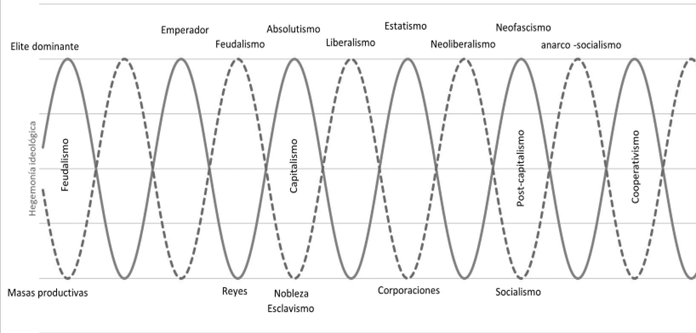
(figure 1)

For reasons of space, for this model of history, we will limit ourselves to considering the last thousand years, analyzing only the last five centuries and focusing in more detail on our time. In this sense, we can observe that each period reacts against the previous one and crystallizes its demands, but, in all cases, it is a matter of opposing ideological narratives that serve the same goal: the accumulation of power in a dominant minority, usually the one percent of the population, through the exploitation of the rest by the exercise of physical coercion first, followed by narrative proselytism and, finally, consolidated by “common sense” and the obvious truths created by the media. Once the economic system convenient to the minority is exhausted by the growing inverse consensus of the majority (Christianity in the time of Constantine) or a new minority with growing power (the capitalist bourgeoisie of the 17th century), it is replaced by the alternative claimed by those below (movements against racism, sexism) and, finally, captured, hijacked, and colonized by the dominant minority. In this way, we can see a continuity between opposing ideologies, such as, for example, feudalism and liberalism, rural slavery and industrial corporatism, monarchical absolutism and Soviet statism.

We start from the axiom that the human condition is the result of a dialectic between a historical component and an ahistorical one that precedes it. We will focus mainly on the observation of the first element of the pair, history, but we will consider its ahistorical component as always present, as are psychic and physiological needs.

On the other hand, this model of reading history is based on another ahistorical component, denied for more than half a century by poststructuralist thought: the dualism of action and reaction in human action and perception. For example, in liberal democracies, elections are almost always decided by a coin toss, that is, by two or three percent of the votes. If not by one percent. In many other aspects of individual and social life, the complexity of reality is often reduced to a pair of opposites, from religions (good-evil, angel-demon, yin-yang), politics (right-left, state-private enterprise, socialism-capitalism, liberal-conservative, rich-poor) to any other aspect of intellectual and emotional life: up-down, white-black, forward-backward, cold-hot, pleasure-pain, inside-outside, euphoria-depression, etc.

In June 2016, in an interview about the possibilities of Donald Trump’s victory in the November elections, we mentioned this pattern and this emotional component in political elections, whereby if a goat were to compete with Mahatma Gandhi, after a certain period of electoral campaigning, the goat would close the supposed logical advantage of the rival candidate.[i] In June 2016, most polls and analysts dismissed a Trump victory. As in the 1844 elections, when everyone laughed at the intellectual shortcomings of candidate James Polk. In 2016, the difference in favor of Hillary Clinton was two percent of the total votes (though Trump was elected president due to the electoral college system inherited from the slaveholding era). In 1844, James Polk won the election by one percent, which ultimately led to a radical change in the history of the world in the following century.[1]

Capitalism emerges as a novelty and reaction (though neither intentional nor planned) against monarchical absolutism, which in turn had arisen as a reaction to feudalism and the power of the landowners. Its economic and ideological system opposes the feudal and absolutist systems while simultaneously drawing from both, and later, it ends up reproducing them with the consolidation of economic and financial corporations, through a radically different culture: the oligopolistic power of transnational corporations served by weaker neocolonial states and protected by central metropolises with almost absolute powers, expressions of democratic political systems indebted to dictatorial economic systems.

The new capitalist class, the bourgeoisie, founds and grounds its revolution in democratic opposition to kings and absolutism, but once it becomes the dominant class, spider-like, it does not abandon the tradition of minority accumulation over the majority. Since its banner is democracy, it cannot abandon it once power is monopolized, but must disguise it to continue the dynamic of appropriating the wealth-power of the majority. In this way, it was possible that throughout the Modern Age, the most brutal empires in the world were democracies. Its ideology, liberalism and more recently neoliberalism, also emerges as a critique of the power of the minority of its time (monarchical absolutism) and becomes the narrative that justifies the dominant power of the new minority, corporate and imperial, articulated by economists functional to the current power with a veneer of science and material objectivity. At the center of the new neoliberal narratives lies a purely ideological and cultural component: the reduction of human existence to a single goal: the pursuit of individual profit at any cost, even at the price of the most radical dehumanization, the simplification of the human being as a producing-consuming machine, and the destruction of the planet. All in the name of democracy and freedom.

Liberals are the continuation of feudal lords, opposed to absolutist kings (to central governments), but they cannot renounce the banner of freedom and democracy, even though they only have the words of these two principles, repeated mechanically like a rosary. By freedom, they mean the freedom of capitalist lords, of the minorities in financial power. By democracy, they mean that electoral system that can be bought every two or four years or, as Edward Bernays, the inventor of modern propaganda, will summarize, that system that tells people what to think for their own good.

In all cases, we will see a progressive divorce between narrative and reality until a new super crisis, a social and civilizational paradigm shift, causes both to collapse. The more words like freedom and democracy are hijacked and repeated, the less relevance they have. A reality creates a dominant narrative-web, and this narrative sustains the reality so that it does not dissolve in its own contradictions. To achieve this, the narrative resorts to religious sermonizing, in our time dominated by mass media.

In this study, we will analyze the most significant moments of the last four centuries of this dynamic. Based on the “Inverse Progression” proposal illustrated earlier, we will begin by projecting the same logic to earlier periods in the following scheme, which, without a doubt, must be adjusted in its details for greater clarity for different readers.

Scheme of Ideological Pairs

PeriodsDominantResistant
MonocraticPolycraticMonocraticPolycratic
Antiquity PolytheismsMonotheisms 
Classical Middle AgesEmpires  Tribes/Provinces
 Confederation Republics CaliphatesDictatorships Empires regional 
Catholic Church  Non-canonical Christianities
 FeudalismMonarchy 
Modern EraCatholic Monarchy  Protestantism Liberalism
 Liberalism FederalismMonarchy Centralism 
Imperialism  Anti-colonialism
 Slavery ConfederationNation, Union 
19th CenturyNation-Empire  Colonies
20th Century Corporate CapitalismState Capitalism 
Fascism Stalinism  Socialism Anarchism
 Liberal CapitalismState Socialism 
State Capitalism  Social Democracies, Unionism
 Neoliberalism NeofeudalismCapitalist Socialism 
21st CenturyMilitarist Capitalism  Cooperative Democracy
 Cooperative DemocracyCommunist Capitalism 

Descriptive Examples

Before we begin, let’s provide a few brief examples. When capitalism emerged, feudalism simultaneously transformed into anti-monarchical liberalism in Europe and, later, into slavery against the central government in the United States. This ideocultural tradition persists today in the Southern principle of “defending state independence,” the same principle that led to the Civil War to maintain slavery over a century ago and later the transformation of slaveholders into CEOs and boards of dominant corporations.

Today, neoliberals repeat the imperial rhetoric of the free market when, in reality, they refer to the earlier school they refuted, mercantilism. Mercantilism was a system of currency accumulation that, to a large extent, practiced the interventionism of imperial states to protect their own economies and destroy those of their colonies through protectionist policies and forced purchases at gunpoint. Not without irony, the ideology of the capitalist free market ended the free market. What we have today, five centuries later, is corporate mercantilism, where corporations are no longer medieval guilds but the same feudal lords who accumulate more power than monarchies. Today, the surplus (capital accumulation) prescribed by the mercantilists of the past does not reside in national governments but in the neo-feudal lords of finance. Conversely, countries manage debts.

In the United States, as in other countries, the competition between two political parties will eventually lead to a role reversal, as with the Southern slaveholding Democrats and the Northern liberal Republicans in the past. The inverse identification of Southern Confederates with the Republican Party, to some extent starting with Franklin D. Roosevelt, or perhaps earlier during the Progressive Era, and of the leftist Democrats, follows this model and leads us to predict that it will eventually reverse again, especially given some demands of the Republican right that align with old demands of the Democratic left. I suspect this crossover and inflection will occur sooner in their disputes over international policy, which have never been very antagonistic. In chapters like “Social Networks Are Right-Wing,” we will provide a more recent case.

If we consider the immediate present and a projection into the future, we can see the case of the United States during Postcapitalism. Only in the last century, the superpower experienced the sine wave of the Inverse Progression in an accelerated manner, with periods of fifty years. During the Great Depression of the 1930s, progressive policies not only migrated from the Republicans to the Democrats but also established the paradigm for the next fifty years. This paradigm strengthened unions, made possible the creation of State Social Security, and allowed government intervention in the economy without major questioning. This cycle ended with the election of Ronald Reagan in 1980 and the triumph of the neoconservative-neoliberal reaction, also a consequence of the global crisis of the 1970s. In all cases, ideological changes were followed by transmutations and travesties of the elites at the top of the social power pyramid to maintain continuity amidst change.

Today, fifty years later, the system is once again in crisis for the third time, with minor symptoms but major causes. For the United States, it is not yet a massive economic crisis, but it is already a crisis of hegemony that will end its monetary privileges and, later, geopolitical ones. As happened with the crisis of the Spanish Empire in 1898, this country will have to turn to deep introspection.

This megacrisis will likely occur in the 2030s or 2040s, and it will be a new opportunity, judging by the dynamics of the Inverse Progression, for new generations to reorganize themselves into a system removed from neoliberalism, from capitalism as an existential framework, and to question the postcapitalist dictatorship with atomized options but with the common factor of a less consumerist and more cooperative politics and philosophy. The death of the capitalist paradigm will not mean the automatic disappearance of its institutions, but rather a new way of seeing and living in the world. Extending the theory of the Inverse Progression, it would not be an exaggeration to predict that, even if the two-party system remains, the current Republican Party, hijacked by the nationalist far-right, could even switch roles again in a few decades and represent these new aspirations that in the past century were associated with the left, while the Democratic Party would return to its 19th-century role of representing the conservative, corporate, and Eurocentric South. But this last point would be a detail.

In the 21st century, another pair begins to invert: a large number of center-left politicians and governments position themselves in favor of the “free market” and trade agreements (which have little to nothing to do with a free market but rather guarantee, in secret agreements like the TPP, the freedom of investors) while other conservative right-wing governments, such as that of Donald Trump, align with the traditional protectionist line of the left. While in the West the neo-feudal model represented by mega-companies and corporations whose powers surpass those of the states signifies not only the death of classical capitalism but also a return to its socioeconomic predecessor, feudalism, in China the system of state capitalism centered on the Communist Party is a confirmation of the monarchical model, where the fiefdoms (the corporations) are subordinated to the State.

Corollary

In a Cartesian graph we can place on the x-axis a progression ranging from (a) absolute government (x=0) to (z) absolute and self-regulated anarchy (x=10) and on the y-axis we distribute the degree of religious fanaticism, starting from (a’) a radically secular or atheist society (y=0) to another (z’) theocratic or sectarian society (y=10). We could speculate that in secular societies with centralized governments, like China, their position would be: x→0; y→0. The Middle Ages or Feudal period could be placed at the top of the curve (x→5; y→10) with a fragmented political power, that of the feudal lords, but not anarchic-democratic. The extreme x→10; y→0 signifies a break with the Middle Ages where the fragmentation of power has surpassed the maximum curve of religious sectarianism to render it ineffective as a ligament (religion, re-ligare) of the concentrated and independent powers of the feudal lords of the Middle Ages or the financial elites of our time. Obviously, the crossing of this critical point (x→5; y→10) cannot occur without a general upheaval, a conflict likely on a global scale.

(figure 2)


[1] We explained this in The Wild Frontier (2021).


[i] Radio Uruguay. (2016). “La teoría de la cabra de Majfud”. 14 de junio de 2016: http://www.youtube.com/watch?v=Y1DXbl2MvIA

From Flies in the Spiderweb: History of the Commercialization of Existence—and Its Means, by Jorge Majfud

Majfud, Jorge. Flies in the Spiderweb: History of the Commercialization of Existence—and Its Means. Humanus, 2023, 2025, p. 17-25

Desire

I did not invent this story. It is a story that was once told in many forms, but it always told, more or less, the same thing. Then, due to the urgency of recent centuries, it fell into oblivion. Like the stories that matter, it may not be true, but it is truthful.

They say that two thousand five hundred years ago, there was a very good man who, on a dark night, received a visit from God. He couldn’t see Him, but he could hear Him.

The man was frightened because the voice was not of this world. Immediately, he knew it was God, who had heard his prayers and had, at last, decided to speak to him.

The good man had fallen ill and was alone, abandoned, so God offered to grant him a wish.

His heart raced, but before he could say anything, God continued: «You have always been a compassionate man. In your prayers, the men and women of your village have never been absent. So, whatever you ask for yourself, I will give twice as much to each of them.»

The man fell silent and, after a moment of thought, said:

«Very well. Take one of my eyes.»

jorge majfud, Jacksonville, 2018

Ideology and Intervention: A Critical Review of Jorge Majfud’s The Wild Frontier

Majfud, Jorge. The Wild Frontier: 200 Years of Anglo-Saxon Fanaticism in Latin America, U.S. Edition, Humanus, 2025.

Jorge Majfud’s The Wild Frontier is a bold and fiercely intellectual account of U.S.-Latin American relations that challenges conventional historical narratives. Rather than offering a detached summary of past events, Majfud invites readers into a searing critique of the cultural, ideological, and political forces that have shaped—and often distorted—the relationship between the Anglo-Saxon North and the Latin American South. His central thesis is unapologetically critical: for over two centuries, the United States has projected an image of moral superiority while pursuing policies rooted in domination, exploitation, and racialized thinking.

Majfud’s approach is far from typical academic writing. The book reads more like an extended political essay or a philosophical reckoning, blending historical documentation with impassioned argument. He delves into major milestones in hemispheric history—beginning with the early 19th century doctrines that legitimized U.S. expansionism—and traces how these ideas have evolved but never disappeared. From the Monroe Doctrine to contemporary neoliberal economic interventions, Majfud makes a compelling case that the same logic of superiority, masked by noble rhetoric, has consistently driven foreign policy decisions in the region.

What truly distinguishes The Wild Frontier is the way it draws connections between past ideologies and current political realities. For example, Majfud explores how 19th-century notions of Manifest Destiny continue to echo in today’s border policies, economic sanctions, and international rhetoric around democracy and human rights. In his view, U.S. foreign policy is not just a series of isolated decisions but part of a larger cultural narrative that positions Anglo-Saxon civilization as a global moral compass—a notion he carefully deconstructs through historical examples and linguistic analysis.

Majfud is especially adept at analyzing the use of language as a political weapon. He argues that words like “freedom,” “development,” and “order” have been systematically used to conceal interventions that served elite interests rather than the common good. Through sharp rhetorical analysis, he shows how such terms gain moral weight while deflecting attention from the violence and dispossession they often accompany. In this sense, the book is not just about what happened, but how those events have been framed and remembered in ways that benefit dominant powers.

Alongside this critique, Majfud brings to life the resistance that has always existed in the shadows of empire. He revives the voices of key Latin American thinkers and activists—José Martí, Augusto Sandino, Eduardo Galeano, and others—who resisted imperial logic and offered alternative visions of regional identity and self-determination. These figures are not merely cited for contrast; they are given space to speak across time, their words highlighting the tension between imposed ideology and lived reality. By placing these voices in conversation with the dominant discourse, Majfud not only reclaims a suppressed intellectual tradition but also emphasizes the intellectual richness and political consciousness that has long defined Latin American resistance.

Another strength of the book is how it tackles the psychological dimension of imperialism. Majfud reflects on how entire societies can internalize myths about their own inferiority or dependency, especially when these myths are reinforced by educational systems, media narratives, and international institutions. This psychological colonization, he suggests, is just as destructive as military invasion or economic exploitation—perhaps even more so, because it can outlast the physical presence of an occupying force.

The translation by Elizabeth Horan deserves recognition as well. She manages to preserve the lyrical and combative tone of Majfud’s prose while making it accessible to English-speaking readers. The complexity of Majfud’s ideas is matched by the rhythm and texture of his language, and Horan’s translation ensures that none of that depth is lost in transition. The result is a book that is both intellectually rigorous and emotionally charged, offering a reading experience that is as moving as it is informative.

Though the book is dense with ideas and historical references, it is never dry. Majfud writes with urgency and conviction, inviting the reader not just to learn, but to reflect, question, and unlearn. The book challenges its audience to confront uncomfortable truths and to recognize how deeply history shapes our present assumptions—about progress, civilization, and justice. It is not a neutral or detached work; it is a call to awareness and, perhaps, a call to action.

For students, educators, and anyone interested in understanding the roots of Latin American political struggles and the role of U.S. foreign policy in shaping them, The Wild Frontier is an essential text. It does more than catalog a history of interventions—it reveals the ideas and ideologies that made such a history possible. Majfud’s work urges readers to rethink the moral narratives that often accompany power and to listen more closely to the voices that history has too often ignored.

Silicon Valley Daily

Daily magazine for entrepreneurs and business owners

The Wild Frontier: 200 Years of Anglo-Saxon Fanaticism in Latin America

«Simply powerful.» Noam Chomsky
The Wild Frontier is a book written with courage and dazzling lucidity. One of the best I’ve ever read.» Víctor Hugo Morales
Fifty years after the publication of How to Read Donald Duck, I am pleased to read a book like The Wild Frontier that explores in detail the less subtle ways in which the United States, for two hundred years, has sought to influence and distort the destiny of our Latin America.» Ariel Dorfman

The Wild Frontier is not only a journey through the most important events of the last two hundred years that marked the expansion of the Thirteen Colonies over the Indigenous nations and over that vast territory we now call Latin America but also the revelation of the logic of their endless wars, of their expansion, and their systematic interventions, direct or secret, in the diverse peoples of the South. These military, economic, political, and narrative practices were the beginning and the continuation of Washington’s imperialism in the rest of the world. These practices and narratives (based on the economic interests of those at the top and the fanaticism instilled in those at the bottom) were the beginning and continuation of American imperialism in the rest of the world, always under other names and excuses. That deep past, as at other moments in history, explains the present and predicts the future of the world superpower. It explains the rise and fall of capitalism and the last Anglo-Saxon empire, like any other empire, based on violence in the name of peace.

El mismo fuego (libro)

Nueva reedición de la novela El mismo fuego, publciada por Cuatro Lunas de Madrid. Estaremos a finales del próximo mes presentando esa en Madrid y otro libro en Valencia, publicado por la editorial PUV de la Universidad de Valencia.

https://editorialcuatrolunas.com/libros/narrativa/el-mismo-fuego/?add-to-cart=3377

Una teoría política de los campos semánticos (PDF)

(A 20 años de su publicación, este estudio se encuentra libre de derechos por parte de la Universidad de Gerogia. En esta página se puede descargar gratis.)

Este estudio sobre la lucha por los campos semánticos en la narrativa social fue publicado originalmente como tesis por la Universidad de Georgia en el año 2005. Desde entonces, los acontecimientos políticos y sociales y las nuevas tecnologías, como las redes sociales, han ido confirmando la relevancia política e histórica de la lucha semántica (aún sobre el siempre presente peso de los sistemas de producción y consumo) expuesta en este libro. En esta nueva edición no se han introducido cambios relevantes al estudio general. Con sus aciertos y errores, el autor ha decidido entregar esta nueva edición de Una teoría política de los campos semánticos tal como fue presentada en 2005, sin revisiones y con la intención de mantener el contexto histórico inmediato.


Una madre y su hijo en una manifestación en Arkansas (1959) contra la integración racial: “Gobernador Faubus, salve nuestra América cristiana”; “La integración racial es comunismo”. (Everett Collection Historical / Alamy Stock Photo)

This work explores the complex relationships between semantic fields, identity, power, and historical narratives, focusing on Latin America. Majfud contrasts differing interpretations and models for understanding the sociopolitical and cultural dynamics of the region, particularly through a critique of Eduardo Galeano’s Las venas abiertas de América Latina and Carlos Alberto Montaner’s Las raíces torcidas de América Latina. The work incorporates poststructuralist, dialectical, and political theory perspectives.


Descargar el libro en formato PDF

Summary of Una teoría política de los campos semánticos by Jorge Majfud (2005)

Introduction to Semantic Fields and Political Struggles
Una teoría política de los campos semánticos develops a theoretical framework to explore the construction, struggle, and administration of meanings within sociopolitical contexts. Central to this work is the idea that history, power, and identity are shaped through competing narratives and semantic interpretations. Majfud describes these “semantic fields” as arenas where concepts like freedom, justice, and progress are contested, revealing the ideological and historical forces behind their formation.

The book focuses on the narratives of Latin America’s identity and history, contrasting Eduardo Galeano’s Las venas abiertas de América Latina (1971), a Marxist critique of imperialism and exploitation, with Carlos Alberto Montaner’s Las raíces torcidas de América Latina (2001), which attributes Latin America’s struggles to internal cultural and ideological failures. Majfud uses these two works to illustrate the dual perspectives of external oppression versus internal flaws in understanding Latin America’s sociopolitical evolution.


Deconstruction of Binary Oppositions

Majfud uses poststructuralist tools, especially Jacques Derrida’s deconstruction theory, to interrogate how binary oppositions like oppressor/oppressed or development/underdevelopment dominate ideological discourse. He argues that these binaries are not «natural» but constructed by dominant metaphors and ideologies. This critical method enables Majfud to expose the underlying power structures embedded in historical narratives. For example, the binaries in Galeano’s and Montaner’s works reflect broader tensions between materialist and culturalist interpretations of history.

Majfud critiques both perspectives for privileging one term in these binaries while marginalizing the other. Galeano views external imperialist exploitation as the primary driver of Latin America’s struggles, whereas Montaner sees internal cultural «deficiencies» as central. Majfud highlights the limitations of these unilateral views, advocating for a synthesis that recognizes both external and internal factors in historical processes.


The Clash of Historical Narratives

A significant focus of the book is the analysis of how historical narratives shape perceptions of justice, freedom, and identity. Galeano’s Las venas abiertas constructs Latin America as a subject of external exploitation, with its resources drained by colonial powers and later by modern imperialism. This materialist perspective posits that economic structures determine cultural and political realities, aligning with Marxist history theories.

In contrast, Montaner’s Las raíces torcidas emphasizes cultural and educational shortcomings, arguing that Latin America’s failures stem from inherited ideological and intellectual frameworks that stifle innovation and progress. Montaner’s approach can be seen as a «culturalist» critique that shifts responsibility inward, portraying Latin America’s underdevelopment as self-inflicted.


Semantic Fields and Identity Formation

Majfud explores the concept of “semantic fields” to analyze how terms like «America,» «Latin America,» and «identity» are socially constructed and contested. He delves into the etymology and historical development of these terms, showing how they reflect layers of ideological and geopolitical conflict. For instance, the term «Latin America» emerged as a French invention to assert cultural connections with the region, but it later became a symbol of resistance and unity against imperialism.

Majfud critiques the homogenization of Latin American identity, arguing that it reduces the region’s diverse cultures and histories into a single, oversimplified narrative. This homogenization serves political purposes, but it also perpetuates misunderstandings and exclusions. For example, indigenous and Afro-descendant populations are often marginalized in mainstream narratives of Latin American identity.

The author highlights the tension between imposed identities (e.g., colonial definitions of “Latin America”) and self-defined identities, showing how the struggle over semantic fields shapes collective consciousness. The process of naming and defining becomes an act of power, where dominant groups impose their meanings while marginalized groups resist and reinterpret them.


Materialist and Culturalist Models of Interpretation

Majfud contrasts two primary models of interpretation in his analysis: the materialist model, which sees economic structures as the foundation of historical processes, and the culturalist model, which attributes historical outcomes to ideological and cultural factors. Galeano represents the materialist perspective, while Montaner exemplifies the culturalist view.

  1. Materialist Model: Galeano argues that the exploitation of Latin America’s natural resources by colonial and neocolonial powers has perpetuated its underdevelopment. Economic dependency and unequal trade relationships have locked the region into a subordinate position in the global capitalist system.
  2. Culturalist Model: Montaner claims that Latin America’s problems stem from internal factors such as authoritarianism, collectivist ideologies, and resistance to modernization. He attributes these traits to cultural legacies, particularly those inherited from colonial and medieval European institutions.

Majfud critiques the rigidity of both models, arguing that they fail to account for the interplay between material and cultural factors. He advocates for a dialectical approach that recognizes the mutual influence of economic and ideological forces in shaping historical realities.


The Role of Metaphors and Symbols

A recurring theme in the book is the power of metaphors and symbols in constructing reality. Majfud argues that metaphors are not merely rhetorical devices but fundamental tools for shaping thought and perception. For instance, the metaphor of «open veins» in Galeano’s work evokes a sense of victimization and exploitation, while Montaner’s metaphor of «twisted roots» suggests internal dysfunction and decay.

Majfud emphasizes that these metaphors are not neutral; they carry ideological baggage and influence how readers interpret history. By unpacking the metaphors in both works, Majfud reveals the underlying assumptions and biases that shape their arguments. He calls for greater awareness of the symbolic dimensions of language, urging readers to critically examine the metaphors they encounter.


Justice, Freedom, and Ethical Evolution

The book also explores the evolving meanings of justice and freedom in historical and ethical contexts. Majfud critiques simplistic notions of justice as either a natural law or a product of economic systems, arguing that justice is a dynamic concept shaped by cultural, ethical, and political struggles.

He draws on examples such as the abolition of slavery and the feminist movement to illustrate how ethical values evolve in response to changing social and economic conditions. Majfud rejects reductionist explanations that attribute these changes solely to material or ideological causes, also emphasizing the symbiotic relationship between ethical consciousness and economic structures.


Toward a Synthesis: A Dialectical Approach

Majfud concludes by advocating for a dialectical approach that transcends the limitations of materialist and culturalist models. He argues that historical analysis must consider the dynamic interplay between external and internal factors, economic and ideological forces, and individual and collective agency. This approach recognizes the complexity of historical processes and avoids the pitfalls of reductionism.

In the context of Latin America, Majfud calls for a reevaluation of the region’s history and identity, one that acknowledges its diversity and contradictions. He urges readers to move beyond binary oppositions and embrace a more nuanced understanding of the factors shaping Latin America’s past and present.


Conclusion

Una teoría política de los campos semánticos is a profound exploration of the power of language, ideology, and history in shaping collective consciousness. Through his analysis of Galeano and Montaner, Majfud reveals the ideological struggles underlying competing narratives of Latin America’s identity and history. His call for a dialectical synthesis challenges readers to critically examine their assumptions and engage with the complexities of historical processes.

The book’s insights extend beyond Latin America, offering valuable tools for analyzing the dynamics of power and meaning in any sociopolitical context. Majfud’s work is a testament to the transformative potential of critical thought and the enduring struggle for justice and freedom in the semantic fields of history.

Today’s World was Already Described at the Beginning of the Century


Between 2005 and 2009, Jorge Majfud wrote two different books that explain the world we are currently living in which, in 2016, began to be perceived as an unexpected novelty.

The first book, published in 2005, is titled La narración de lo invisible. Una teoría política sobre los campos semánticos (The Narration of the Invisible. A political theory on semantic fields), an essay and analysis book [Second edition EAE], and the second book, published in 2009  and titled La ciudad de la Luna (The City of the Moon) is a novel. 

Contradicting the classic precepts of economic materialism, La narración de lo invisible analyzes the importance of the semantic struggle and social narratives as determinants in our world’s social and political outcomes.
It draws a definition of the positive semantic fields (what is) and the negative fields (what is not) defined by the association of the established/consolidated social valuations (ideolexicos) to outline the meaning of the disputed/still uncrystallized social valuations.

In the novel La ciudad de la Luna (The City of the Moon) (anticipated by the same author for years in different journalistic articles and in short stories), he describes, in a metaphorical way, a city in the Sahara desert called Calataid, inhabited by European immigrants since the Spanish Reconquest.

The city is surrounded by thick walls, and its inhabitants, divided into sects that hate each other, are considered, as a whole and with a strong patriotic pride, the moral reserve of the world. Calataid hates immigrants and every new idea that comes from outside, such as the secular thought of Enlightenment, to the point of eliminating his only contact with the outside world, a train that arrived once a month with almost no passengers. Finally, with another reference that reminds us of the current drama of climate change and the rising sea levels, the inhabitants of Calataid deny the growing threat of desert sands that will eventually sink the arrogant city, blinded by its fighting and self-indulgent narratives.

These two books, published more than a decade ago, offer two global perspectives from different literary genres. They both warned us, long ago, what we were going to live through from the second decade of the 21st century.

Today, just a few people recognize this reality. The rest simply do not see it or refuse to see it.

Translation of Jorge Majfud’s The Walled Society by Bruce Campbell

Traducción automática de Google al español here:

Una teoría política de los campos semánticos» by Jorge Majfud explores the political theory of semantic fields, engaging in an analysis of how narratives, symbols, and meanings are shaped in social and historical contexts. It contrasts two major ideological texts: Eduardo Galeano’s «Las venas abiertas de América Latina» and Carlos Alberto Montaner’s «Las raíces torcidas de América Latina.» Both works reflect opposing interpretations of Latin America’s social and historical realities.

Here’s a key concept clarity analysis:

Main Ideas from the Paper:

  1. The Nature of Semantic Fields:
    The study examines how semantic fields are constructed, contested, and wielded in socio-political narratives. Majfud emphasizes the dialectical struggle over meanings and symbols as a central theme in shaping history and identity.
  2. Binary Oppositions in Ideology:
    Drawing from Derrida, the text discusses binary oppositions (e.g., development vs. underdevelopment, materialism vs. culturalism) and their ideological roots. It critiques these dichotomies as artificial yet impactful constructs that influence interpretations of history and society.
  3. Comparison of Galeano and Montaner:
    • Galeano’s «Las venas abiertas» critiques the external exploitation of Latin America, attributing its challenges to historical and economic subjugation by foreign powers.
    • Montaner’s «Las raíces torcidas» focuses on internal cultural and educational deficiencies as the root causes of Latin America’s issues.
    • Majfud situates these texts within broader ideological debates, noting their contrasting methodological approaches: materialist vs. culturalist.
  4. Cultural Identity and Symbolism:
    The author highlights the problematic nature of defining «Latin America,» both as a geographical and cultural entity. It discusses how historical colonization and global narratives have shaped perceptions and simplified complex identities into monolithic representations.
  5. Dialectical Complexity:
    The paper argues against linear cause-effect models in understanding socio-political phenomena. Instead, it advocates for recognizing the symbiotic relationships between economic structures, cultural norms, and ethical systems.
  6. Ethics and Economic Systems:
    The interaction between ethical values (e.g., anti-slavery, gender equality) and economic necessities is explored. Majfud posits that ethical advances often emerge from economic transformations but also influence these systems reciprocally.

Would you like further elaboration on any specific section or additional analysis?

Critical Inquiry Questions:

  1. Question on Ideological Construction:
    Majfud critiques binary oppositions as ideological constructs that simplify complex realities (e.g., development vs. underdevelopment).
    • To what extent do these binaries limit alternative perspectives, and how might one construct a more inclusive framework for understanding historical narratives?
  2. Question on Semantic Fields and Power:
    The text discusses the struggle over semantic fields as a political and historical phenomenon.
    • How can marginalized groups effectively reclaim or reshape dominant semantic fields to better represent their realities and resist hegemonic narratives?
  3. Question on Comparative Analysis (Galeano vs. Montaner):
    Majfud contrasts Galeano’s materialist interpretation of history with Montaner’s culturalist view.
    • Are these two frameworks inherently contradictory, or can they be integrated into a cohesive model for understanding Latin America’s socio-economic challenges?

For Perspective Research (Method 6), I’ll review and synthesize diverse viewpoints on the key themes of Jorge Majfud’s «Una teoría política de los campos semánticos» to enhance understanding. This will include exploring perspectives on:

  1. The construction of semantic fields in historical and ideological contexts.
  2. The ongoing debate between materialist (e.g., Galeano) and culturalist (e.g., Montaner) approaches.
  3. The implications of binary oppositions for understanding social and historical realities.

Let me start gathering academic perspectives for a well-rounded analysis. Please hold on for a moment while I conduct research.

Diverse Academic Perspectives on Semantic Fields and Political Theory

  1. Contextual Dependence and Complexity in Semantic Fields:
    Maton’s work in Legitimation Code Theory highlights how the complexity of semantic fields depends on their socio-political and disciplinary context. He emphasizes that academic discourse often uses «semantic waves,» oscillating between abstract and concrete concepts to make knowledge accessiblens with Majfud’s exploration of how binary oppositions (e.g., materialist vs. culturalist interpretations) simplify nuanced socio-historical dynamics.
  2. Reconstruction of Political Languages:
    Richter’s analysis in History and Theory discusses how semantic fields are shaped by historically defined contexts, influencing political thought and action. He underscores the role of language in constructing political ideologies . This perrelevant to Majfud’s comparison of Galeano’s and Montaner’s ideological frameworks, showcasing how semantic tools can be wielded for contrasting political purposes.
  3. Ambiguity in Semantic and Political Concepts:
    Diner’s reflections in The Jewish Quarterly Review focus on how political and legal theories are imbued with semantic ambiguity, particularly in culturally entangled contexts . This complements Maque of the reductive nature of binary ideological constructs, suggesting that ambiguity can foster broader, multifaceted understandings of social issues.
  4. Semantic Evolution in Historical Contexts:
    Vydaichuk et al. analyze the semantic evolution of lexemes in historical settings, emphasizing the interplay between meanings and their contexts . This resonates with Majfud’s a historical narratives are not static but evolve as they are contested within semantic fields.
  5. Conceptual History and Political Theory:
    Ihalainen’s research in Journal of Historical Pragmatics bridges historical semantics with political pragmatics, demonstrating how reconstructing semantic fields provides insight into historical political thought . This perspective underscores Majfud’s focuological contestation of Latin American historical narratives.
  6. Semantic Frames and Action:
    Nerlich and Clarke explore the interface between language, action, and cognition through the lens of semantic fields and frames. They highlight the historical origins of these concepts and their application in understanding social actions . Majfud’s work similarly investigates how socio-politire framed within and influenced by constructed semantic fields.

Integration with Majfud’s Analysis

The above perspectives enhance Majfud’s arguments by:

  • Providing a deeper theoretical foundation for the critique of binary oppositions in socio-political narratives.
  • Highlighting the role of ambiguity and context in shaping ideological debates.
  • Offering methods to reconstruct semantic fields for a more nuanced understanding of historical and political phenomena.

“Zombis, autómatas en la cadena de producción-consumo”

“Zombis, autómatas en la cadena de producción-consumo”.

Antología de Nueva York

Jorge Majfud’s books at Amazon>>


«Edición de súper-lujo, que no sólo tiene a escritoras de primerísima línea como Francis Scott Fitzgerald, Chester Himes. O. Henry, Edgar Allan Poe, Ambrose Bierce y Henry James, sino que cuenta además con escritores actuales de primerísima línea como Lourdes Ortiz, María Zaragoza, Joaquín Leguina José Luis Alonso de Santos, Andrés Trapiello y los mejores escritores actuales de España e Hispanoamérica.

MAR Ed.

De las respectivas obras:© María Zaragoza, Lourdes Ortiz, José Luis Ordóñez, Juan Vivancos
Antón, Jesús Yébenes, Nelson Verástegui, José Luis García Rodríguez, Andrés Fornells, Juan
Serrano, José G. Cordonié, Carlos Augusto Casas, José M. Fernández Argüelles, Andrés Trapiello, Cristina Ruberte París, José Vázquez Romero, Joaquín Leguina, Elena Marqués, Juan Martini, Manuel Gómez Gemas, Fabricio de Potestad, Jorge Majfud, Joseba Iturrate, Vizconde de Saint-Luc, Álvaro Díaz Escobedo, Isaac Belmar, Miguel Angel de Rus, José Luis Alonso de Santos, Tomás Pérez Sánchez, Mar Cueto, Francisco Legaz, Pedro Amorós, Anunciada Fernández de Córdova y Chester Himes con autorización de Himes Literary Estate & Trust.
De las traducciones: © José Luis Gª (inglés)
De la edición: © M.A.R. Editor
Edición y prólogo de Miguel Angel de Rus
Mayo de 2012
http://www.mareditor.com
ISBN: 978-84-939322-5-1
Depósito legal:
Diseño de la colección: Absurda Fabula
Imprime: Publidisa
Impreso en España.

PRÓLOGO
Al hacer una antología sobre Nueva York se puede caer
en la fascinación o en la denuncia, en la descripción alucinada del ambiente turístico o en lo más sórdido de las calles desconocidas en las que duermen a la intemperie los homeless, en el drama-espectáculo de las Torres Gemelas o en el Nueva York de los dulces años en que parecía que el mundo sólo podía ir a mejor y que la ciudad era una fiesta continua. Por ello, en M.A.R. Editor hemos procurado mantener un equilibro entre todas las posturas y entre los autores clásicos, los clásicos vivos, y los autores que se abren camino y que aportan una visión fresca y distinta de una ciudad que fascina o que repele, principal destino turístico del planeta. Por ello se han buscado autores que nos han sido contemporáneos, como el gran Chester Himes, para mostrar el N.Y. más duro; clásicos de los años del gran desarrollo neoyorquino
como O. Henry, Francis Scott Fitzgerald, Edgar Allan Poe, Ambrose Bierce o Henry James; destacados autores actuales
que resultan muy familiares a los buenos lectores, como Lourdes Ortiz, María Zaragoza, Andrés Trapiello, José Luis Alonso de Santos y Joaquín Leguina, y autores de España e Hispanomérica cuya gran calidad no está en relación con la fama, y que nos presentan obras de verdadero interés, como José Luis Ordóñez, Juan Vivancos Antón, Jesús Yébenes, Nelson Verástegui, José Luis Gª Rodríguez, Andrés Fornells, Juan Serrano, José G. Cordonié, Carlos Augusto Casas, José M. Fernández Argüelles, Cristina Ruberte París, José Vázquez Romero, Elena Marqués, Juan Martini, Manuel Gómez Gemas, Fabricio de Potestad, Jorge Majfud, Joseba Iturrate, Vizconde de Saint-Luc, Álvaro Díaz Escobedo, Isaac Belmar, Tomás Pérez Sánchez, Mar Cueto, Francisco Legaz, Pedro Amorós y Anunciada Fernández de Córdova, que cierra este libro de relatos con un curioso poema a los taxis de Nueva York, uno de los iconos culturales del tiempo presente (para bien o para mal), como sabe cualquier amante del cine.


Jorge Majfud’s books at Amazon>>